AI Showcase
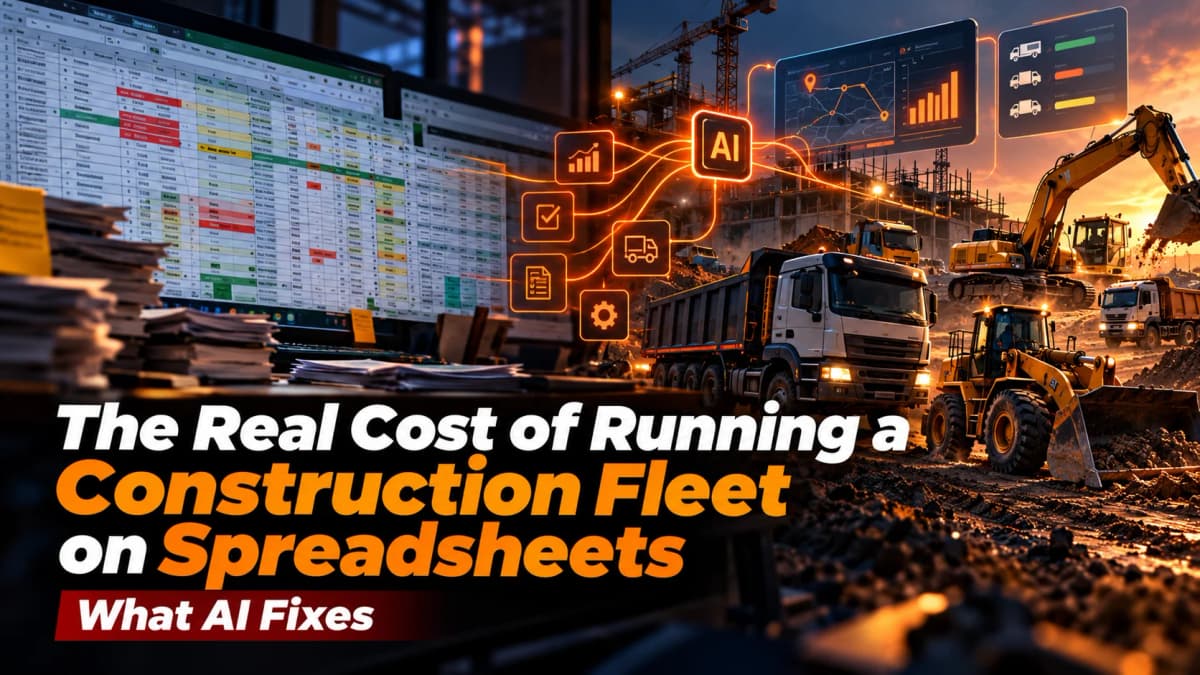
The Real Cost of Running a Construction Fleet on Spreadsheets and What AI Fixes
Running fleets on spreadsheets costs hours a week and real compliance risk. Here's what AI-powered construction fleet management fixes.
Share
Heavy vehicle fleet operations typically run three disconnected systems, telematics, a spreadsheet, and a paper diary, and nothing checks one against the other automatically. AI closes that gap by continuously cross-referencing licences, usage data, and work hours in the background, catching a conflict before a job starts rather than after an audit.
It isn't a fix for every fleet, and it's only as reliable as the records feeding it, but for multi-site operators it removes a specific, recurring manual task rather than just adding more data.
AI as a business tool tends to get discussed in the abstract: it "improves efficiency" or "unlocks insights." What that actually looks like in practice is easiest to see in industries with a lot of moving parts and a hard compliance deadline attached to getting it wrong.
Construction is one of the clearer examples, because the problem it solves isn't hypothetical. It's a specific, measurable failure that construction operators have been living with for years, and AI closes it in a way no manual process realistically sustains.
The Three-System Problem Every Construction Fleet Has
A construction fleet isn't just trucks. It's plant and equipment moving between multiple active sites. It's subcontractors bringing their own vehicles and machinery onto a job, which turns subcontractor management into its own ongoing compliance task. It's a workforce that needs the right licence, ticket, or site induction before they're allowed on-site at all.
Most operators run this across three disconnected systems: a telematics platform tracking vehicle and equipment location, a spreadsheet holding servicing schedules for that plant, and driver or operator hours sitting in a paper diary or basic digital log.
Each does its own job well. None of them reconcile against each other automatically, and on a multi-site job, that gap gets wider, not narrower, the more sites and subcontractors are added.
This is precisely the gap purpose-built construction management software is designed to close, by connecting those three systems into one record instead of leaving reconciliation to whoever remembers to run it.
What the Gap Actually Costs
| Cost area | What happens in practice | Why it isn't a data problem |
|---|---|---|
| Duplicate data entry | Staff re-enter mileage, plant usage, and site allocation into a spreadsheet after a telematics system already logged it | The data exists and is accurate; nothing automatically checks one system against the other |
| Missed service intervals | A piece of plant's next service date lives in a spreadsheet cell or a calendar reminder, while the equipment itself has already moved to a different site | Live usage data exists in the telematics feed; nothing reads it against the maintenance schedule |
| Records that can't be produced on demand | Driver hours, site inductions, and subcontractor compliance documents logged on paper or across separate systems, difficult to retrieve completely when asked for | The record exists somewhere; the system was never built to be searchable under time pressure |
Take for example a fleet manager running 30 to 50 vehicles on spreadsheets typically spends 5 to 10 hours a week on this kind of manual administrative work. It's a full working day, every week, spent re-typing information a system already captured, instead of managing the job.
For businesses with compliance obligations attached, like Australia's heavy vehicle operators under Chain of Responsibility (CoR) rules, the cost compounds further. CoR places a legal duty on operators to demonstrate they actively checked and managed compliance risks, not just that records exist somewhere if asked.
On a construction site, that duty extends past the vehicle to the subcontractor's licence, the operator's ticket for that specific machine, and the induction record proving they were cleared to be there. A scattered, manual system struggles to prove that kind of ongoing diligence across multiple sites and multiple subcontractors, because proving it means producing the right record, fast, on request, not eventually finding it.

What AI Is Actually Doing Under the Hood for Fleet Management
The mechanism matters more than the label, and it's worth being specific about what AI compliance checking actually does here.
In practice, this isn't one algorithm doing something mysterious. It's usually a combination of rules-based checks and pattern-matching models that flag anomalies a fixed rule would miss, such as a piece of plant running unusually high engine hours relative to its typical usage on similar jobs.
What changes when this is applied here isn't that more data gets collected. It's that the reconciliation work a spreadsheet can't do at scale, across multiple sites and multiple subcontractors, gets done continuously and in the background, without anyone triggering it manually.
Checking Operator and Subcontractor Status Against the Site Roster
Instead of a scheduler manually cross-referencing a licence, ticket, or induction register against tomorrow's site allocations, an AI-driven system checks that continuously and flags a conflict before someone is allocated to a job, not after they've already arrived on-site. The same records existed before; what's new is that they're checked at the moment a decision is made, across every site at once, rather than during a periodic audit weeks later.
Checking Plant Usage Against Maintenance Schedules
Telematics has always reported live engine-hour and usage data for plant and equipment, wherever it's currently allocated. What it didn't do on its own is compare that data against a service interval and raise a flag, especially once a machine moves between sites and falls out of whoever was tracking it on the last job.
AI-based systems close that specific gap, matching real usage against scheduled maintenance continuously, so a service date doesn't slip just because the equipment changed sites and nobody happened to check the spreadsheet that week.
Checking Work-and-Rest Records Against Compliance Thresholds
Fatigue management under Australia's Heavy Vehicle National Law (HVNL) sets specific limits on driver and operator work and rest hours. An electronic work diary (EWD) captures this data digitally instead of on paper, and an AI layer on top of it can check hours against thresholds in real time, surfacing a risk before a shift starts rather than during an audit response, regardless of which site that person worked the day before.
None of this replaces the person making the operational call. A scheduler still decides how to resolve a flagged conflict; a compliance manager still owns the outcome. What AI removes is the specific failure where the right information existed somewhere in the business, often on a different site or with a different subcontractor, but didn't reach the right person in time to matter.
This Isn't Just a Construction Problem
The construction example is concrete, but the underlying pattern shows up anywhere operational data is spread across systems that don't talk to each other:
- A retailer reconciling stock levels against supplier delivery data
- A supply chain manager checking shipment tracking against customs and compliance documentation
- A logistics operator matching sensor data against a maintenance plan
In every case, the manual version of the job is the same: someone periodically checks system A against system B, and the gap between those checks is where risk accumulates. Construction simply makes the pattern easiest to see, because multiple sites and multiple subcontractors multiply the number of checks a manual process has to run.
AI's role in these situations isn't intelligence in the abstract sense. It's continuous, automated cross-referencing at a speed and consistency no manual process sustains, especially as the number of sites, assets, and subcontractors grows.
That's a narrower, more useful way to think about what "AI as a business tool" actually buys a business: not a vague productivity gain, but the removal of a specific, recurring reconciliation task that used to depend on someone remembering to do it, for every site, every day.
Check Your Own Exposure First
Before evaluating any AI-driven platform, it's worth establishing how exposed the current, manual setup actually is. A few questions worth answering honestly:
- Can your team produce a complete compliance record (licence, ticket, induction, work hours, service history) for any single worker, subcontractor, or piece of plant, on demand, in under ten minutes, regardless of which site they're on?
- Is there one place, not three, where that record lives?
- If a compliance status changes today, on any site, does anything stop the wrong allocation being made tomorrow, or does it depend on someone noticing?
Businesses that hesitate on more than one of these are carrying more exposure than their existing systems make visible, simply because those systems were never built to check themselves across multiple sites at once.
That's the real test: not whether the records exist, but whether anything checks them continuously, on every site, without waiting for someone to go looking. Bringing tracking, servicing, and compliance data into one connected system is what makes that checking happen by design, rather than being bolted on after the fact.
The data was rarely the missing piece. What was missing was something checking it, on every site, every time, without waiting to be asked.
FAQs

Editorial Staff
The Editorial Staff at AIChief is a team of Professional Content writers with extensive experience in the field of AI and Marketing. AIChief was Founded in 2025, AIChief has quickly grown to become the largest free AI resource hub in the industry. Stay connected with them on Facebook, Instagram and X for the latest updates.