AI Use Cases
Why AI in Supply Chain Management Is the Future of Business?
Explore how AI in supply chain management works to optimize efficiency, improve demand forecasting, reduce costs, and enhance logistics in key industries.
Share
Supply Chain Management is already a complex challenge, and issues like inventory errors, unexpected delivery delays, and fluctuating demand only add to the difficulty. Running a supply chain smoothly is a challenging task, but what if you could predict and prevent these issues before they even occur? Sounds cool, right?
More than 64% of supply chain leaders say AI and generative AI capabilities are important for evaluating new tech investments, showing how central AI has become to supply chain strategy
That’s where AI in supply chain management steps in. Imagine being able to not just react to problems, but anticipate them ahead of time. With AI solutions like machine learning, predictive analytics, and robotics, businesses can forecast demand with precision, automate repetitive tasks, and make real-time, data-driven decisions.
The AI in the supply chain market is expected to grow from USD 14.49 billion in 2025 to USD 50.01 billion by 2031, at a CAGR of nearly 23%, underscoring robust enterprise adoption.
This means smoother inventory management, more efficient logistics operations, and a supply chain that’s far more resilient. However, while the potential of AI is vast, the path to fully integrating it into supply chains isn’t without its challenges.
From data integration to the costs of AI implementation and adapting to new technologies, it’s not always a smooth ride. Yet, the benefits, enhanced efficiency, cost reduction, and the ability to stay ahead of disruptions, make the investment worthwhile. Let’s explore how AI in supply chain management works, along with its use cases and more.
Robotic process automation (RPA) and AI agents reduce manual work, freeing staff to focus on exception handling and strategic issues. Some companies report up to 65% improvement in service levels from smarter AI planning.
What is Supply Chain Management with AI Solutions?

Supply Chain Management (SCM) is the process of overseeing the flow of goods, from sourcing raw materials to delivering the final product to consumers. It involves key activities such as inventory management, logistics, and distribution, all aimed at meeting customer demands while minimizing costs.
But traditional supply chain management faces challenges like demand forecasting errors, inventory imbalances, and logistical delays. These issues can be costly and lead to inefficiencies.
The real impact can be seen in measurable performance improvements across key supply chain functions.
Enter AI solutions. By integrating technologies like machine learning, predictive analytics, and robotics, businesses can streamline processes, make data-driven decisions, and enhance operational efficiency.
AI's Key Contributions to Supply Chain Management
- Demand Forecasting: AI helps predict future demand with greater accuracy, reducing the risk of overstocking or stockouts.
AI and machine learning reduce forecasting errors by 20–50% over traditional methods, resulting in more precise planning and better supply-demand matching. - Automation: AI automates repetitive tasks like inventory tracking and order processing, improving efficiency and reducing human error.
- Enhanced inventory levels have also been tied to up to 35% better inventory optimization, meaning less capital tied up in stock and higher availability
- Logistics Optimization: AI helps optimize delivery routes and schedules, cutting down transportation costs and improving delivery speeds.
Studies suggest AI‑integrated supply chains are more resilient and can adjust to market disruptions 30–40% faster than traditional models by dynamically adjusting planning and routing based on real‑time dat
In the next section, we’ll explore the major role of AI in supply chain management, focusing on how it’s driving digital transformation and creating new opportunities for businesses.
Executive Overview: AI’s Impact on the Modern Supply Chain
Managing a supply chain is like juggling a variety of tasks all at once, ensuring that raw materials are sourced on time, products are manufactured efficiently, and orders are delivered as promised. Behind the scenes, teams in procurement, quality assurance, and production are always working to keep things moving smoothly.
Reduced forecasting errors (20–50%), leading to better planning and fewer disruptions.
However, as supply chains become more complex, businesses face challenges like rising customer expectations and unpredictable market shifts.
This is where technology steps in. With AI-enabled supply chain management solutions, companies are now equipped with tools that help them see the bigger picture and make faster, more informed decisions.
For example,
Walmart uses AI-powered demand forecasting to predict which products will see increased demand, allowing the company to adjust inventory in real-time and prevent overstocking or stockouts.
So, instead of relying solely on manual efforts, AI offers a helping hand by analyzing vast amounts of supply chain data and providing businesses with actionable insights. Let’s explore which AI technologies are being used in it, or how AI is driving digital transformation and optimizing supply chain processes.
Key AI Technologies in Use
Among manufacturing leaders, 94% expect IoT data integration with AI to significantly improve the accuracy and relevance of supply chain decision‑making.
| AI Technology | Description |
|---|---|
| Natural Language Processing (NLP) | It helps AI systems to understand and interact with human language, which is crucial for customer service and supply chain management automation. |
| Internet of Things (IoT) | Connects devices to collect real-time data to manage inventory levels, product conditions, and transportation status. |
| Data Analytics | Uses AI to analyze data, identify patterns, and improve decision-making across the supply chain network. |
Market Momentum: The Rise of AI Adoption Across Industries
AI adoption is picking up speed across industries like retail, automotive, manufacturing, and healthcare. Companies are increasingly turning to AI tools to improve supply chain visibility, optimize inventory management, and streamline logistics operations.
According to a survey, 88% of companies are using AI in at least one business function, AI adoption trends 2025.
By embracing these AI-powered solutions, businesses are able to boost efficiency, lower operational costs, and ultimately deliver a better customer experience. As a result, AI is not only transforming how businesses operate but also reshaping how they connect with and serve their customers.
Key Statistics and Trends Showing AI Adoption in Global Supply Chains
| Statistic | Data | Reference |
|---|---|---|
| Market Growth | The AI supply chain market is expected to grow from USD 7.15 billion in 2024 to USD 192.51 billion by 2034, at a CAGR of 39%. | Markets and Markets |
| Adoption in Logistics | 56% of supply chain professionals are using AI for route optimization and inventory control. | Supply Chain Game Changer |
| Cost Reduction | AI adoption has led to a 12-15% cost reduction through automation and predictive analytics. | Deliberated Directions |
| Investment in Predictive Analytics | 75% of enterprises are investing in AI tools to improve demand forecasting and supply chain planning. | Hyena AI |
| Warehouse Automation | 65% of warehouses are implementing AI-driven robotics for picking and sorting. | Flox Blog |
| Customer Experience | 80% of companies using AI report improved customer satisfaction through better tracking and optimized deliveries. | Master of Code |
| Sustainability | 60% of supply chain leaders report that AI has helped them adopt more sustainable practices. | 3BL Media |
Forecast Snapshot (2024–2031): Growth and Investment Trends
The global market for AI in supply chain management is on a fast track to significant growth. Experts predict that by 2031, it will evolve into a multi-billion-dollar industry. As AI adoption accelerates across industries, more businesses are focusing their investments on powerful tools like predictive analytics, machine learning models, and automated systems.
The market is expected to increase from about $8.49 billion in 2024 to around $89.18 billion by 2031, at a CAGR of roughly 39.9 % during this period — a clear sign of strong business demand for AI solutions that enhance efficiency and visibility.
These AI-driven solutions are not just nice-to-haves; they offer a high return on investment (ROI) by driving down costs and boosting operational efficiency. With the ability to optimize supply chain systems and enhance supply chain visibility, AI is helping businesses stay ahead of the curve and prepare for the future.
AI in Supply Chain Management- 5 Use Cases with Examples
Imagine you’re managing a supply chain, juggling inventory, shipments, and customer orders, all while trying to keep costs down and meet deadlines. It’s a lot, right? Now, imagine having a tool that can predict what customers will want before they even know it, automate repetitive tasks, and optimize routes for faster delivery. It sounds like something out of a sci-fi movie, right? Well, it’s not. It’s the power of AI in supply chain management.
According to industry research, AI‑driven forecasting can reduce forecasting errors by 20 – 50% compared to traditional methods, significantly lowering risks associated with demand uncertainty and stock imbalances.
AI is transforming how companies manage their supply chains, making them more efficient, agile, and resilient. From demand forecasting to logistics optimization, AI provides businesses with the ability to streamline operations and make data-driven decisions. No more guesswork, no more delays, just smarter, faster processes that improve both the bottom line and customer satisfaction.
Research indicates that AI adoption has helped companies cut excess inventory by up to 30% and cut logistics and operational costs by 15 – 25%, demonstrating measurable value beyond hype.
In this section, we’ll explore how AI-powered solutions are revolutionizing supply chains across industries. From automating warehouses to predicting supply chain disruptions, AI is changing the game. Let’s dive into the most impactful AI use cases that are reshaping how businesses manage their supply chains
1. Demand Forecasting and Inventory Optimization
Imagine running a business and constantly having to guess how much inventory you’ll need next month. Too little, and you risk stockouts and disappointing customers. Too much, and you're left with excess inventory costs. It’s a tricky balancing act that many businesses face. This is where AI becomes a game-changer.
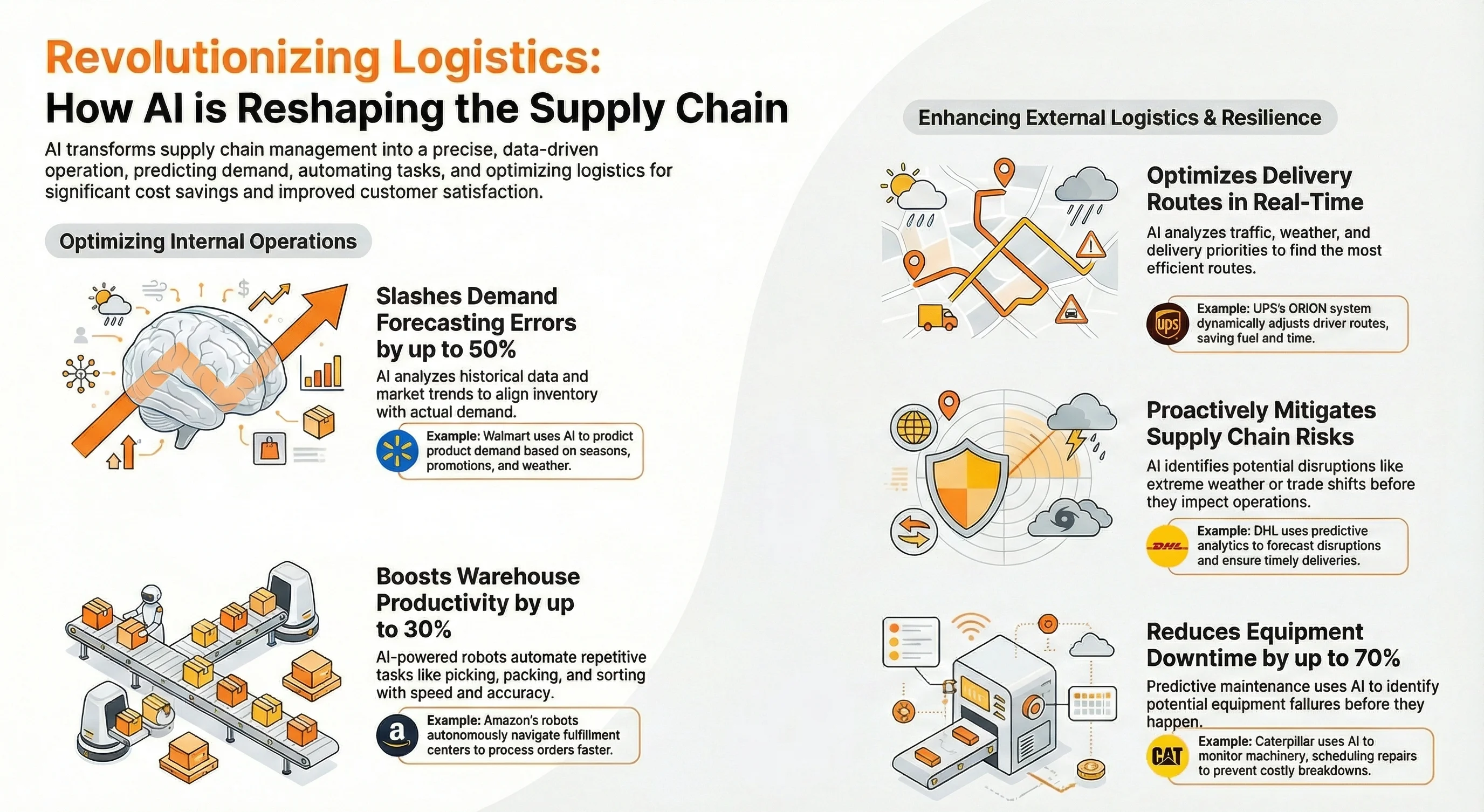
According to research from McKinsey and Capgemini, AI‑driven forecasting can reduce demand-forecasting errors by up to 50%, leading to fewer stockouts and better alignment of inventory with actual demand.
AI takes the guesswork out of demand forecasting. By analyzing historical sales data, current market conditions, and consumer trends, AI systems can predict future demand with incredible accuracy. This allows businesses to align their inventory levels with actual demand, minimizing costly mistakes like overstocking or running out of stock.
Gartner found that implementing AI‑based inventory management solutions can reduce holding costs by 20 – 30%, while improving inventory turnover and reducing waste from overstocked items.
How AI Helps:
- Analyzes Historical Data: AI examines past sales to predict future demand.
- Monitors Market Conditions: It adjusts forecasts based on factors like promotions or holidays.
- Real-Time Adjustments: AI adapts to demand shifts in real-time.
Example: Walmart
Walmart uses AI to predict demand across thousands of stores, adjusting its inventory based on seasonal trends, promotions, and even weather patterns.
Walmart uses machine learning models and predictive analytics to forecast product demand across its vast network of stores and fulfillment centers. These systems incorporate historical sales, seasonal trends, local events, and other variables to optimize inventory levels, reducing both stockouts and excess stock situations.
This ensures that popular products are stocked at the right time and in the right quantities, leading to better supply chain efficiency and lower inventory costs.
2. Warehouse Automation and Robotics
AI-driven robotics is transforming warehouse operations by automating repetitive tasks like picking, packing, and sorting. This improves speed, accuracy, and reduces human error, making warehouses much more efficient while lowering operational costs.
According to industry research, robotics adoption can boost productivity by 25 – 30% within the first year and cut logistics costs by up to 40%, illustrating the significant impact automation has on core operations.
Example: Amazon
Robotics dramatically improves performance and efficiency. For example, advanced warehouse robots can cut travel time by roughly 10%, leading to quicker processing, less energy consumption, and reduced operational costs.
- At Amazon’s fulfillment centers, AI-powered robots autonomously navigate the warehouse, picking and sorting products with incredible precision.
- This automation speeds up the order fulfillment process, allowing Amazon to handle more orders in less time, reduce manual labor, and increase overall efficiency in its warehouses.
- The result is faster delivery times and a more cost-effective supply chain.
3. Supply Chain Risk Management and Mitigation
Running a supply chain means dealing with uncertainties, from natural disasters to geopolitical issues and unexpected market shifts. These disruptions can cause major setbacks. But what if you could anticipate and mitigate these risks before they happen? That’s where AI comes in.
By analyzing vast amounts of data, AI models can identify potential threats and help businesses prepare for disruptions. With AI’s ability to predict these events, businesses can act proactively, improving their supply chain resilience and ensuring smoother operations.
Example: DHL
- DHL uses AI-powered predictive analytics to monitor and forecast disruptions, like extreme weather or global trade changes.
- This allows them to take early actions, ensuring timely deliveries and minimizing delays in their global supply chains.
4. Logistics Optimization and Real-Time Route Planning
Imagine running a delivery fleet and trying to figure out the fastest, most cost-effective routes for your drivers. Traffic jams, weather conditions, and last-minute customer requests can throw everything off.
Traditional planning can waste as much as 25% of fuel costs simply because routes aren’t optimized, and updates happen too late.
This is where AI comes in, helping businesses optimize logistics and make real-time adjustments to delivery routes. By considering traffic, weather, and customer demand, AI ensures fuel consumption is minimized, delivery delays are reduced, and cost-efficiency is maximized.
Example: UPS
UPS’s AI‑driven route optimization system, known as ORION (On‑Road Integrated Optimization and Navigation), is a standout case.
- UPS uses AI-powered route optimization to improve delivery speed.
- The system constantly monitors traffic conditions, weather patterns, and delivery priorities, dynamically adjusting routes for each driver.
- As a result, fuel consumption is lowered, carbon emissions are reduced, and operational costs drop, making deliveries both faster and greener.
5. Predictive Maintenance and Equipment Monitoring
Imagine knowing when your equipment might fail before it actually does. With AI-driven predictive maintenance, businesses can monitor equipment and vehicles in real-time, spotting potential issues before they happen. This minimizes downtime, cuts repair costs, and keeps everything running smoothly.
Modern AI tools can reduce unplanned downtime by up to 70%, significantly increasing uptime and operational reliability compared to reactive strategies.
Example: Caterpillar
- Caterpillar uses AI-powered predictive maintenance for its heavy machinery.
- Sensors provide real-time data, and AI algorithms predict potential breakdowns, allowing them to fix issues before they cause downtime.
- This approach increases uptime, reduces maintenance costs, and boosts overall productivity in their supply chain operations.
AI insights help schedule maintenance during low‑impact windows and reduce unnecessary preventive work, cutting both downtime and expense
AI in Supply Chain Management for Different Industries

In every industry, supply chains are the lifeblood of operations, but they’re not without their challenges. Whether it’s keeping up with demand forecasting, managing inventory levels, or optimizing logistics, the pressure is always on. But what if AI in supply chain management could turn these challenges into opportunities?
According to McKinsey & Company research, organizations that adopt AI in supply chain management see up to 35 % improvements in inventory levels and up to 65 % improvements in service levels, while also reducing logistics costs
Across industries like retail, healthcare, and manufacturing, AI is helping businesses stay ahead of the curve. From predicting customer demand to automating inventory processes, AI allows companies to optimize supply chains, reduce costs, and improve efficiency.
With real-time data and predictive analytics, AI doesn’t just keep the wheels turning; it makes them run smoother and faster. Let’s explore how it impacts various industries in real-time.
| Industry | AI Use Cases & Impact |
|---|---|
| Retail & E-commerce |
|
| Manufacturing & Automotive |
|
| Healthcare & Pharmaceuticals |
|
| Consumer Goods |
|
| Logistics & Transport |
|
Retail & E-commerce: AI in Supply Chain Management
In the retail and e-commerce world, staying ahead of consumer demand while managing inventory can be a constant challenge. AI steps in to make it easier, providing businesses with data-driven insights and automation that streamlines operations. From demand forecasting to enhancing customer service, AI is a game-changer for the retail industry.
How AI Helps:
- Demand Forecasting: AI analyzes market trends and sales data to predict future demand, helping businesses avoid stockouts or overstocking.
AI for demand planning can reduce forecasting errors by up to 50 %. It can lead to 20–30 % increases in inventory accuracy and up to 75 % fewer stockouts, cutting costs and improving service levels - Inventory Optimization: AI helps align inventory levels with demand, reducing storage costs and ensuring products are always available.
- Customer Service: AI-powered chatbots offer 24/7 support, resolving customer inquiries instantly, and enhancing customer satisfaction.
- Personalized Shopping Experience: AI tailors product recommendations based on consumer behavior, increasing sales and improving the shopping experience.
AI personalization, leveraging history and preferences, provides a critical retail edge: relevant recommendations and promotions, making 91% of consumers more likely to purchase.
By using AI tools, retailers can make smarter decisions, optimize their supply chains, and ensure their customers receive the best possible service, without the guesswork.
Manufacturing and Automotive: AI in Supply Chain Management
In both the manufacturing and automotive industries, AI is making significant strides by optimizing operations and reducing inefficiencies. From improving production scheduling to managing inventory more effectively, AI enhances supply chain management at every step. In the automotive sector, AI ensures that parts inventory is accurately tracked and predictive maintenance is performed to avoid costly downtime.
How AI Helps:
- Production Scheduling: AI optimizes production timelines by analyzing demand and operational capacity, improving manufacturing efficiency.
AI‑driven automation improves operational efficiency by up to 29 % and reduces costs by 15 – 20 % in automotive and industrial sectors. - Inventory Control: AI ensures parts inventory is aligned with production schedules, reducing excess stock and preventing shortages.
- AI improves demand prediction accuracy by 20 – 30 %, helping align inventory with actual need and reducing waste.
- Predictive Maintenance: AI predicts equipment failures before they occur, ensuring machines run smoothly and minimizing downtime.
- Logistics Streamlining: AI enhances logistics operations, improving the movement of materials between suppliers and factories, reducing delays.
AI optimizes material flow and scheduling, helping automotive makers ensure the right parts arrive on time
Healthcare and Pharmaceuticals: AI in Supply Chain Management
AI is revolutionizing the healthcare supply chain, ensuring that critical products are always available when needed. It helps businesses stay on top of demand forecasting and timely deliveries of essential items.
How AI Helps:
- Demand Prediction: AI forecasts demand for critical products like PPE, medical devices, and pharmaceuticals, preventing shortages.
- Inventory Management: AI helps manage inventory levels of life-saving products, ensuring they are readily available.
AI reduces medical supply waste by 30 – 40% while maintaining high availability of critical stock. - Timely Deliveries: AI optimizes delivery routes and schedules, ensuring on-time deliveries and smooth operations across the supply chain.
Consumer Goods: AI in Supply Chain Management
In the consumer goods industry, AI helps businesses optimize production planning and improve logistics. By predicting demand, AI ensures that products reach consumers quickly, minimizing excess inventory and storage costs.
How AI Helps:
- Demand Forecasting: AI predicts consumer demand, ensuring the right products are available at the right time.
- Production Planning: AI streamlines production schedules, reducing waste and ensuring timely delivery.
- Logistics Optimization: AI enhances delivery routes, improving efficiency and cutting down on transportation costs.
AI improves production planning by dynamically syncing output with real‑time demand signals and trends.
Logistics and Transport: AI in Supply Chain Management
AI is transforming the logistics industry by optimizing fleet management, route planning, and supply chain networks. These AI-driven solutions help businesses reduce costs and improve delivery efficiency..
How AI Helps:
- Fleet Management: AI tracks and optimizes fleet performance, reducing fuel consumption and maintenance costs.
Companies using AI for fleet optimization report up to 42 % reduction in unplanned vehicle downtime and 34 % lower operational costs. - Route Planning: AI analyzes real-time data to find the most efficient delivery routes, minimizing delays.
- Supply Chain Networks: AI improves network efficiency by optimizing the movement of goods across the entire supply chain, ensuring faster deliveries.
AI‑driven dynamic route planning can cut fuel costs by up to 15 % and improve on‑time deliveries by 35 % by incorporating real‑time traffic, weather, and delivery conditions.
Global and Regional AI Adoption in Supply Chain Management
The AI in the supply chain market is projected to grow exponentially over the next decade. As businesses increasingly embrace AI technologies, the demand for AI-powered solutions across industries will drive significant market expansion.
The global AI in supply chain market is expected to grow from USD 7.15 billion in 2024 to ~USD 192.5 billion by 2034, at a CAGR of ~39 %.
| Region | Key Insights |
|---|---|
| North America | Leading in AI adoption, with a focus on technological advancements and high investment in AI solutions for digital transformation and supply chain resilience. |
| Europe | Focused on leveraging AI tools to improve supply chain sustainability, efficiency, and transparency in logistics and operations. |
| Asia Pacific | Rapid growth in AI, especially in manufacturing and logistics, is driven by the need for predictive maintenance, real-time data analysis, and advanced systems. |
| Latin America, the Middle East & Africa | Growing interest in AI-powered solutions to enhance efficiency and data security, with an emphasis on robotic process automation and supply networks. |
Key Growth Territories
Asia Pacific and North America are expected to experience the fastest growth, particularly in industries like automotive, e-commerce, and logistics, where AI is transforming decision-making and operational efficiency.
Benefits of AI in Supply Chain Management
As supply chains become more complex and customer expectations rise, AI is proving to be a valuable tool in optimizing operations. By automating tasks, enhancing decision-making, and improving efficiency, AI is transforming how businesses manage their supply chains. Here’s how AI is benefiting supply chains across industries:
- Enhanced Operational Efficiency: AI automates routine tasks and analyzes large data sets, improving workflow, reducing human error, and making better decisions.
Companies using AI for demand forecasting have reduced forecasting errors by 20 – 50 %, allowing smoother planning and fewer disruptions. - Significant Cost Reduction: AI optimizes inventory, streamlines logistics, and boosts supply chain transparency, resulting in major cost savings.
- Improved Customer Service & Satisfaction: AI ensures timely deliveries, enhances visibility, and personalizes services, leading to higher customer satisfaction.
Early adopters of AI have seen up to 65 % improvement in service levels due to better forecast accuracy and inventory alignment. - Real-Time Data Monitoring & Decision Making: With real-time insights, AI allows businesses to respond faster, make informed decisions, and adapt to dynamic market conditions.
- Scalability & Flexibility: AI solutions scale with business growth, adjusting to changing demand and enabling businesses to adapt to new challenges.
By automating repetitive tasks and providing predictive insights, AI helps companies scale operations without proportionally increasing costs or headcount.
We hope you now have a clear idea about the importance of AI in supply chain management. But the question that arises is, how does it work? Let’s have a look at it.
How Does AI Work in Supply Chain Management? Top AI Tools
AI plays a transformative role in optimizing and automating supply chain operations. By processing vast amounts of historical data and real-time data, AI systems help supply chain managers make informed decisions, automate routine tasks, and predict future trends to reduce inefficiencies.
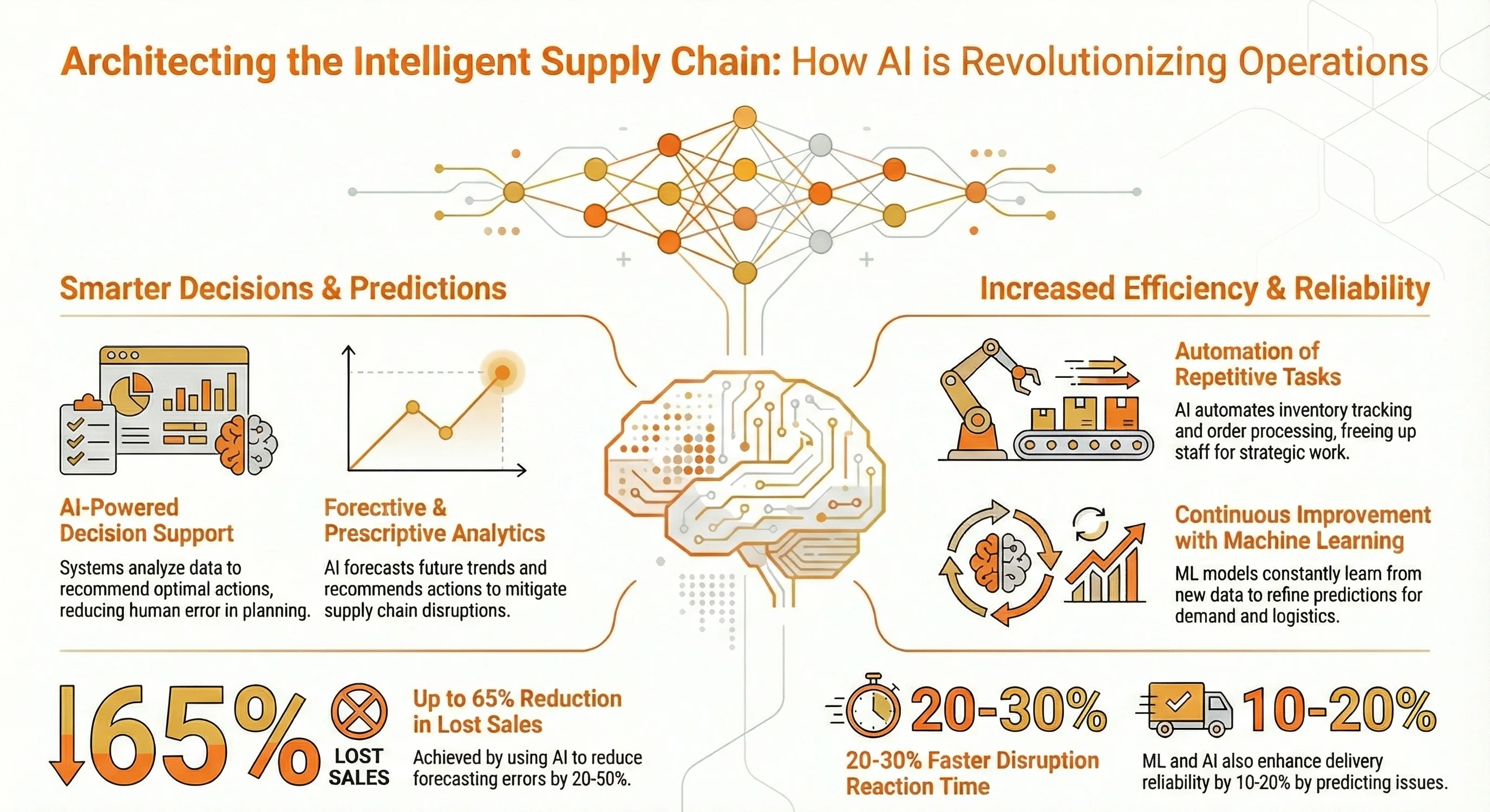
AI decision support tools ingest large datasets and recommend optimal actions to improve planning, allocation, and execution.
Let’s explore how AI-enabled systems help businesses streamline supply chain activities:
AI-Powered Decision Support Systems
AI analyzes data processing to recommend optimal actions, improving decision-making across various supply chain systems powered by AI. These systems help identify inefficiencies, cost-saving opportunities, and areas for improvement. AI tools like IBM Watson and SAP Leonardo provide predictive insights that ensure timely interventions and reduce the risk of human error in supply chain planning.
How it works:
IBM Watson uses advanced machine learning algorithms to analyze historical data and consumer trends, allowing businesses to make informed decisions about inventory management, logistics networks, and demand planning.
Automation of Repetitive Tasks
AI tools like UiPath and Automation Anywhere are capable of automating mundane tasks such as inventory tracking, order processing, and shipment scheduling. This reduces reliance on manual efforts, allowing supply chain planners to focus on more strategic activities.
How it works:
UiPath's robotic process automation (RPA) automates inventory management, data entry, and report generation, freeing up resources for higher-value activities in supply chain operations.
Predictive and Prescriptive Analytics
AI uses predictive analytics to forecast trends, while prescriptive analytics recommends actions based on those predictions. These capabilities help businesses optimize demand forecasting, production schedules, and inventory levels. Tools like Microsoft Azure AI and Oracle AI provide insights to help companies stay ahead of supply chain disruptions and demand fluctuations.
Applying AI‑based predictive forecasting can reduce forecasting errors by 20 – 50 %, translating into up to a 65 % reduction in lost sales and product unavailability.
How it works:
Azure AI uses data science and machine learning models to predict future supply chain disruptions, consumer demand, and production schedules. It recommends actions to mitigate potential risks, ensuring supply chain resilience.
Machine Learning and Continuous Improvement
AI-powered machine learning models continuously improve predictions over time. With tools like Amazon SageMaker and Google Cloud AI, businesses can enhance supply chain optimization by adjusting inventory levels and route planning. For that, you can use Amazon SageMaker.
ML and AI together can improve disruption reaction times by 20 – 30 % and enhance delivery reliability by 10 – 20 % by predicting issues and recommending changes.
How it works:
Amazon SageMaker uses machine learning to analyze historical data and adjust predictions, improving demand planning, optimizing production schedules, and minimizing stockouts. It learns from each cycle to refine future decision-making.
Key Factors Impacting AI Adoption in Supply Chain Management
AI is revolutionizing supply chain operations across the globe, but its adoption comes with both opportunities and challenges. The key drivers, restraints, and opportunities for AI adoption help businesses navigate their journey toward more efficient, resilient, and cost-effective supply chains.
Only 23 % of supply chain leaders have a formal AI strategy in place, showing planning lags actual experimentation.
| Factors | Description |
|---|---|
| Key Drivers |
|
| Major Restraints |
|
| Opportunities |
|
| Strategic Challenges |
|
AI adoption in supply chains presents both significant opportunities and challenges. By addressing these key factors, businesses can unlock the full potential of AI, leading to smarter, more efficient supply chain operations.
Surveys show that 62 % adoption of AI for sustainability tracking and measurement in supply chains has already been reported.
Future of AI in Supply Chain: What’s Next?
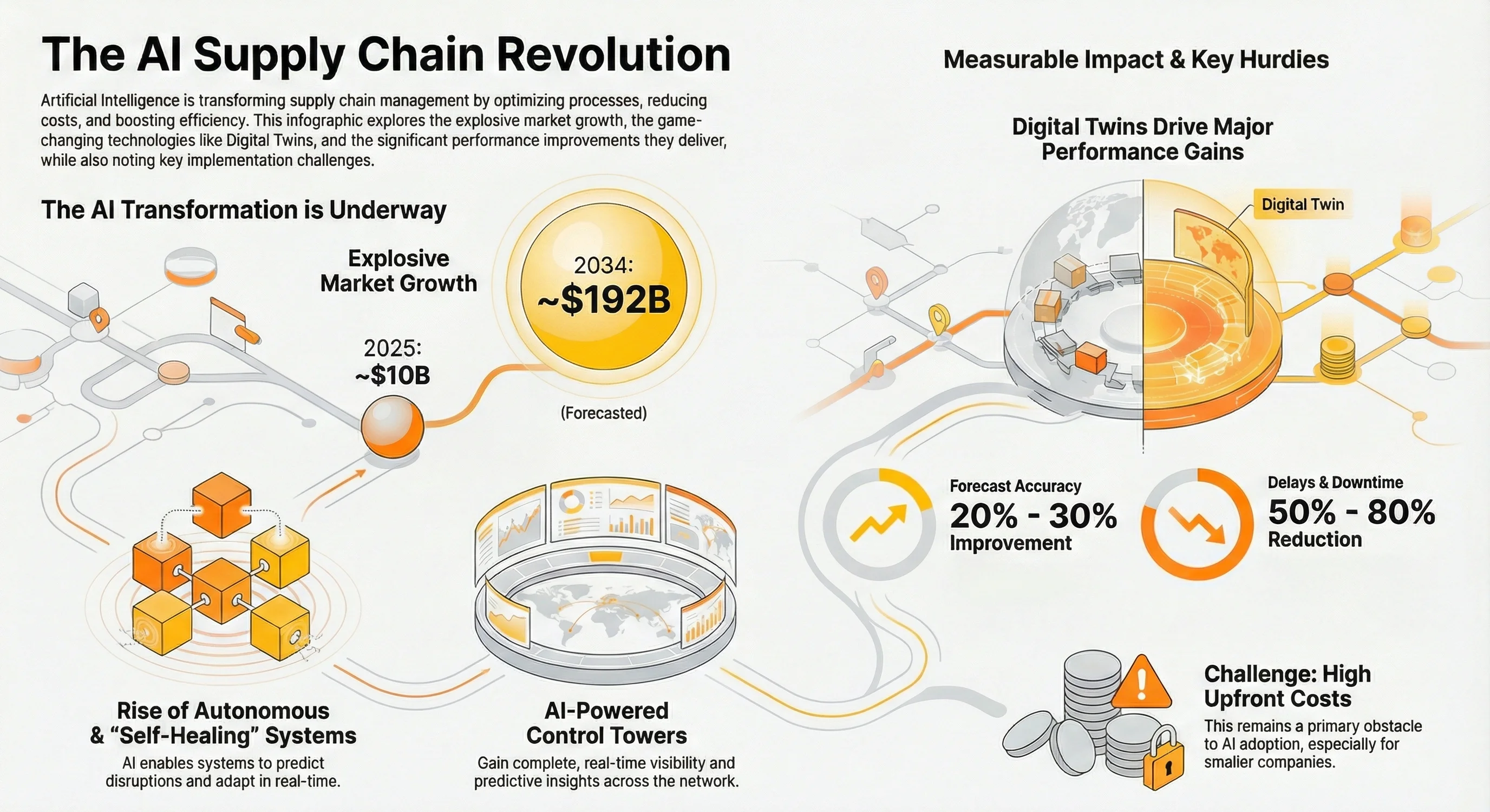
The future of Artificial Intelligence in supply chain management holds incredible potential, with innovations like autonomous supply chains, digital twins, and self-healing systems leading the way. As AI-enabled systems continue to evolve, businesses are poised to unlock even greater capabilities for supply chain optimization, reducing costs, enhancing operational efficiency, and improving service delivery.
The AI in the supply chain market is forecast to grow from USD 9.94 billion in 2025 to ~USD 192.5 billion by 2034, at a CAGR of ~39 %.
Here’s what to expect:
- Supply chain planners will leverage more sophisticated AI solutions for better demand planning, forecasting trends, and adapting to market changes in real time.
- Historical data will play a critical role as AI systems use this data to enhance supply chain activities, predicting future trends and ensuring more accurate decision-making.
- Supply chain partners will be better integrated through cloud computing, enabling seamless data processing and collaboration across the logistics networks.
Companies using value chain digital twins have seen 20 – 30 % improvement in forecast accuracy and 50 – 80 % reductions in delays and downtime. - The rise of generative AI solutions and digital twins will provide supply chain manufacturers with the ability to simulate scenarios, identify risks, and design sustainable supply chains that are adaptive to disruptions.
- AI tools will enable legacy supply chain planning systems to evolve, ensuring that supply chain systems powered by AI can continuously improve through machine learning and real-time data insights.
High upfront costs remain one of the biggest obstacles to investment in AI systems — especially for smaller enterprises with limited budgets. Large enterprises may pilot AI, but fewer achieve full implementation
AI‑driven supply chain control towers give companies real‑time visibility, predictive insights, and agility, enabling better responsiveness to disruptions.
As AI develops further, the integration of AI into management systems will ensure companies can create more resilient and efficient supply chain solutions, paving the way for continuous growth and innovation.
Conclusion
Artificial Intelligence is transforming supply chain management, driving supply chain optimization, improving efficiency, and reducing costs. As businesses increasingly adopt AI systems, they must address challenges like integrating AI with legacy supply chain planning systems and managing high implementation costs.
However, the benefits are clear: AI empowers supply chain planners to make more informed decisions, improve demand planning, and streamline supply chain activities. By leveraging AI-enabled systems, companies can build sustainable supply chains, improve logistics networks, and ensure a resilient, future-proof supply chain. Academic research and advancements in human resources management are crucial in helping businesses adapt to and maximize the potential of these AI solutions.
At AIChief, we track the AI tools, platforms, and strategies that are driving this transformation across industries. Whether you are evaluating your first AI investment or scaling an existing deployment, the right information makes the difference between a pilot that stalls and a system that delivers.
The supply chain of the future is already being built. The question is whether your organization is building it.
FAQs

Arfa Farheen
Arfa Farheen is part of AIchief's global editorial team, reviewing and testing AI tools. With a background in digital marketing, she helps businesses grow their online presence using simple, no-code strategies.