AI Use Cases
How AI in Financial Forecasting Accelerates ROI by 30%
Discover how AI in financial forecasting transforms planning with predictive models, real-time insights, and strategic decision-making. Learn best practices and tools to implement AI effectively.
Share
In an era where milliseconds can impact millions, relying solely on spreadsheets and human intuition for financial planning is no longer enough. Enter AI in financial forecasting, a revolutionary approach that’s redefining how organizations model outcomes, manage risk, and make decisions.
Many companies report that AI reduces forecasting errors by 20–50% compared to traditional models, thanks to its ability to analyze vast historical and real‑time data simultaneously.
By combining historical financial data, real-time market inputs, and advanced AI models, businesses can now create more accurate predictions with greater speed and precision. This isn’t just about automation; it’s about empowering finance teams to see around corners, anticipate disruptions, and seize opportunities before the competition even spots them.
One review of financial forecasting research shows that AI not only improves accuracy but also significantly enhances risk identification and prediction capabilities
Whether you're part of a startup fine-tuning your cash flow or a global enterprise navigating complex economic landscapes, AI's role in shaping financial strategy has never been more crucial.
Some research finds that AI can make forecast planning cycles 30% faster and forecasts 20–40% more accurately. Productivity in finance teams improves by around 20–30% with AI‑enabled models.
In this guide, we’ll explore how AI is changing the forecasting process, the tools making it happen, and how your business can capitalize on it.
What Is AI in Financial Forecasting and Why Does It Matter?
Financial forecasting has long been a cornerstone of strategic planning; however, the growing pace of change in markets and technology has rendered traditional methods less reliable. That’s where AI in financial forecasting steps in—offering real-time adaptability, deeper insights, and more accurate predictions.
Let’s break down why it matters, starting with its role in financial planning.
Understanding AI’s Role in Financial Planning
AI helps finance teams streamline their financial planning processes by automating data analysis, spotting patterns, and enabling real-time decision-making.
AI models are significantly more accurate than traditional methods; many businesses report improvements in forecast precision by 20–30% thanks to AI’s ability to incorporate real‑time inputs alongside historical data.
| Benefit | Impact on Financial Planning |
|---|---|
| Pattern recognition | Detects complex trends in historical data |
| Automated forecasting | Reduces manual errors and saves time |
| Scenario modeling | Simulates outcomes for better risk assessment |
| Data consolidation | Integrates financial data from multiple sources |
| Decision support | Aids finance professionals with insights for strategic moves |
How AI Is Transforming Traditional Forecasting Models
Traditional forecasting methods rely heavily on static spreadsheets and human assumptions. In contrast, AI models adapt continuously and pull from dynamic sources like real-time market trends and economic indicators.
Traditional spreadsheet forecasting can suffer from high error rates and inflexibility. In contrast, AI models have been shown to reduce forecasting errors by up to 20–50% by learning complex relationships in data that static models miss.
| Traditional Methods | AI-Powered Forecasting Models |
|---|---|
| Static spreadsheets | Adaptive machine learning models |
| Manual data entry | Automated data collection and ingestion |
| One-size-fits-all assumptions | Personalized, real-time predictive models |
| Lag in updates | Real-time forecasting with deeper insights |
| Limited scalability | Scalable across entire finance teams |
Core Technologies Behind AI Forecasting (ML, NLP, Big Data)
The power behind AI in forecasting lies in a blend of cutting-edge technologies.
More than 57% of finance teams now use AI for some financial operations, including forecasting and planning, reflecting broad adoption of these underlying technologies.
Here’s a snapshot of what’s driving the shift.
| Technology | Function in Financial Forecasting |
|---|---|
| Machine Learning (ML) | Learns from historical financial data to generate predictive models |
| Natural Language Processing (NLP) | Analyzes reports, news, and text for sentiment and signals |
| Big Data Analytics | Processes massive volumes of financial data for real-time insights |
| Deep Learning | Identifies complex patterns in unstructured or nonlinear data sets |
| AI Algorithms | Continuously refine forecasting logic based on outcomes and feedback |
How Does AI Work in Financial Forecasting?
After understanding the tech powering AI in finance, it's time to dive into how it works in action. From leveraging historical financial data to uncovering hidden patterns, AI in financial forecasting provides tools that surpass the capabilities of traditional systems and even experienced analysts working alone.
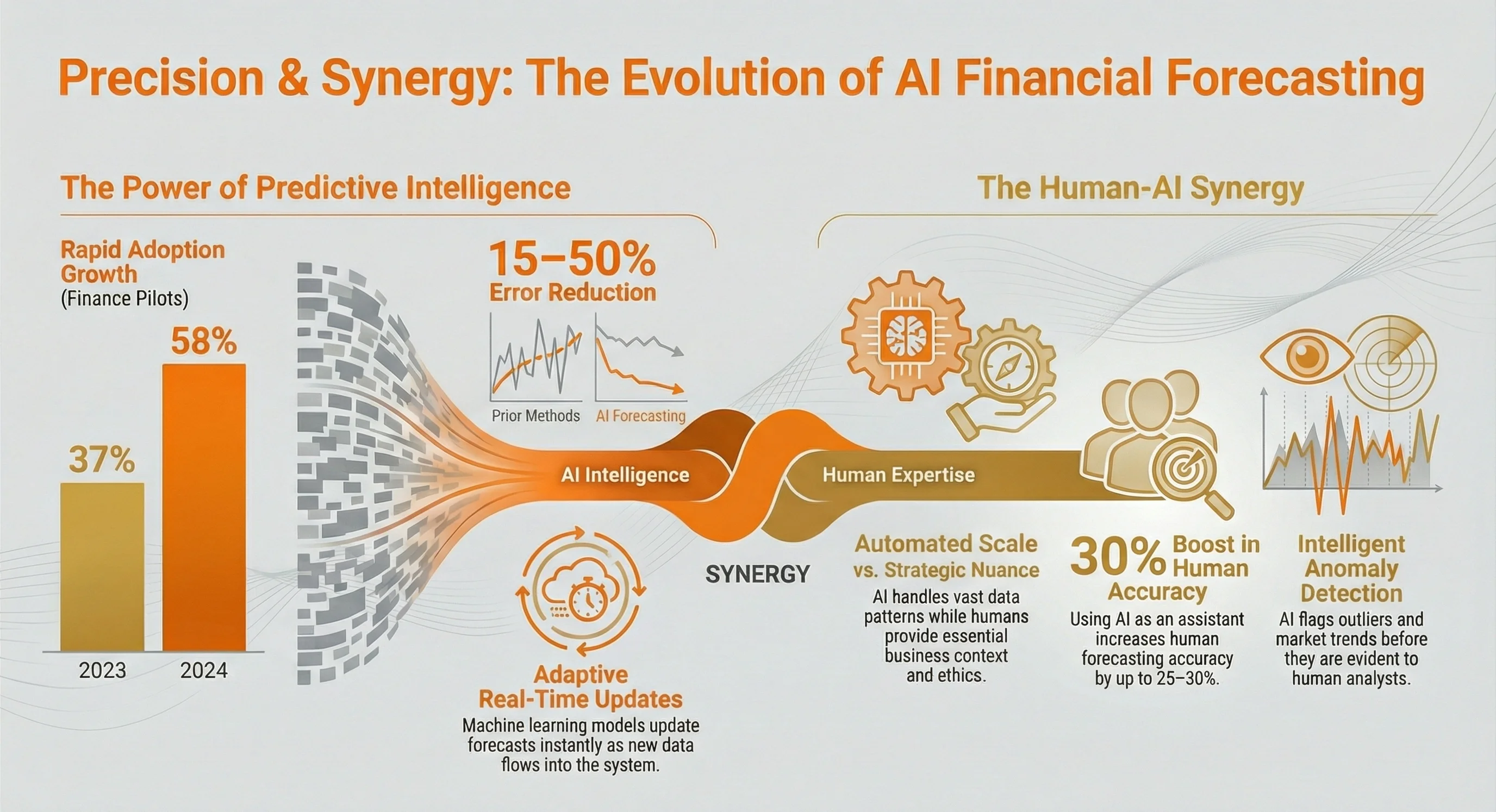
According to industry data, 58% of finance functions were piloting AI tools for forecasting in 2025, up from 37% the year before, showing rapid adoption of these systems.
From Historical Data to Predictive Models
AI doesn't just crunch numbers—it learns from them. By analyzing past performance, it builds models that accurately predict future outcomes.
- Processes historical data to uncover trends and seasonality
- Uses machine learning to build adaptive, self-improving predictive
- Updates forecasts in real-time as new data flows
- Enables more accurate financial forecasts through pattern
- Supports continuous improvement by learning from actual vs. forecasted outcomes
AI algorithms digest past financial records to spot recurring patterns that help project future behavior.
Identifying Trends, Risks, and Anomalies with AI
One of AI’s biggest strengths is its ability to find what humans might miss, especially when it comes to fast-moving or subtle changes in financial environments.
- Detects market trends before they’re evident to human analysts
- Flag outliers and inconsistencies for risk assessment
- Highlights anomalies in transactional or financial data streams
- Supports finance professionals in understanding volatility and market dynamics
- Enables deeper insights from large or complex data sets
About 33% of finance teams already use AI for anomaly detection and trend identification to improve forecasting accuracy and uncover insights that manual approaches would miss
AI vs. Human Forecasting: Strengths and Limitations
AI doesn’t replace human judgment—it complements it. Each brings unique strengths to the forecasting process.
Some studies show AI forecasting can reduce errors by 15–50% compared to traditional, human‑only methods.
AI Strengths:
- Handles vast amounts of data at scale
- Reduces bias and human error
- Generates consistent, accurate forecasts faster
- Excels at identifying complex patterns
Human Strengths:
- Brings context, intuition, and strategic thinking
- Evaluates unforeseen events not yet in the data
- Adds ethical oversight and business nuance
Together, they enable a more innovative, more resilient approach to strategic financial planning.
In some experimental forecasting tasks, AI has been shown to boost human accuracy by up to ~25–30% when used as an assistant rather than a replacement.
Key Applications of AI in Financial Forecasting
Now that we understand how AI models function and outperform traditional forecasting approaches, let’s explore where they shine most in practice. From optimizing day-to-day operations to making high-stakes investment decisions, AI in financial forecasting is driving sharper, faster, and more strategic business outcomes.
Financial Planning & Budgeting (Revenue, Expenses, Cash Flow)
AI enables finance teams to build adaptive, data-driven budgets that adjust to changing market conditions.
- Automates financial planning by analyzing trends in historical financial data
- Delivers more accurate predictions for revenue and expense fluctuations
- Improves cash flow forecasting with scenario-aware adjustments
- Reduces manual errors and speeds up the budgeting cycle
- Enhances visibility for financial professionals and executives
AI helps forecast cash positions, assess liquidity risks, and optimize working capital, giving CFOs a clearer picture of financial health
Investment and Risk Management (Portfolios, Credit, Underwriting)
When markets move fast, AI in financial contexts helps investors and risk officers stay ahead of volatility.
- Identifies asset correlations and market dynamics for portfolio optimization
- Assesses borrower creditworthiness using AI algorithms and alternative data
- Automates risk assessment and fraud detection
- Supports financial institutions with dynamic risk modeling in real-time
- Enables faster and fairer underwriting decisions with AI models
AI tools analyze vast market data to detect hidden patterns and relationships that help portfolio managers optimize allocations and balance risk vs reward
Scenario Modeling and Stress Testing
Anticipating what-if scenarios is vital. AI empowers organizations to simulate both opportunity and crisis.
- Builds diverse forecasting paths using machine learning models
- Tests business resilience under various economic indicators and disruptions
- Helps finance professionals understand potential exposures
- Supports compliance through automated stress simulations
- Encourages more resilient and agile financial processes
A growing number of financial institutions are adopting AI tools that can evaluate multiple scenarios in real time, a capability crucial for managing risks in volatile markets where static assumptions fall short.
Real-Time Forecasting and Decision Support
In dynamic markets, decisions must be made at the moment. AI enables real-time forecasting, informing strategic moves instantly.
- Processes streaming financial data for up-to-the-minute insights
- Flag emerging risks and anomalies as they occur
- Supports strategic decision-making with live dashboards and alerts
- Reduces decision latency across the entire finance team
- Makes forecasting a continuous, always-on capability
By automating the analysis of incoming data, AI cuts down on the time between data capture and insight generation, enabling faster, data‑driven responses when markets shift.
Benefits of Using AI for Financial Forecasting
Now that we’ve explored how AI is applied, let’s dive into the powerful advantages it brings. Whether you’re refining quarterly budgets or managing global portfolios, AI in financial forecasting delivers game-changing benefits that outpace traditional methods. The result? More accurate financial forecasts, less guesswork, and more intelligent decisions.
Research shows that AI approaches, especially those incorporating deep learning and hybrid models, significantly outperform traditional forecasting methods in terms of accuracy and responsiveness to changing conditions.
Enhanced Accuracy and Reduced Bias
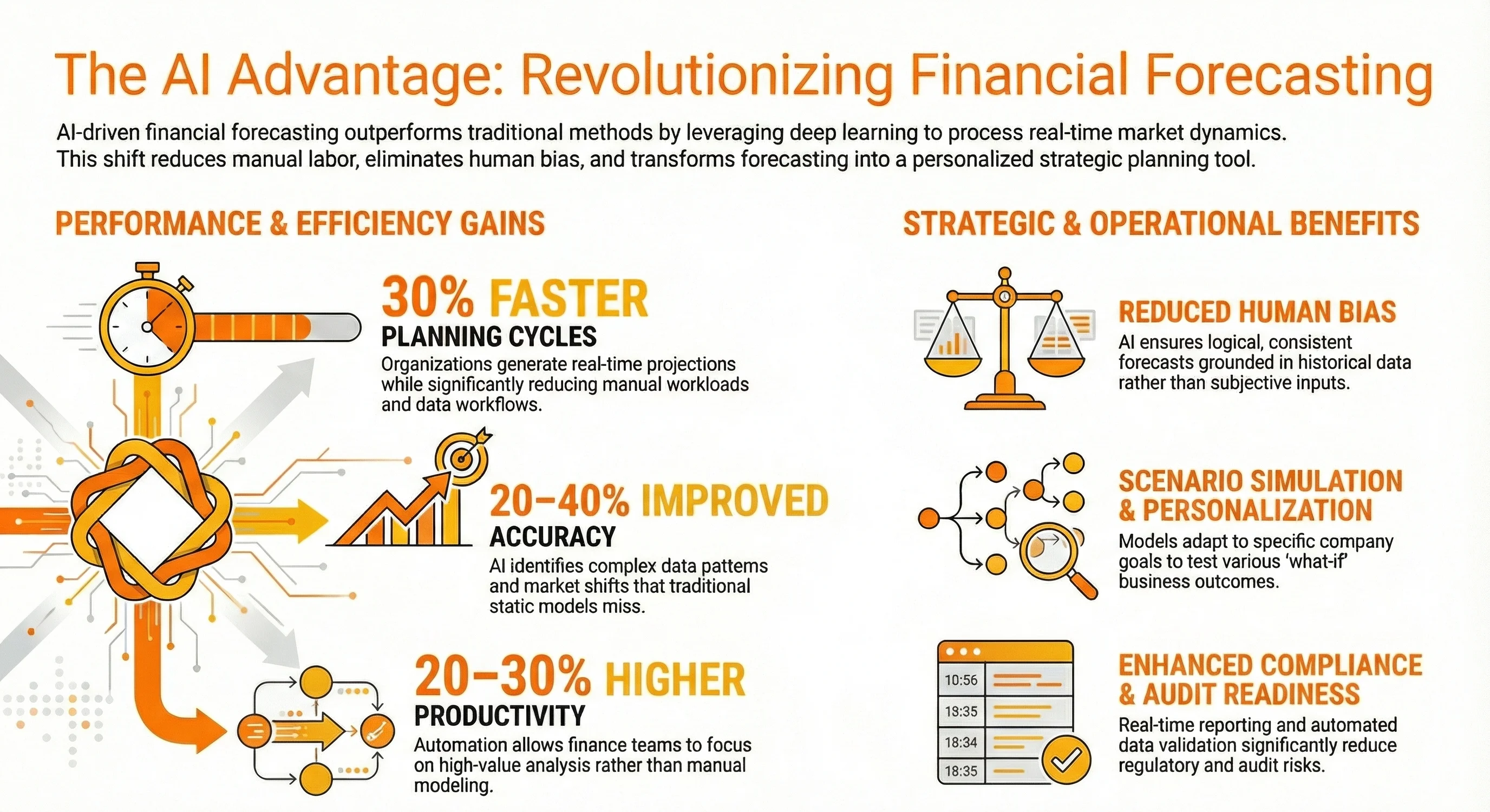
One of the most transformative advantages of AI in financial forecasting is its ability to reduce human bias while increasing accuracy significantly. Unlike traditional forecasting methods, which often rely on static models or subjective inputs, AI models continuously learn from historical data and evolving market insights. This allows them to detect complex patterns that even experienced human analysts might miss. The result is a forecasting process grounded in logic, consistency, and performance, which drives more accurate predictions that support smarter decisions throughout the organization.
Real‑time adaptability not only enhances precision but also empowers finance teams with insights that reflect current market dynamics rather than historical lag.
Speed, Efficiency, and Cost Savings
Speed matters in finance, and AI delivers. By automating the forecasting process, organizations can generate projections in real time rather than waiting days or weeks. This reduces manual workload, streamlines data workflows, and empowers finance teams to act faster with greater confidence. AI also leads to notable cost savings by cutting down the resources needed for modeling, planning, and financial analysis, making it a smart investment for long-term efficiency.
According to industry analysis, companies that integrate AI into planning and forecasting see planning cycles become about 30% faster, accuracy improves by 20–40%, and overall finance productivity increases by 20–30%
Personalization and Strategic Forecasting
AI doesn't just automate; it adapts. With the ability to tailor models to a company’s goals, seasonality, and financial metrics, AI transforms forecasting into a strategic financial planning tool. It allows teams to simulate different outcomes, test scenarios, and align predictions with evolving business priorities. This personalization gives decision-makers the context and clarity they need to plan confidently, not just for what’s likely, but for what’s possible.
AI-enabled forecasting improves accuracy and delivers more strategic insights for tailored planning.
Improved Compliance and Regulatory Reporting
As compliance demands become increasingly complex, AI enables financial institutions and enterprises to maintain accuracy and transparency. AI tools help validate financial data, track regulatory changes, and generate real-time reports, thereby reducing audit risk. By ensuring data quality and flagging inconsistencies, AI enhances both internal controls and external accountability, making it a crucial component of modern financial forecasting and governance frameworks.
Getting Started with AI Forecasting Tools and Platforms
Jumping into AI in financial forecasting doesn't have to be overwhelming. With the right tools and strategy, your team can unlock more brilliant insights, more accurate projections, and future-ready decision-making. Whether you're starting from scratch or upgrading from legacy systems, understanding how to evaluate, choose, and integrate the right tech will define your success.
What to Look for in an AI Forecasting Tool
Not all platforms are created equal. Before diving in, it's essential to know what truly matters to your business use case.
| Feature | Why It Matters |
|---|---|
| Data Integration Capabilities | Connects with your financial data sources easily (ERP, CRM, spreadsheets) |
| Customizable AI Models | Tailor's predictions based on your industry and goals |
| User-Friendly Interface | Keeps it usable for finance teams, not just data scientists |
| Scenario Planning Tools | Enables fast what-if modeling and strategic planning |
| Real-Time Forecasting | Updates projections instantly with new data inputs |
| Security and Compliance | Protects sensitive data and aligns with regulations |
| Scalability | Grows with your business and handles complex patterns |
AI adoption in finance is rising fast: tools like Planful and Datarails are being used to consolidate data and improve forecasting accuracy by up to 25–30%.
Top AI Forecasting Tools for 2025
Here’s a quick comparison of leading tools that are shaping AI in financial operations this year.
| Tool | Key Strengths | Best For |
|---|---|---|
| Fuelfinance | Easy interface, tailored models | Startups, small finance teams |
| Anaplan | Scalable, powerful scenario modeling | Enterprises, FP&A |
| Planful Predict | Real-time forecasting, signal detection | Mid-to-large financial teams |
| Vena Solutions | Integrated planning, Excel compatibility | Teams used to spreadsheets |
| Pigment | Visual modeling, collaboration-friendly | Cross-functional finance orgs |
| Datarails | Automation and dashboarding for SMBs | Finance-led organizations |
These tools offer different advantages, so consider your company’s size, technical resources, and forecasting process maturity when selecting one.
Gartner research shows 30% of finance functions were using AI by 2028, up significantly from prior years — indicating broad momentum behind these platforms.
Setting Up the Right Tech Stack for AI Integration
To unlock the full potential of AI models, your finance team needs a tech stack that connects, automates, and scales with your needs.
| Layer | Tools/Tech Examples | Role in AI Forecasting |
|---|---|---|
| Data Layer | APIs, Data Lakes, Cloud Storage | Collects and stores historical financial data |
| AI & ML Engines | Python, TensorFlow, Azure ML, AutoML tools | Runs your machine learning models |
| Integration Tools | Zapier, Make, custom connectors | Syncs systems like ERP, CRM, spreadsheets |
| User Interface | BI dashboards, spreadsheets, and SaaS platforms | Allows finance professionals to view and act |
| Security Layer | Role-based access, encryption, and compliance | Ensures data security and governance |
Setting this foundation right not only enhances your AI capabilities but also accelerates adoption, boosts ROI, and future-proofs your financial forecasting.
Organizations that modernize their data infrastructure report 5x better AI project success and up to 60% cost savings on data processing and training workloads
Common Challenges and Limitations of AI in Forecasting
While AI in financial forecasting holds massive potential, it's not without its roadblocks. Understanding these limitations early helps finance teams manage expectations, make more informed implementation choices, and maintain control over their forecasting process.
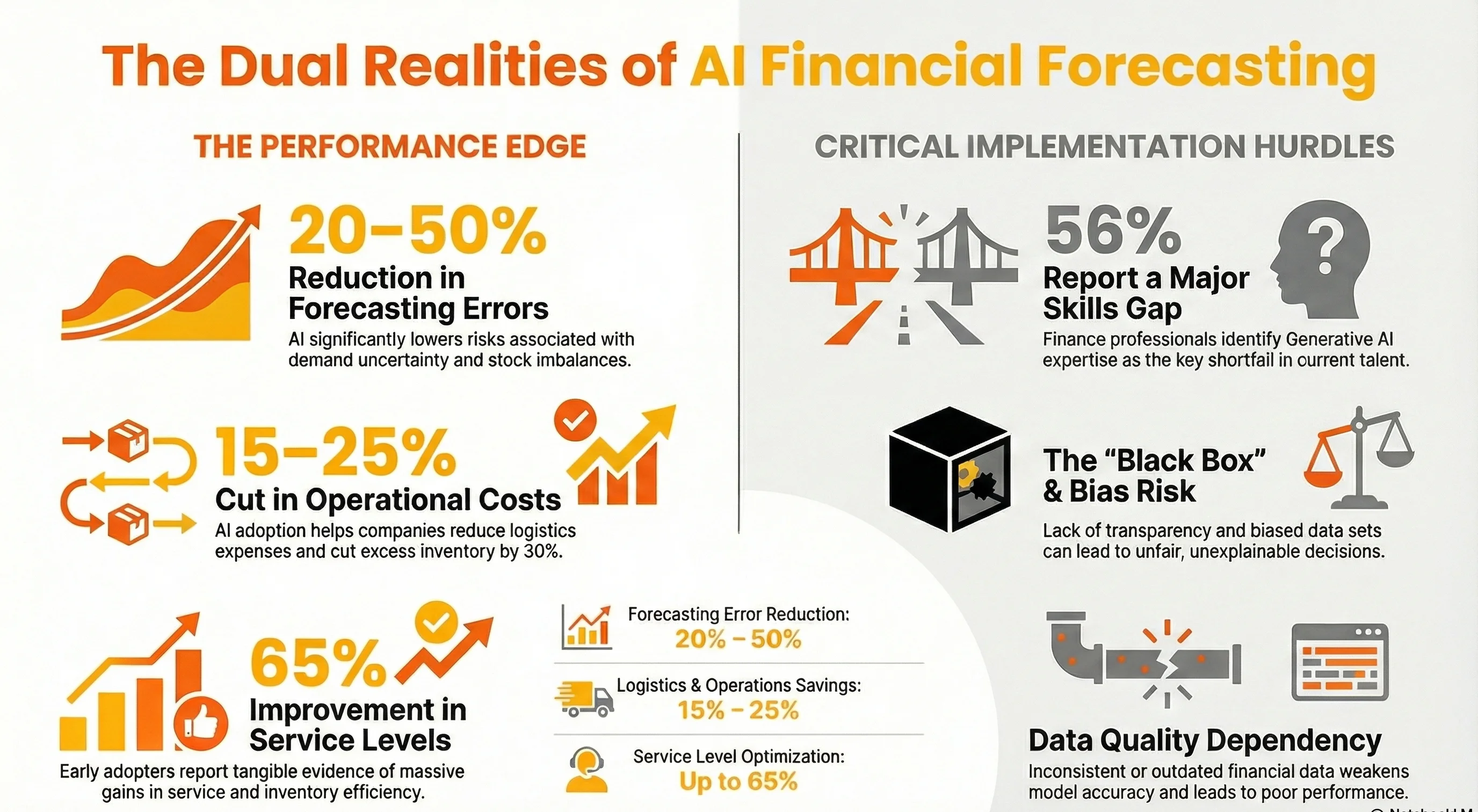
AI‑driven forecasting can reduce forecasting errors by 20 – 50% compared to traditional methods, significantly lowering risks associated with demand uncertainty and stock imbalances.
Data Quality and Model Dependency
Even the most innovative AI models can’t function well without high-quality inputs.
- Poor data quality can distort predictions and reduce reliability
- Inconsistent or outdated financial data weakens model accuracy
- Many models rely heavily on historical financial data, limiting adaptability during market shifts
- Overfitting models can lead to impressive past results but poor future performance.
AI adoption has helped companies cut excess inventory by up to 30% and cut logistics and operational costs by 15 – 25%, demonstrating measurable value beyond hype.
Ethical Concerns and Algorithmic Bias
AI isn’t always neutral—it reflects the data it learns from.
- Biased data sets can lead to skewed forecasts and unfair decision-making
- Lack of transparency in AI algorithms makes it hard to explain predictions
- Financial decisions influenced by biased systems can raise regulatory red flags
- Companies must implement ethical frameworks to govern AI in financial operations
According to surveys of early AI adopters, organizations have improved inventory levels by as much as 35% and service levels by up to 65%—clear evidence of tangible performance gains.
Overreliance on Automation
AI can do a lot—but not everything.
- Blind trust in AI can sideline human analysts and reduce critical thinking
- Overdependence may cause issues when new data or black-swan events occur
- Not all financial processes can be fully automated; some still require judgment and expertise.
Talent Gaps and Technical Expertise in Finance
The AI skill gap in finance is real.
- Many finance professionals lack the necessary data science or coding expertise.
- Implementing AI requires collaboration across IT, data, and finance departments.
- Upskilling takes time and resources that not all financial institutions have.
- Hiring AI-fluent talent is competitive and can strain smaller organizations
Finance professionals increasingly identify Generative AI skills gaps as a major issue, with 56% pinpointing it as the key shortfall.
What’s Next: Future Trends in AI-Driven Forecasting
As AI continues to transform finance, the future of AI in financial forecasting promises not just better accuracy but a complete reimagination of how forecasts are built, interpreted, and applied. From generative AI to next-gen tech integration, we’re entering an era where finance becomes faster, wiser, and more adaptive than ever before.
The Rise of Generative AI in Financial Forecasting
Generative AI is changing the game by automating complex model creation, generating multiple forecast scenarios, and even writing narrative reports from financial data. Its ability to enhance predictive models and simulate real-world variables makes it an exciting force in financial modeling. For finance teams, this means reduced manual labor, richer insights, and more accurate predictions at scale.
AI for ESG, Sustainability, and Responsible Investing
AI isn’t just about profits; it’s becoming a vital ally in responsible investing. By analyzing unstructured data like sustainability reports, news, and ESG metrics, AI tools can evaluate non-financial risk and support ethical decision-making. This is especially relevant for financial institutions navigating new regulatory frameworks and public expectations.
Today, 58 % of finance teams are already using AI, up significantly from prior years, with adoption growing rapidly as leaders recognize its strategic value
Integrating AI with Blockchain, IoT, and Smart Systems
The convergence of AI with blockchain, IoT, and smart infrastructure is creating real-time, data-rich ecosystems. Imagine AI models pulling transaction data from blockchain ledgers or economic indicators from connected IoT sensors, resulting in truly dynamic forecasting. This integration enhances transparency, traceability, and data quality across the board.
Adaptive Forecasting and the Future of Human-AI Collaboration
Looking ahead, the most impactful trend may be the collaboration between finance professionals and AI. Instead of replacing humans, AI will act as an intelligent co-pilot, suggesting outcomes, spotting risks, and guiding strategy. This adaptive forecasting approach blends human analysts’ judgment with machine efficiency, delivering both context and confidence in every decision.
Research shows AI‑based forecasting systems can improve prediction accuracy by up to 92 % compared with traditional statistical methods, translating into more precise revenue, market, and risk projections.
How to Implement AI in Your Forecasting Process
Implementing AI in forecasting financials can be challenging for those who don’t know how to do it properly. In this section, we will guide you through some simple steps that will help you learn it with precision and excellence. So, let's find out how you can implement AI in your forecasting process.
Choosing the Right Platform for Your Business Needs
Selecting an AI platform tailored to your organization's specific requirements is crucial. Consider the following factors:
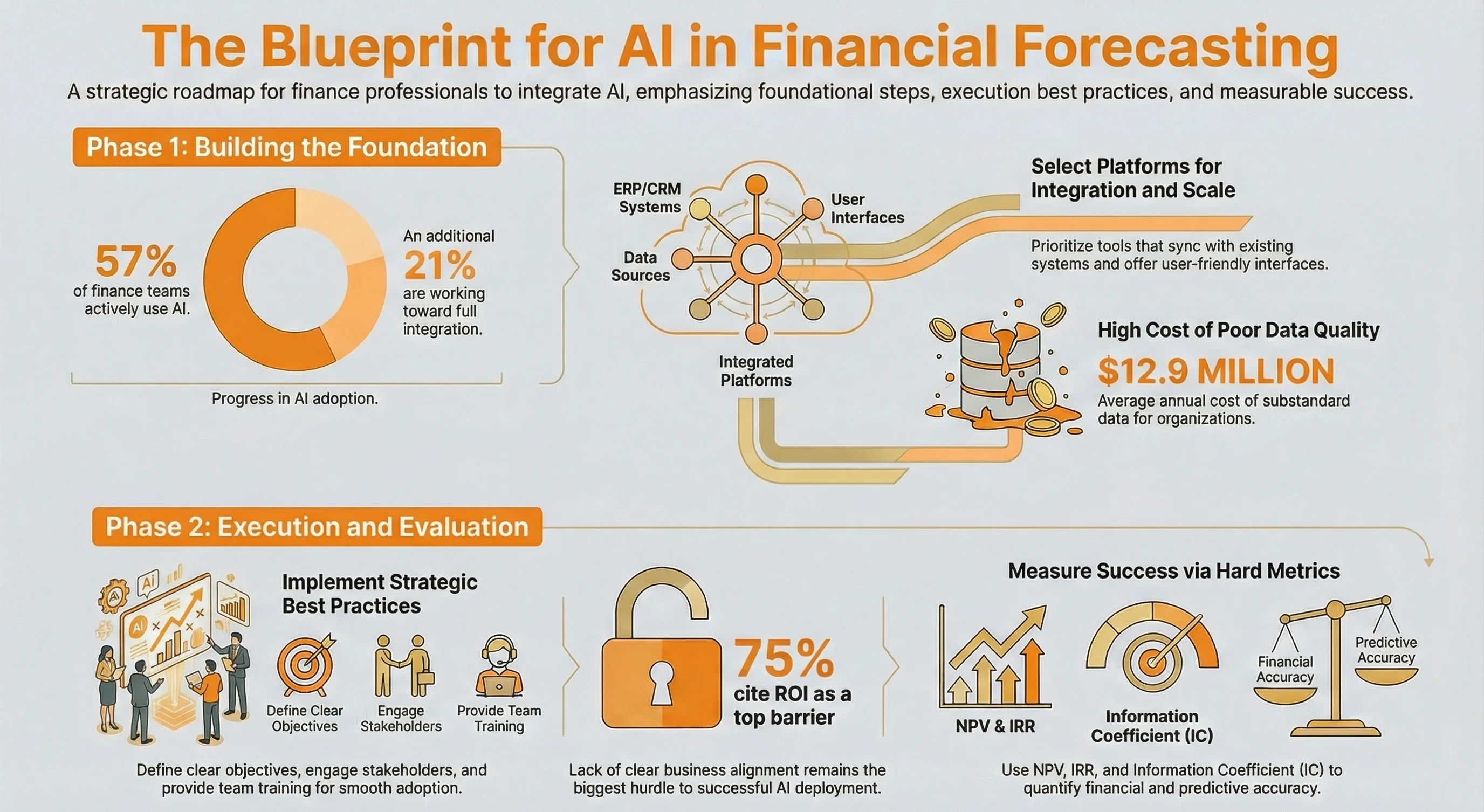
- Integration Capabilities: Ensure the platform seamlessly integrates with your existing financial systems, such as Enterprise Resource Planning (ERP) and Customer Relationship Management (CRM) tools.
- Scalability: Choose a platform that can grow with your business, accommodating increasing data volumes and complexity.
- User-Friendliness: Opt for platforms with intuitive interfaces that facilitate adoption by finance professionals without extensive technical expertise.
- Support and Training: Evaluate the availability of vendor support and training resources to assist your team during and after implementation.
By aligning the platform's features with your business needs, you can enhance the effectiveness of your AI-driven forecasting processes.
According to industry data, 57% of finance teams today are actively using AI for some financial operations, with another 21% having adopted tools they have yet to fully integrate.
Building a Data-Driven Financial Infrastructure
A solid data foundation is essential for effective AI forecasting. Focus on:
- Data Quality: Ensure accuracy, consistency, and completeness of your financial data to train reliable AI models.
- Data Security: Implement robust security measures to protect sensitive financial information and comply with regulatory requirements.
- Data Accessibility: Organize data in a way that allows easy access for analysis and model training, utilizing cloud storage solutions if necessary.
- Data Governance: Establish clear policies for data management, including data ownership, access controls, and data lifecycle management.
A well-structured data infrastructure supports the development of predictive models that can provide deeper insights into financial trends.
According to industry research, poor data quality costs organizations an average of around $12.9 million/year, making it one of the biggest hidden drains on AI and analytics projects
Best Practices for AI Implementation in Finance Teams
Successful AI integration involves more than just technology; it requires a strategic approach:
- Define Clear Objectives: Establish specific goals for AI implementation, such as improving forecasting accuracy or reducing manual data processing time.
- Involve Stakeholders: Engage key stakeholders, including finance professionals and IT staff, to ensure alignment and address potential concerns.
- Provide Training: Equip your team with the necessary skills to utilize AI tools effectively, fostering a culture of data-driven decision-making.
- Monitor and Iterate: Continuously evaluate the performance of AI models and make adjustments as needed to improve outcomes.
By following these best practices, you can facilitate a smooth transition to AI-enhanced financial forecasting.
Measuring ROI and Performance of AI Forecasts
Assessing the impact of AI on your forecasting processes is vital:
- Establish Baselines: Determine current performance metrics to compare against post-implementation results.
- Quantify Benefits: Measure improvements in areas such as forecasting accuracy, time savings, and cost reductions.
- Consider Intangible Benefits: Evaluate factors like enhanced decision-making capabilities and increased stakeholder confidence.
- Use Appropriate Metrics: Employ metrics like Net Present Value (NPV), Internal Rate of Return (IRR), and Information Coefficient (IC) to assess financial returns and predictive accuracy.
Regularly reviewing these metrics ensures that your AI investments deliver tangible value and align with strategic objectives.
In fact, nearly 75 % of organizations list a lack of clear ROI and business alignment as a top barrier to successful AI deployment
Conclusion:
As we conclude this comprehensive guide on integrating AI into financial forecasting, it's evident that embracing artificial intelligence is no longer optional—it's essential. From enhancing accuracy and efficiency to enabling real-time insights and scenario planning, AI is transforming how businesses approach financial planning. However, navigating this transformation requires the right tools, strategies, and support.
At AIChief, we are committed to making AI accessible and actionable for finance professionals. Our comprehensive guides and resources are designed to demystify AI technologies, providing you with the knowledge and tools needed to harness their full potential. Whether you're selecting the right AI platform, building a data-driven infrastructure, implementing best practices, or measuring ROI, AIChief is here to support you every step of the way.
The future of financial forecasting is here, and with AIChief by your side, you can lead the way in making smarter, data-driven financial decisions.
FAQs

Asia Hussain
Asia helps brands create a strong online presence with smart content strategies. She also reviews and curates the best AI tools, shaping editorial content and providing insights at AIChief.