AI Use Cases
7 AI Trends Transforming Ecommerce and Boosting Revenue
Learn how AI helps in eCommerce through personalization, smart logistics, and automation to boost sales, customer experience, and efficiency.
Share
AI is revolutionizing the global eCommerce landscape, and by 2032, it’s projected to exceed $22.6 billion. According to SellersCommerce, the AI-enabled eCommerce market is valued at $8.65 billion in 2025 and continues to accelerate with personalization and automation at its core. Want to know how AI helps in eCommerce further?
Let’s explore together.
Imagine if online stores had helpful salespeople who knew exactly what you liked, your budget, and when you were ready to buy. Or you're about to leave a website, and the perfect product shows up, just the right price, with a chatbot that already understands your needs. Sounds magical?
That’s the power of Artificial Intelligence in eCommerce platforms.
The old, boring shopping days are gone. Today, AI-powered tools help businesses make smarter decisions, analyzing data, managing inventory, and delivering personalized shopping experiences that actually convert.
Whether you're running a small eCommerce website or a global store, AI is changing the way brands connect with customer data, streamline routine tasks, and build customer loyalty.
In this blog, we’ll explore AI in eCommerce, along with the latest market trends and real-world use cases. Let’s figure out how AI is improving customer satisfaction and operational efficiency, all while driving real results.
Why AI Is Becoming Core to Modern eCommerce?
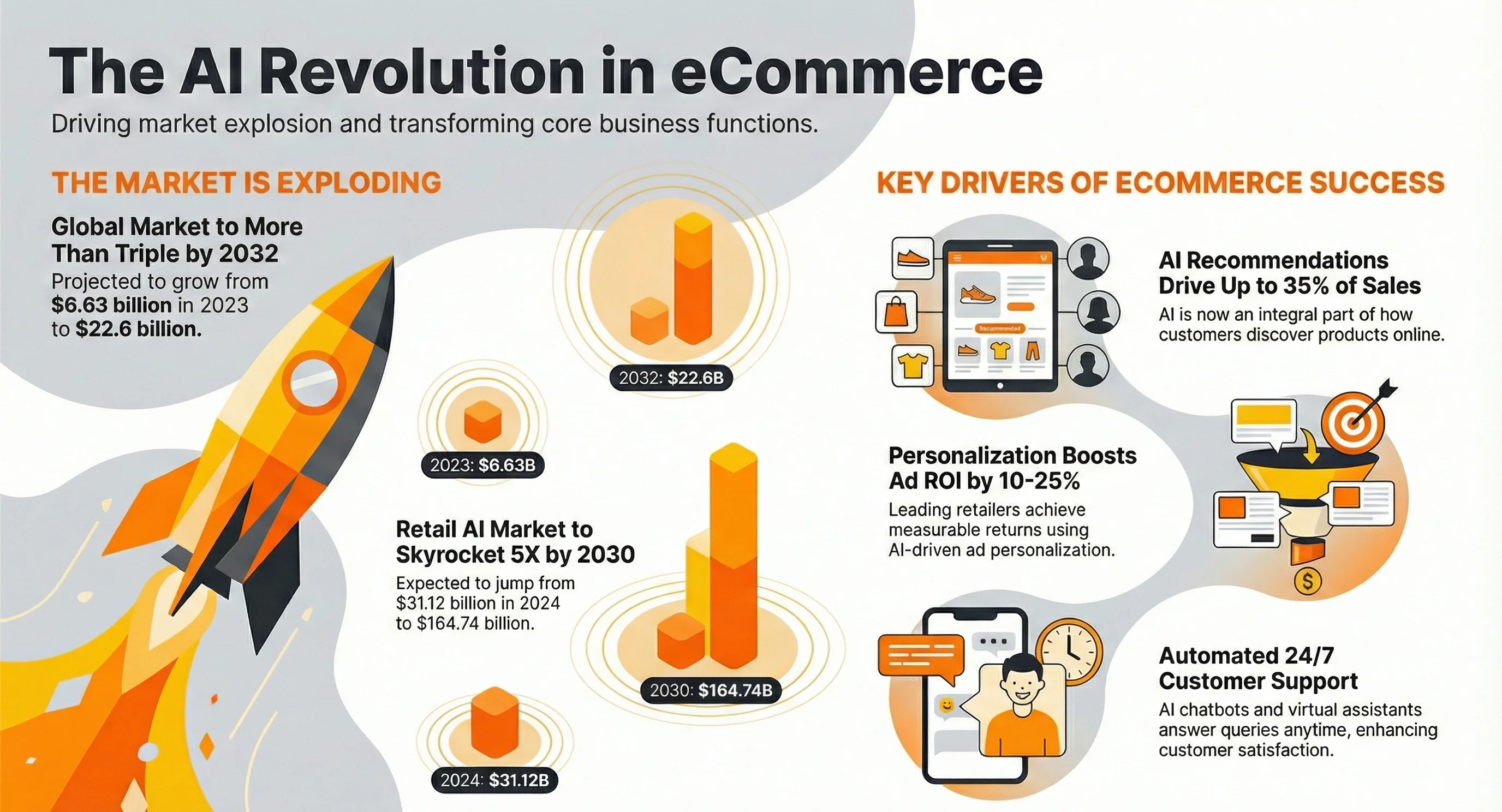
AI has become the backbone of modern eCommerce, with the global market growing from $6.63 billion in 2023 to a projected $22.6 billion by 2032.
AI also improves supply chain, automates inventory management tasks, and offers personalized recommendations. You can detect fraud, improve decision-making, sales, and more with its Machine Learning and Natural Language Processing AI technology.
5 Real Reasons Why AI Is Taking Over eCommerce
It’s true, AI is not just taking over eCommerce, but this whole world. It automates routine tasks, boosts productivity, and much more. Let’s find out more about it.
- AI-powered personalization is driving measurable ROI, with Bain & Company reporting that leading retailers achieved a 10–25% increase in return on ad spend using AI-driven personalization.
- Smart pricing powered by AI is part of a retail AI market that’s set to explode, from $31.12 billion in 2024 to $164.74 billion by 2030, according to Markets & Markets.
- You’ll get AI-driven customer interactions, like chatbots and virtual assistants, that offer 24/7 support, answering customer queries and enhancing customer satisfaction.
- AI-driven product recommendations are now responsible for up to 35% of online sales, according to Netscribes, showing just how integral AI has become in product discovery.
- Behind the scenes, AI systems are automating routine tasks, refining warehouse operations, and streamlining everything from product descriptions to delivery timelines.
The result? A smoother online shopping experience for customers and a more efficient sales process for retailers.
What Today’s Customers Want, and How AI Delivers?
People, and their expectations, are also changing with AI usage. Now, shoppers expect more than just products; they want convenience, speed, and a personal touch. However, AI-powered tools can exactly solve these issues and help users to turn high expectations into real results for eCommerce businesses.
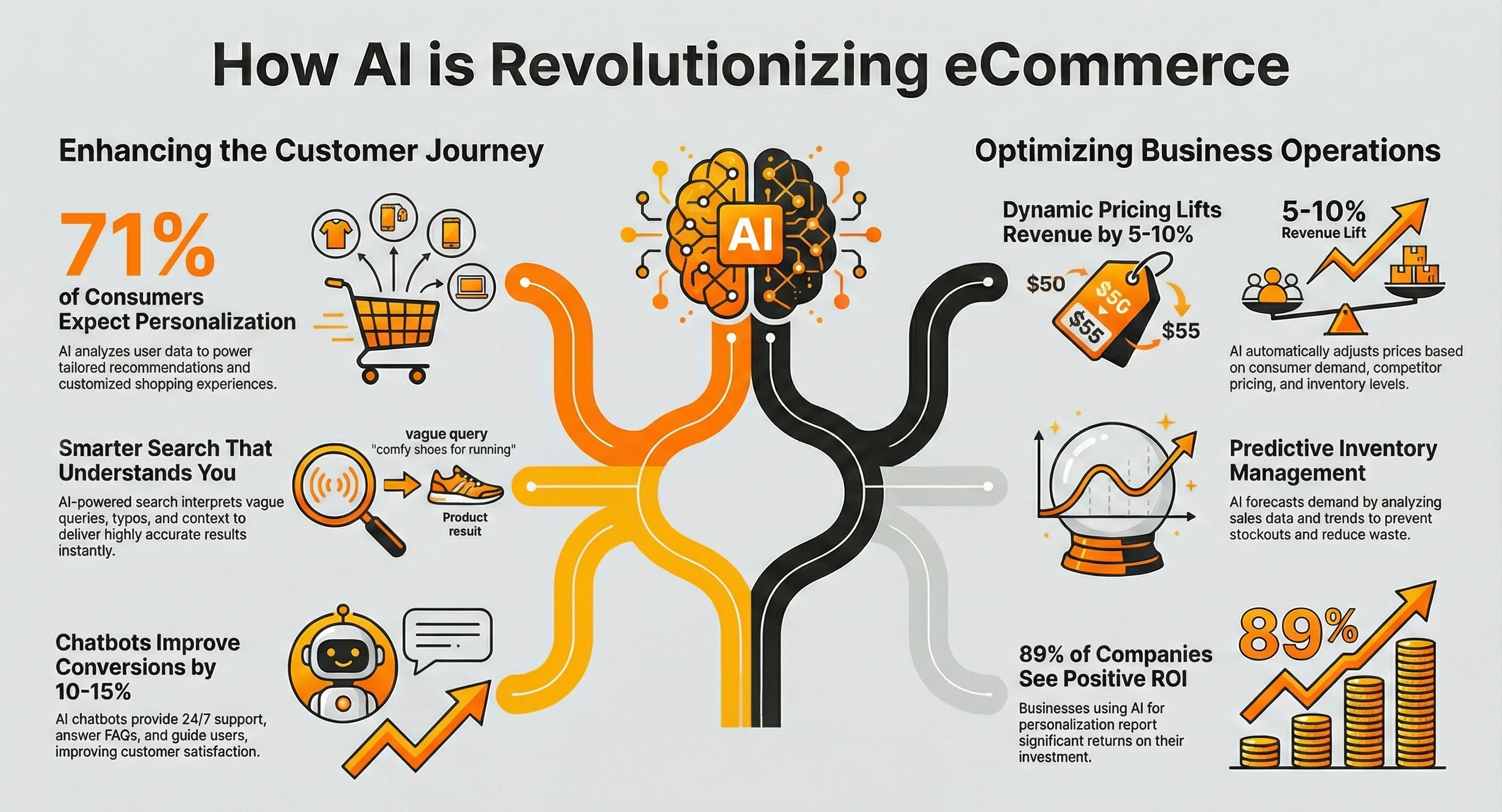
- Modern shoppers expect personalization. IBM reports that 71% of consumers now expect tailored experiences when interacting with brands online.
- Chatbots using natural language processing make support feel more human, reducing wait times and enhancing customer service.
- AI adoption among eCommerce teams is accelerating, with Gorgias finding that 77.2% of professionals use AI or automation to enhance performance.
- AI also empowers marketing teams with actionable insights drawn from big data, enabling better decisions on what to promote and when.
- With tools powered by generative AI, even content creation and customer engagement are becoming faster and more tailored.
In short, AI is helping eCommerce platforms not just meet but exceed customer expectations, resulting in increased customer satisfaction, better retention, and greater business value.
5 Practical AI Use Cases That Make eCommerce Smarter
When you shop online, and everything just works, the right product shows up, the price feels fair, and support is quick, that’s often AI doing the heavy lifting. Behind the scenes, it’s helping businesses run more smoothly, and customers shop smarter. It’s not just hype anymore; AI is already solving real problems in eCommerce.
Here are five ways it’s quietly making online shopping better for everyone.
1. Smarter Product Discovery and Personalized Recommendations
Ever wonder how your favorite online store seems to just know what you’re looking for? That’s AI at work. When you browse a site like Amazon and get a “you might also like” carousel, or see handpicked suggestions on Netflix or Spotify, it’s all powered by machine learning algorithms analyzing your purchase history, clicks, and preferences in real time.
This kind of AI-powered personalization helps customers find what they want faster, and sometimes even before they know they want it. For businesses, it means higher conversion rates, better customer engagement, and stronger customer loyalty.
AI also boosts sales by analyzing customer data, including purchase history, customer preferences, and user behavior.
Here’s how AI makes it happen:
- Recommending similar or complementary products based on past customer behavior
- Personalizing homepages, emails, and promotions to match each user’s behavior
- Grouping customers into smart segments for tailored campaigns using big data
- Adapting product suggestions in real time as users click, scroll, or search
- You’ll also get increased customer loyalty, customer engagement, and conversion rates.
In short, AI doesn’t just guess, it learns, adapts, and helps boost sales while improving the customer experience.
2. Smarter Search That Actually Understands What You Mean
We’ve all been there: you type something vague into a search bar, and the results are way off, like searching for “black sneakers” and getting everything from socks to stilettos. That’s where AI-powered search steps in to save the day.
Generative AI is shaping shopper behavior, with Digital Commerce 360 revealing that 47% of Gen Z consumers now use AI weekly for search and shopping.
Here’s how it works in real-world eCommerce:
- Typo-tolerant results: AI handles, or understands “black jacket” and still shows black jackets.
- Context-aware filtering: Searching “office chair under $200” brings exactly that, not every chair ever made.
- Voice or conversational search: Think “show me red dresses like the one I viewed last week.”
- Intent prediction: AI can tell if a shopper typing “apple” wants fruit or a new iPhone, based on behavior and customer data.
By delivering more accurate results, AI tools not only reduce frustration but also increase customer satisfaction, keep users on-site longer, and help eCommerce retailers move customers smoothly toward a purchase.
3. Why Prices Fluctuate Online, and How AI Makes It Happen
AI-driven dynamic pricing can lift retailer revenues by 5–10%, according to Market US, helping brands stay agile amid changing consumer demand.
In eCommerce, dynamic pricing uses machine learning and predictive analytics adjust prices based on things like:
- Consumer demand (more demand = higher price)
- Competitor pricing (staying competitive in real-time)
- Purchase history and buying patterns
- Inventory levels and historical sales data
For example:
- A fashion retailer might lower prices on winter jackets in March as consumer demand drops. AI algorithms use historical sales data, customer behavior, and even weather patterns to trigger smart markdowns at just the right time.
- A tech store may raise the price of a trending product when stock is low. AI-powered tools analyze inventory management, user behavior, and competitor pricing to recommend the best pricing move in real time.
In both cases, artificial intelligence is doing the heavy lifting, analyzing data, spotting patterns, and automating decisions that would take humans hours. This allows eCommerce businesses to adapt instantly and run a more efficient sales process while improving the customer experience.
4. AI Chatbots That Actually Help - Not Frustrate
Customer support is one of the most demanding areas of any eCommerce business. Long wait times, repetitive questions, and inconsistent responses can frustrate both customers and support teams. That’s where AI-powered chatbots step in, not to replace humans, but to make support faster, smarter, and scalable.
AI-powered chatbots aren’t just assistants; they’re sales drivers, improving conversions by 10–15%, as found in research from the ACM Digital Library.
Whether it's helping track an order, processing a return, or offering personalized recommendations, chatbots are reshaping how customer interactions happen online.
Real examples of how AI helps:
- Answering FAQs 24/7 (shipping, refunds, product availability) without delays
- Assisting online shoppers during checkout to reduce abandonment
- Using customer data and purchase history to create personalized product recommendations
- Gathering customer feedback for improving future interactions
Continuous learning delivers measurable value. Envive.ai notes 89% of companies using AI personalization see positive ROI. For businesses, they free up human teams from routine tasks, lower costs, and deliver truly enhanced customer service.
Key Benefits:
- Lower support costs and fewer tickets
- Always-on service that scales with demand
- Improving customer satisfaction with instant, accurate help
- Strengthens customer loyalty by providing seamless support throughout the customer journey
In today’s fast-paced eCommerce industry, smart support isn’t optional; it’s expected. And AI tools are helping brands meet that expectation head-on.
5. How AI Helps Stores Stay Stocked Without the Guesswork
Running out of popular products, or having too many that don’t sell, is a problem every eCommerce business faces. That’s why more brands are using AI-powered tools to handle inventory management smartly.
By looking at historical sales data, consumer demand, and even seasonal trends, AI helps predict what customers will want and when.
This kind of demand forecasting means fewer stockouts, less waste, and smoother planning across the supply chain, saving money while improving the customer experience.
Key Benefits:
- Smarter restocking decisions
- Lower storage costs
- More reliable delivery and availability
The Real Benefits of AI for eCommerce Teams:
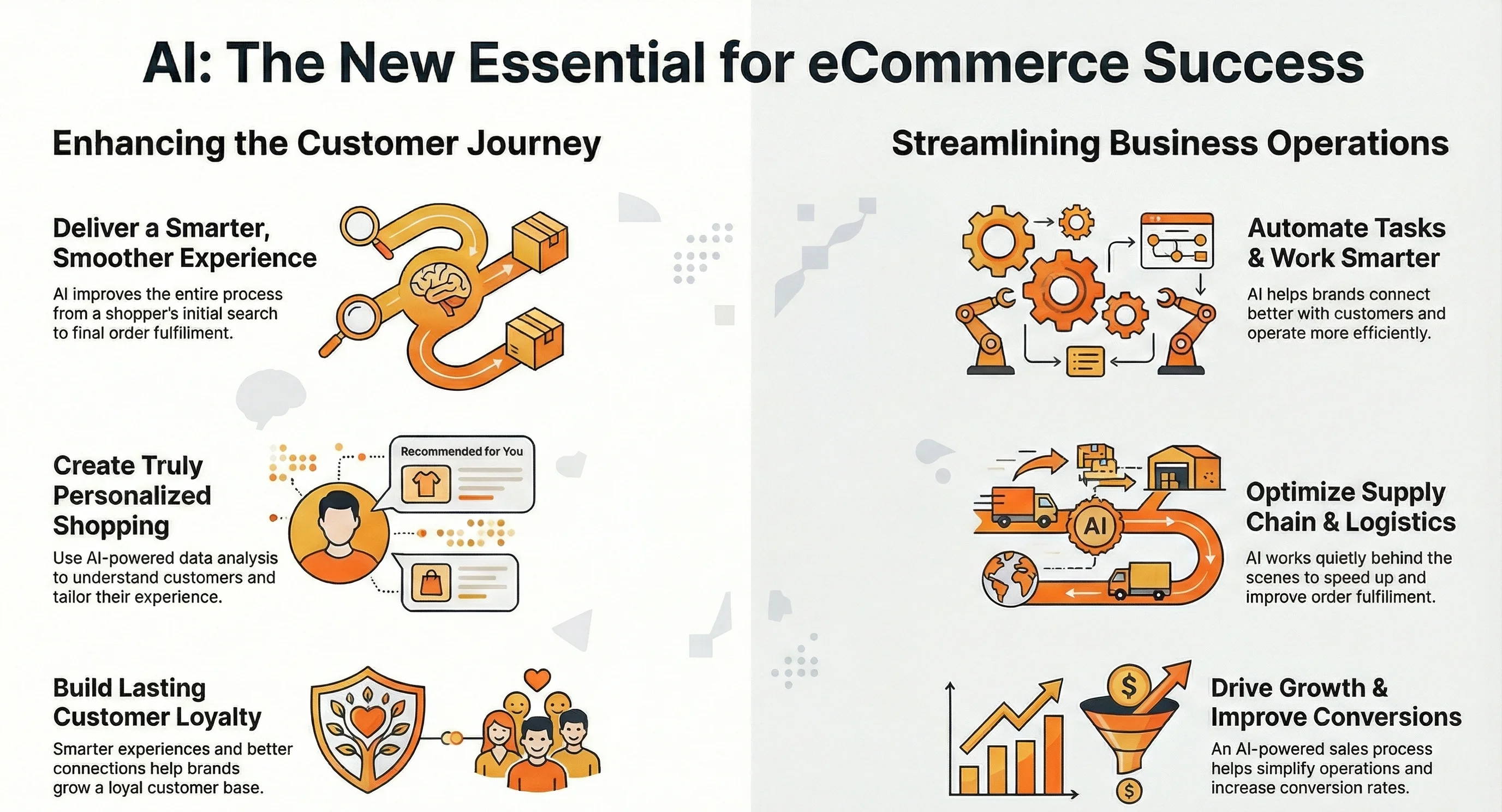
AI in eCommerce isn't just about automating tasks; it's about helping people work smarter. Whether you're part of the marketing team, running operations, or focused on sales and support.
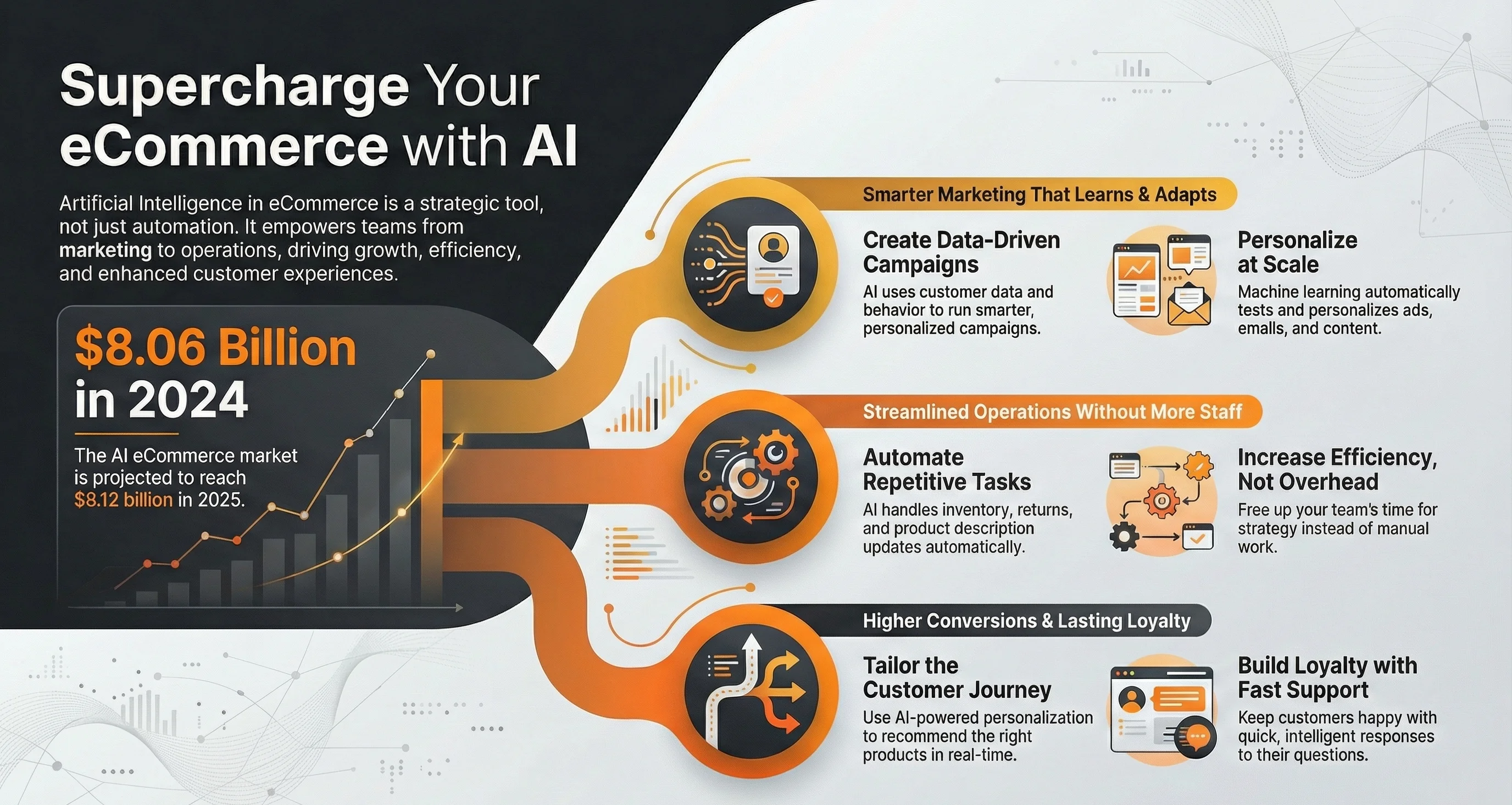
The AI-powered eCommerce market continues to expand, rising from $8.06 billion in 2024 to $9.12 billion in 2025, according to The Business Research Company.
Let’s explore how AI helps your team succeed!
1. Marketing That Learns and Adapts
Instead of sending out the same campaign to everyone, marketers can now create targeted, data-driven experiences. AI uses customer data, purchase history, and user behavior to understand what works and then adapts automatically.
- Run smarter campaigns with AI that learns from every click and conversion
- Use machine learning to test and personalize ads, emails, and content at scale
- Deliver more relevant, personalized shopping experiences across all touchpoints
2. Operations That Don’t Need More Staff
Growing your store doesn’t mean hiring a huge team. With the right AI tools, brands can automate everything from inventory management and returns to updating product descriptions.
- Eliminate repetitive tasks and free up time for strategy
- Use predictive analytics to catch issues before they affect customers
- Improve operational efficiency without increasing overhead
3. Higher Conversions and Long-Term Loyalty
Shoppers today expect speed, accuracy, and relevance, and AI helps deliver all three. Whether it's smart recommendations or fast support, AI boosts both conversion rates and customer satisfaction.
- Tailor the customer journey based on real-time customer behavior
- Recommend the right products with AI-powered personalization
- Keep customers happy with quick, intelligent responses that build customer loyalty
How to Use Artificial Intelligence in eCommerce
Adopting AI in eCommerce doesn’t mean overhauling your entire system overnight. The smartest brands start small, aligning AI tools with real goals, ensuring their customer data is in good shape, and choosing the right approach that fits their resources.
Here’s how to do it right:
AI Tools for eCommerce Growth
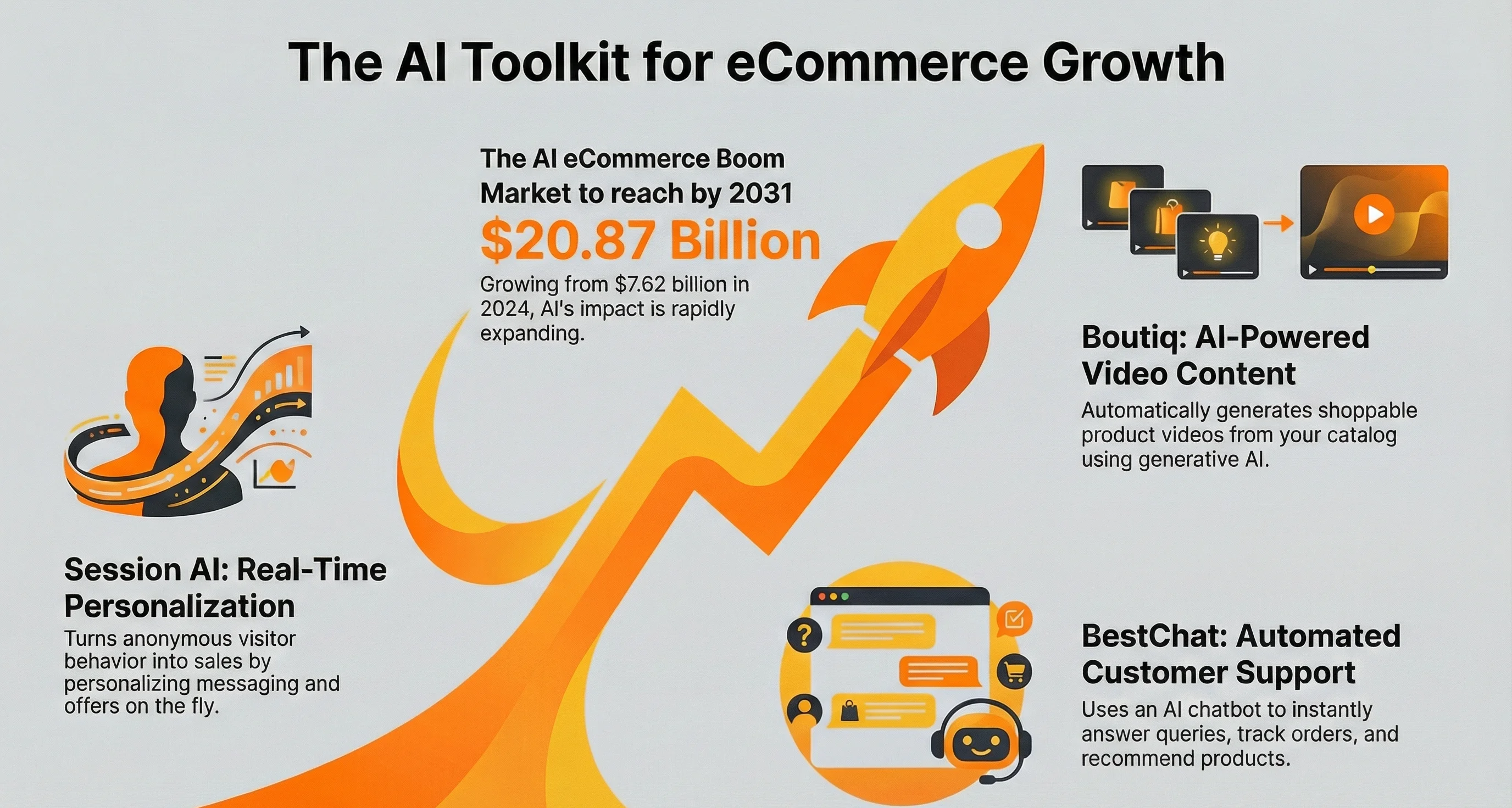
AI’s influence on eCommerce growth is undeniable, with Verified Market Research projecting the market to grow from $7.62 billion in 2024 to $20.87 billion by 2031.
Here are three powerful platforms built to help eCommerce businesses grow smarter and faster:
1. Session AI
Session AI turns anonymous visitor behavior into real-time opportunities, helping brands boost engagement before a user even logs in.
- Analyzes user behavior to personalize messaging on the fly
- Increases conversion rates by targeting users with timely offers
- Uses predictive analytics to reduce bounce rates and drive sales
- Ideal for adapting the customer journey in real time
2. Boutiq
Boutiq is a video AI tool designed for eCommerce, automatically creating personalized video content to drive sales and engagement.
- Generates shoppable product videos from your catalog using generative AI
- Personalizes video recommendations based on customer preferences and purchase history
- Enhances the online shopping experience with rich, interactive storytelling
- Great for increasing customer engagement and visual merchandising
3. BestChat
BestChat is an AI chatbot solution built for eCommerce, helping you automate support and drive conversions with human-like conversations.
- Uses natural language processing to answer customer queries instantly
- Recommends products with AI-powered logic based on customer data
- Supports routine tasks like order tracking, returns, and FAQs
- Delivers enhanced customer service that scales with demand
These tools are a great starting point for implementing AI in a way that aligns with your growth goals, whether you're focused on smarter marketing, better content, or more helpful customer interactions.
Build vs. Buy: What Makes Sense for You?
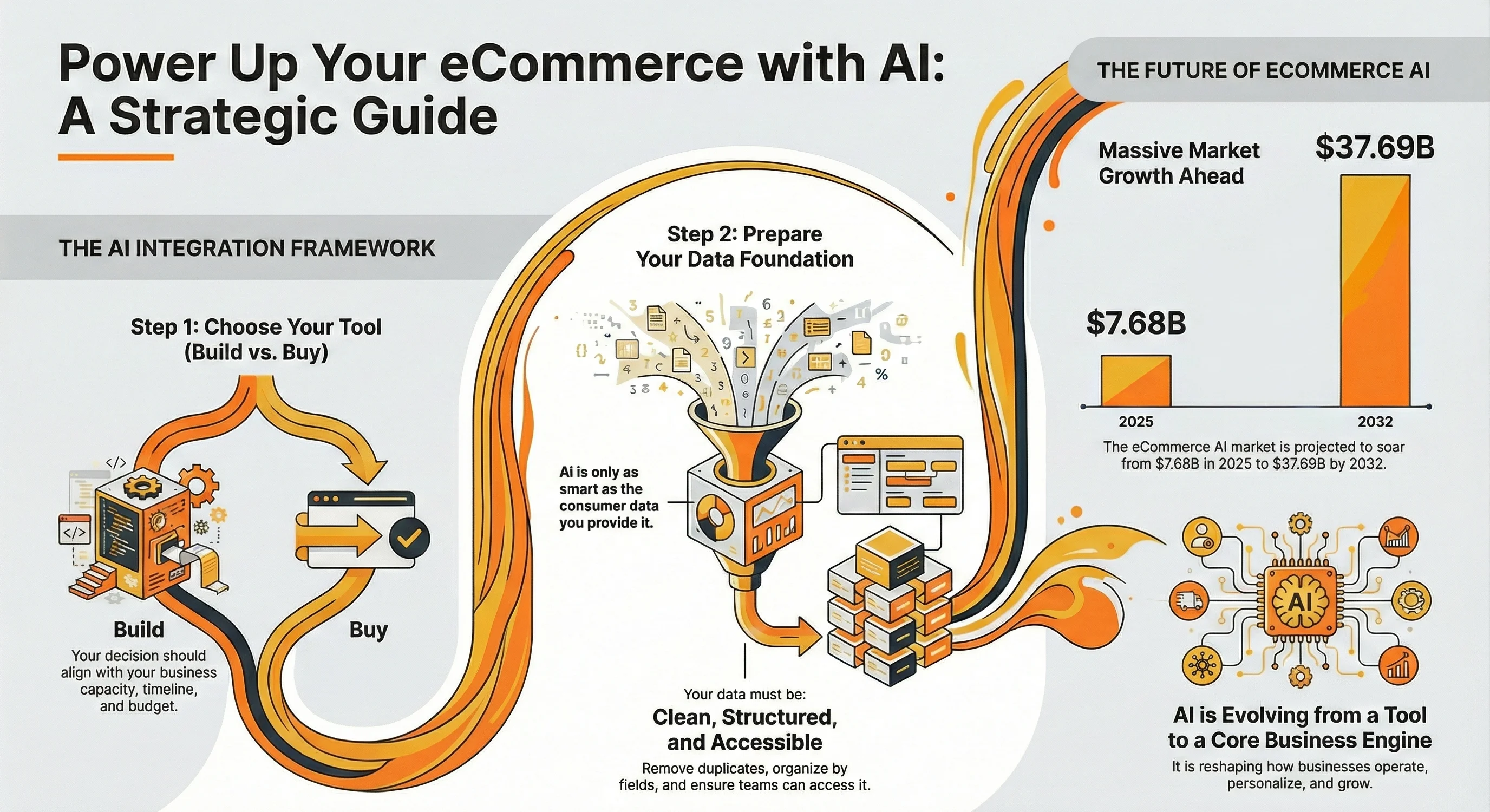
Not every eCommerce business needs a custom-built AI platform. In fact:
- Larger eCommerce retailers with in-house tech teams might benefit from building AI tailored to their unique needs.
- Accessible AI tools are driving massive growth, with Coherent Market Insights projecting the market to soar from $7.68 billion in 2025 to $37.69 billion by 2032.
Choose what aligns best with your capacity, timeline, and budget.
Data First: Make Sure You’re Ready
No matter what tool you pick, it’s only as smart as the consumer data you feed it. To get real results from AI systems, your data needs to be:
- Clean (no duplicates or outdated info)
- Structured (organized by fields like purchase history, customer preferences, etc.)
- Accessible across teams
Even small, well-maintained datasets can deliver great outcomes when paired with machine learning algorithms, so don’t wait for “perfect” data. Start with what you have, and grow from there.
What’s Next: AI Trends That Will Shape the Next 5 Years
AI isn’t slowing down, and neither are the expectations of today’s online shoppers. AI is transitioning from a tool to a core business engine, with Bloomreach 45.7 billion by 2032.
Here's a glimpse at the trends that will reshape how eCommerce businesses operate, personalize, and grow.
As AI in eCommerce becomes more powerful, it's important to approach it responsibly. From protecting customer data to ensuring fairness and maintaining a human touch, here’s how to address common challenges that come with using AI technology and AI tools.
Conclusion
At the end of our discussion, AIChief has concluded that AI in eCommerce isn’t just a competitive advantage; it’s becoming essential. From automating the small stuff to creating truly personalized shopping experiences, AI-powered tools are helping brands connect better, work smarter, and grow faster.
Whether you're running a lean startup or scaling a large eCommerce business, embracing AI can simplify operations, streamline the sales process, improve conversion rates, and build lasting customer loyalty. The future of eCommerce is smart, and now’s the time to invest in it.
More importantly, as online shopping keeps improving, success in the eCommerce sector isn’t just about having the right products; it’s about delivering a smarter, smoother experience from start to finish. With thoughtful AI integration, brands can simplify the entire process, from how shoppers enter search queries to how their orders are fulfilled using smart logistics.
Behind the scenes, AI helps with powerful data analysis, allowing you to better understand potential customers and tailor a truly personalized experience. And by helping to optimize supply chains, AI isn’t just speeding things up; it’s working quietly to enhance customer experience every step of the way.
FAQs

Arfa Farheen
Arfa Farheen is part of AIchief's global editorial team, reviewing and testing AI tools. With a background in digital marketing, she helps businesses grow their online presence using simple, no-code strategies.