AI Tutorial
Strengthen Your Thinking Patterns with ChatGPT
Learn how to use ChatGPT to shift your thinking, uncover blind spots, and generate creative solutions for problems where you feel stuck.
Share
In this guide, you’ll learn how to reshape the way you think and generate creative ideas and solutions for almost any challenge using ChatGPT.
Best Suited for:
- Founders and startup builders who feel blocked by repeat problems
- Creators and knowledge workers looking for new angles
- Product managers are searching for better ways to improve churn or engagement
- Anyone who wants to adjust their thinking habits and unlock breakthrough ideas
Step 1: Start by opening ChatGPT
To begin, go to ChatGPT and turn on GPT-5. Keep it in Auto mode for now, so ChatGPT can decide whether your problem needs a quick response or deeper reasoning. You can try Thinking Mode later if you want GPT-5 to reason more deeply, but Auto is a strong starting point.
The important part is using a focused prompt that helps shift your thought patterns. Rather than repeating the same familiar solutions, GPT-5 will ask targeted questions that reveal gaps in your thinking.
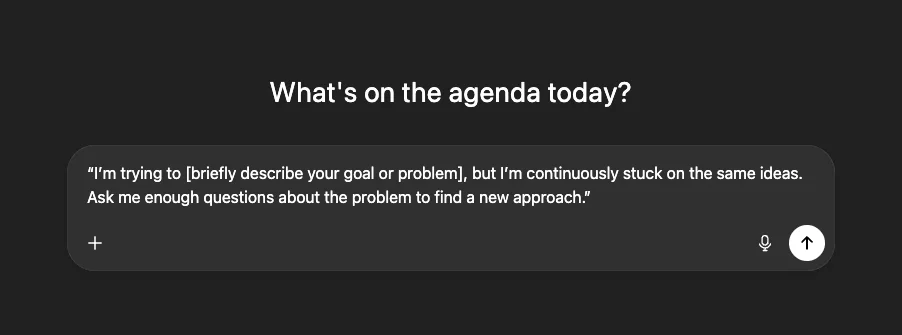
Step 2: Paste the prompt and explain your challenge
Use this prompt:
“I’m trying to [briefly describe your goal or problem], but I keep getting stuck on the same ideas. Ask me enough questions about the problem to help me find a new approach.”
Replace the brackets with your own problem and dictate it into ChatGPT. I used Wispr Flow for voice input, though Super Whisper also works, and it made the process easier.
For example, I used this hypothetical:
“I’m trying to find a way to reduce churn for a calorie-tracking AI app.”
That’s all you need as a starting point. From there, let GPT-5 guide the process. You can also add more context upfront by explaining how you currently approach the problem. This helps narrow the questions GPT-5 asks in the next step.
Step 3: Share your existing approach
This is where the process becomes more useful. Before GPT-5 asks questions, tell it what you’re already trying so it understands your current focus. In my case, I added:
- User interviews: Speak with as many users as possible to understand why they churn, then address those reasons through new features or education.
- Cancellation surveys: Show a survey when someone cancels, paired with a discount incentive to collect feedback.
After I shared that context, GPT-5 understood what I was already doing and could push me toward less obvious ideas.
Step 4: Let GPT-5 guide you toward new angles
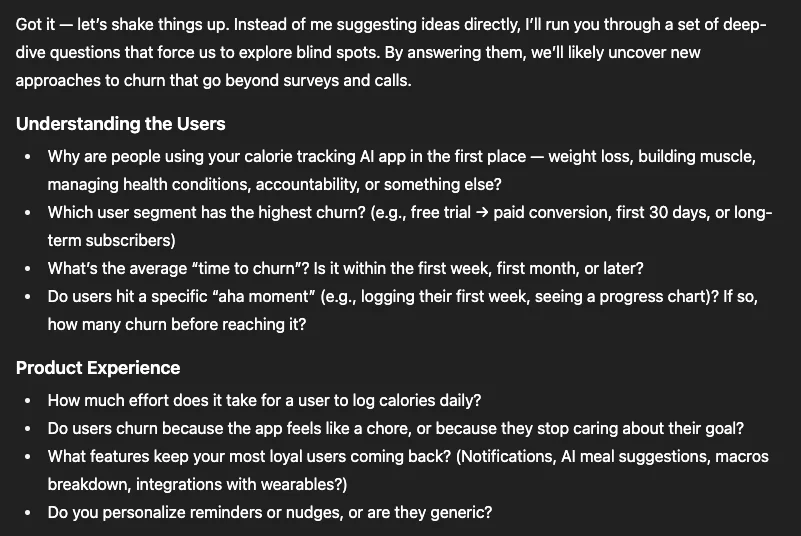
After I submitted the prompt, GPT-5 returned structured areas I hadn’t fully explored, including user understanding, product experience, engagement, education, aha moments, offers, and analytics.
It asked more precise questions, such as:
- Why are people really using the app? Health goals, streaks, motivation, or something else?
- Which segment churns the most? For example, free-trial users who never convert to paid.
- What is the aha moment? Maybe logging a first meal or having a workout is created automatically.
- Which engagement levers are still untested? Day-one challenges, guided onboarding, pause options, or community features.
That questioning exposed churn issues I had not previously considered.
Step 5: Evaluate new ideas and continue refining
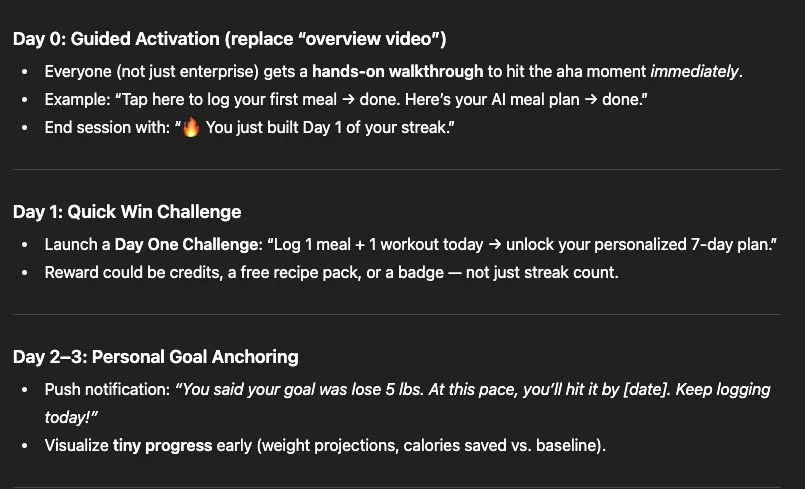
By answering GPT-5’s questions, I uncovered a full week’s worth of churn-reduction ideas that were not part of my original plan. These included:
- Strengthening personal goal anchoring
- Testing a first-day challenge to encourage habit formation
- Adding community features beyond basic social sharing
- Trying subscription pauses instead of immediate cancellations
- Bundling additional value instead of relying only on exit discounts
These ideas were not obvious at first, but they emerged because GPT-5 pushed me to examine the problem from new directions.
Pro Tip
Use this workflow for any challenge, not only churn. The value comes from how GPT-5 keeps questioning you until you uncover fresh thinking paths. It is especially useful for stronger brainstorming.

Editorial Staff
The Editorial Staff at AIChief is a team of Professional Content writers with extensive experience in the field of AI and Marketing. AIChief was Founded in 2025, AIChief has quickly grown to become the largest free AI resource hub in the industry. Stay connected with them on Facebook, Instagram and X for the latest updates.