AI Showcase
How AI Can Help With Your Text | Clever AI Humanizer Review
Discover how Clever AI Humanizer rewrites AI-generated text at the sentence level to create more natural writing. Read our hands-on review, features, benchmark results, and why it's one of the best free AI humanizers in 2026.
Share
AI drafts read fast but sound the same, and a trained reader spots the pattern in seconds. Writers, students, and content teams need a way to keep AI's speed without losing their own voice.
This guide breaks down why machine prose gets flagged, and shows what a genuine free AI humanizer changes at the sentence level.
Where AI Writing Breaks Down and What This Guide Covers
Most AI drafts fail the same test: a detector, a professor, or a careful reader notices predictable rhythm before the ideas even register. The pattern shows up hardest in formal writing, since academic and professional registers already favor that same evenness, the exact trait a detector treats as a red flag. A synonym swap alone does not fix that pattern, so this guide tests the claim against one free AI humanizer built specifically around sentence-level rewriting: Clever AI Humanizer, which restructures a sentence instead of swapping its words and publishes exact test figures instead of a vague promise.
This guide walks through that fix in practical order:
- Why detectors disagree on the same passage
- A recommended order to humanize AI text without wasted steps
- What actually changes at the sentence level during a rewrite
- How the results hold up against other approaches
- Who benefits most from this workflow
The mechanism behind that first point comes next.
What Actually Changes When a Sentence Gets Rewritten
A rewrite that only swaps words for synonyms rarely fools a detector, since the sentence keeps its original rhythm and structure. The real way to make AI writing undetectable works one level deeper: it adjusts entropy and burstiness, the two traits most detectors track. Some sentences shrink, others expand, punctuation shifts, and the whole paragraph starts to read less AI instead of following one predictable shape. That structural shift, not word substitution, is what breaks the pattern a detector looks for, and it explains why AI-generated writing sounds more human once the rewrite reaches the sentence level.
Clever AI Humanizer builds its process around that exact mechanism. It runs entirely on its own model now, without a third-party API in the loop, and the shift from AI to human text happens end to end on one system instead of nudging individual words inside a sentence.
That mechanism only matters if it fits into a real routine, which is where the tool's ecosystem comes in.
One Free Account, Three Ways to Finish the Job
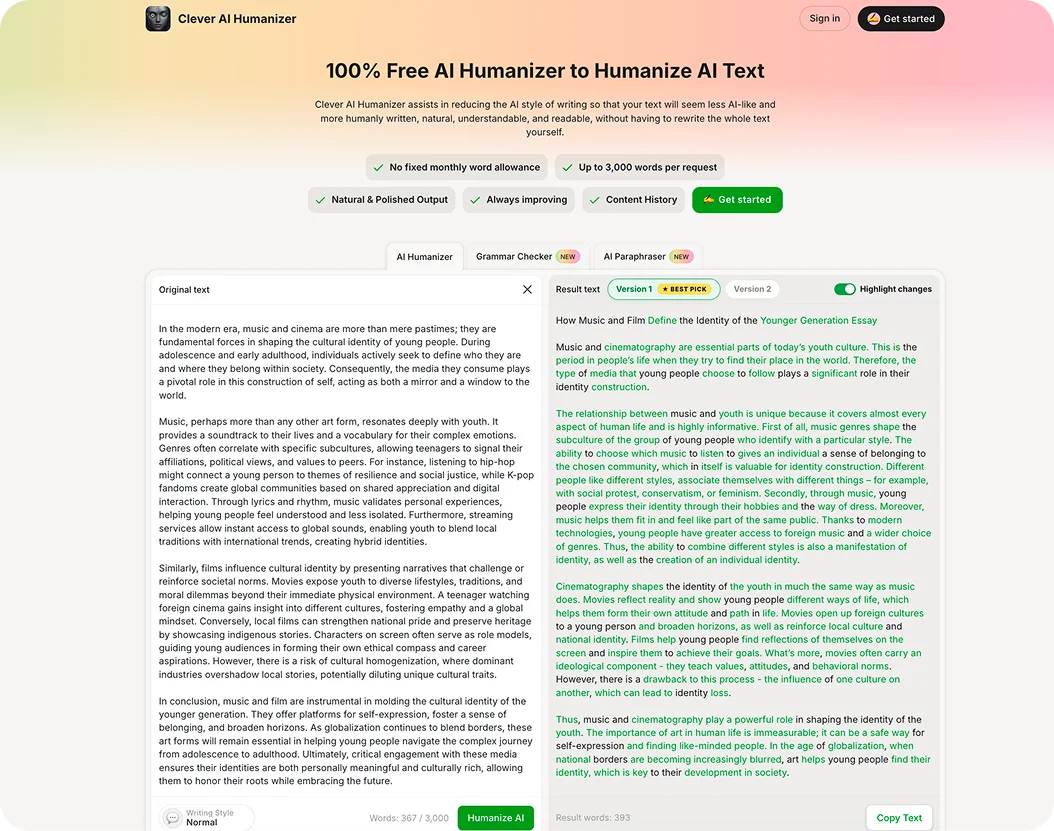
A free humanizer earns trust only when speed does not cost quality, and this one clears that bar in two or three clicks: paste the draft, keep the default Normal style, and press “Humanize AI.” That simplicity works as a feature, not a shortcut, and it keeps output steady without extra configuration. A content history panel saves past runs, so nothing gets lost between edits.
The bigger advantage shows up once the rewrite is done. The same free account also includes an easy-to-use grammar checker and a separate paraphrasing tool, so a single stubborn sentence or a leftover typo never needs a different service. Say the humanizer clears every paragraph except one line that still reads stiff: instead of running the whole draft through the process again, the paraphraser fixes that one sentence on its own.
We see this as the real edge over a narrow, single-purpose competitor, and over a generic AI text generator that only drafts new content instead of rewriting text a person already wrote. Most tools in this category meter each function separately and cap a free pass at 250 to 400 words. Here, the humanizer, the checker, and the paraphraser share one free account with no signup required, unlimited words each month, and up to 3,000 words per single run, which is what makes it work as a genuine free AI text humanizer rather than a limited trial of a paid product.
That combination is worth little if it doesn't reach the right audience, so the next section maps out who benefits most.
Who Gets the Most Out of This Approach
Students carry the clearest case. Academic writing already leans on the formal, structured register that trips up a detector in the first place, so a rewrite built around that exact register solves a problem generic tools miss. We recommend it just as strongly for content teams and researchers polishing an AI-assisted first draft, since the same sentence-level rewrite works on marketing copy, reports, and blog drafts without flattening the tone a brand or a publication expects.
Freelancers and small teams get a practical bonus on top of the fit: a free workflow removes the budget question entirely. Where a paid competitor charges by the word or locks the best results behind a subscription, this one asks nothing upfront, so a real test on an actual draft costs nothing but a few minutes.
A Real Test for the Idea
Theory is easy to write. Numbers are harder to fake. A July 2026 benchmark from Benchmark Lab put that to the test, running 12 humanizers through the same fixed set of 20 AI-generated texts, scored by three detector APIs (GPTZero, ZeroGPT, and Originality.ai) and three large language model judges (Claude Opus 4.8, Gemini 3.1 Pro, and GPT-5.5). Clever AI Humanizer took the top spot with a 76.2% bench score and the lowest GPTZero average of the test (9.6% AI), while adding only 16% more words to the average draft, far below a rival that inflated a 1,000-word piece into nearly 1,800 words.
That gap matters for the whole idea behind this guide: a rewrite that touches structure instead of padding length or swapping words keeps the draft readable while it drops detection scores. The same benchmark scored the tool's quality panel at 74.2%, in the top four for quality among all 12 tools tested. If one sentence still needs a lighter touch after that pass, a free paraphrase tool handles it without a second full rewrite.
The same numbers also answer the questions readers ask most, covered next.
Conclusion
Before you close this guide, here's the real takeaway: a structural rewrite outperformed every shortcut in this benchmark, whether that shortcut padded a draft with extra words or broke its grammar for a lower score. Keep three habits in mind next time a draft reads too machine-made:
- Humanize the structure first, then check grammar, not the reverse
- Save the paraphraser for one stubborn sentence, not a full rewrite
- Revisit the research on why AI writing gets flagged before trusting one score alone
Detector percentages will look different next year, since every tool on this list keeps changing. What stays constant is the test worth applying to any of them: does the rewrite keep your structure and your meaning, or does it just chase a number.
FAQs

Editorial Staff
The Editorial Staff at AIChief is a team of Professional Content writers with extensive experience in the field of AI and Marketing. AIChief was Founded in 2025, AIChief has quickly grown to become the largest free AI resource hub in the industry. Stay connected with them on Facebook, Instagram and X for the latest updates.