AI Showcase
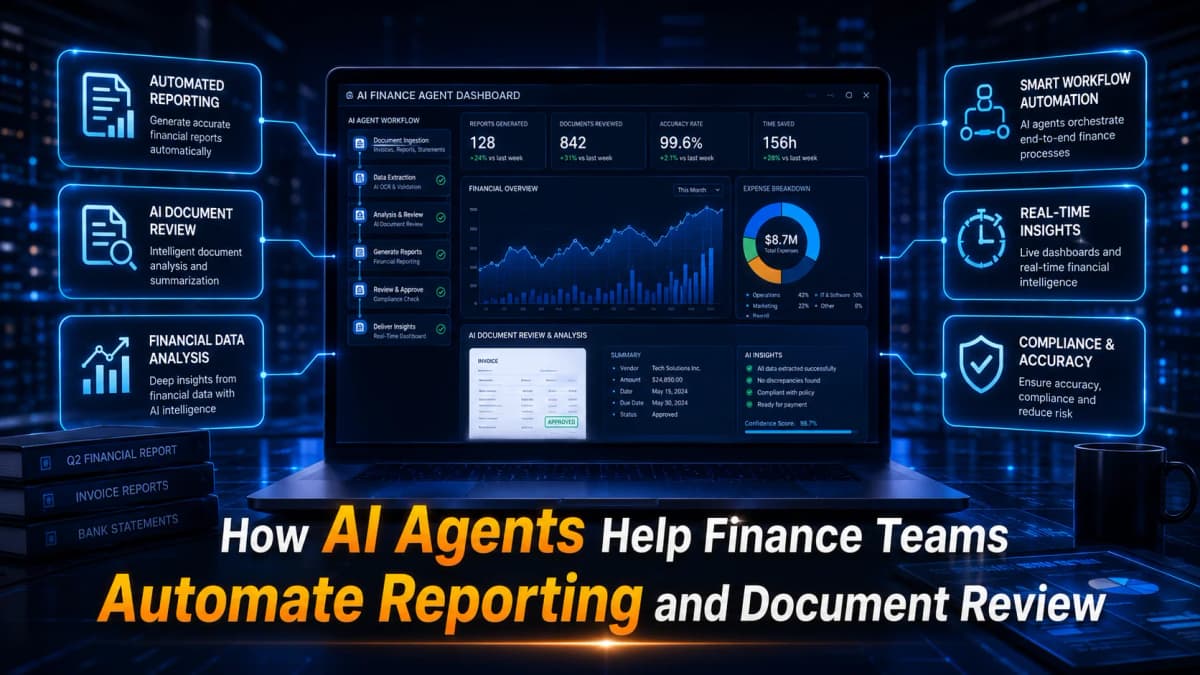
How AI Agents Help Finance Teams Automate Reporting and Document Review
Learn how AI agents help finance teams automate reporting, document review, reconciliations, variance analysis, compliance workflows, and approvals in 2026.
Share
Finance teams spend 72 business days per year on reconciliations and reporting, while CFOs can still wait 10 to 15 days after period-end for visibility. AI agents can compress both timelines by automating repetitive workflows across connected systems.
Finance runs on documents: invoices, contracts, bank statements, GL entries, audit trails, and board decks. Rule-based automation breaks when inputs change, while chatbots answer questions without taking action. AI agents perceive context, plan multi-step actions, and execute workflows.
According to Zip, 60% of finance teams are piloting AI, but only 7% of CFOs report strong impact. This article focuses on closing that pilot-to-production gap and what Azumo's AI agent development for fintech is designed to deliver.
What Is an AI Agent for Finance, and Why It Matters Now
An AI agent for finance is an autonomous software system that executes multi-step financial workflows across connected systems. It pulls data from the GL and subledgers, matches transactions, generates variance commentary, and flags exceptions for human review.
Three distinctions matter:
- RPA is deterministic and brittle, breaking when inputs change.
- Chatbots answer questions but do not execute financial workflows.
- AI agents perceive context, plan, and execute actions across systems.
LLM reasoning, RAG grounding, and orchestration frameworks such as LangGraph, CrewAI, and AutoGen are making production agent architectures more viable. Unlike RPA, agents can handle variable inputs rather than simply replaying scripts.
How Do AI Agents Automate Finance Reporting?
Leading teams are moving toward continuous close, where agents run reconciliation daily instead of waiting for period-end. Problems are detected and resolved in real time, turning the close into a confirmation process.
Six reporting workflows agents can automate:
- Reconciliation: Pulls GL and subledger data, matches transactions, and flags unmatched items.
- Journal Entry Generation: Generates recurring entries for depreciation, accruals, FX adjustments, prepaid amortization, intercompany charges, and similar patterns.
- Flux and Variance Analysis with Narrative: Compares balances, drafts variance commentary, and flags unusual activity.
- Cash Flow Forecasting: Updates cash forecasts using historical patterns, market signals, and open commitments.
- Board Deck and Management Report Assembly: Produces P&L, balance sheet, cash flow, and variance deliverables from close data.
- Regulatory and Filing Calendar Monitoring: Tracks deadlines and regulatory updates.
AI-driven close automation can cut cycle time 40 to 50% and reduce reconciliation errors significantly. Agents can also scan transactions in real time to flag duplicate invoices, split payments, and unusual vendor patterns.
How Do AI Agents Automate Financial Document Review?
Document review covers contracts, invoices, expense reports, audit files, and regulatory filings.
Contract agents extract payment terms, obligations, renewal dates, clauses, and financial exposure, feeding information into workflows such as accrual accounting, ASC 606 revenue recognition, and ASC 842 lease accounting.
Invoice agents extract line items, amounts, vendor data, and payment terms from PDFs, email attachments, and other formats. Expense validation can categorize expenses and check them against company policies.
For compliance, agents compile documentation and audit trails into structured evidence packages. They can also monitor vendor payment schedules and summarize audit reports, contracts, and lease agreements.
OCR extracts characters and IDP extracts fields, but neither necessarily reasons across context or takes downstream action. An agent can extract contract data, match it to vendor records, generate an accrual entry, and route exceptions to a controller.
What AI Solutions for Enterprise Finance Teams Actually Ship
Production-ready finance agents generally fall into three groups:
Document processing agents:
- Invoice Processing
- Contract Term Extractor
- Expense Categorization
- Audit Trail Generator
Analytics and forecasting agents:
- Cash Flow Forecaster
- Anomaly Detection
- Budget Variance Analyzer
Process automation agents:
- Reconciliation Automation
- Financial Report Generator
- Vendor Payment Tracker
A multi-agent architecture can reduce integration overhead through shared models and a common governance layer.
How to Evaluate Whether an AI Agent Vendor Can Ship
The challenge is not building an agent; it is operating one reliably in production. Evaluate vendors on six areas:
- Production operation and measurable telemetry.
- SOC 2 or equivalent third-party security validation.
- MLOps maturity, including prompt versioning, evaluation, guardrails, routing, and monitoring.
- Verified third-party client reviews.
- Named enterprise clients with measurable outcomes.
- Delivery model and time-zone overlap.
The right vendor depends on scope: global systems integrators suit large transformations, while focused agents build suit defined finance KPIs and timelines.
What Compliance and Security Requirements Apply to AI Agents for Finance
Finance agents operate under strict reporting, privacy, and security requirements.
SOX requires audit trails, segregation of duties, and human sign-off for material judgments. SOC 2 provides third-party validation of security, availability, and confidentiality. GDPR and CCPA require appropriate handling of financial and personal data, including encryption and privacy controls.
Hallucination is another concern. Agents should begin with structured, auditable use cases such as reconciliation, invoice extraction, and contract clause extraction rather than judgment-heavy reporting. RAG can ground outputs in verified sources such as accounting policies, chart of accounts, and historical audit reports.
Every output should be traceable to source data. The practical pattern is simple: agents propose, controllers approve, and every output remains auditable.
Where Azumo's AI Agent Development for Fintech Fits
Azumo has built production AI systems for fintech clients since 2016, holds SOC 2 certification, and has delivered hundreds of production deployments. Its fintech software development services practice uses frameworks including LangGraph, CrewAI, and Microsoft AutoGen with foundation models from major providers.
Its finance-focused catalog includes ten agent types covering document processing, forecasting, anomaly detection, reconciliation, reporting, and vendor payments.
Case studies demonstrate the broader production approach. Stovell AI's Financial AI Suite has supported predictive analytics and systematic trading workflows for more than eight years. Angle Health reduced an RFP workflow from about 45 minutes to 5 minutes through document ingestion, LLM extraction, classification, normalization, and human verification.
Azumo also operates its own AI Receptionist in production, providing measurable telemetry around response time and uptime.
For teams evaluating AI agents for finance in 2026, the question is no longer whether the technology works. It is which vendor can integrate it into the ERP, respect the control framework, and keep it running in production.
FAQs

Editorial Staff
The Editorial Staff at AIChief is a team of Professional Content writers with extensive experience in the field of AI and Marketing. AIChief was Founded in 2025, AIChief has quickly grown to become the largest free AI resource hub in the industry. Stay connected with them on Facebook, Instagram and X for the latest updates.