AI Showcase
AI Overviews and B2B Search: Why GEO Matters Now
Here’s why a competitor is cited in 30% of searches and building a shortlist position you don't have yet, even when you are ranking on page 1 of Google.
Share
AI Overviews and chat-based search have changed B2B discovery. Buyers now receive a synthesised answer before they reach a traditional list of search results. Generative engine optimisation (GEO), helps brands make their expertise understandable, verifiable and suitable for citation across these experiences. SEO remains the foundation that makes meaningful visibility possible.
TL;DR
- Search visibility now has two layers: a brand appears within a generated answer as well as among conventional organic results.
- SEO remains essential: generative search systems depend on accessible, indexed and useful web content GEO builds on that foundation.
- GEO strengthens source inclusion: by connecting technical accessibility, expert content, consistent brand information and credible external evidence.
- Measurement extends beyond rankings: citations, brand mentions, appearing pages, AI referrals and commercial outcomes all count now.
SEO Without GEO Versus an Integrated Approach
| Criterion | SEO without a GEO programme | SEO with GEO integration |
|---|---|---|
| Primary objective | Rank individual pages for relevant queries | Rank pages while improving inclusion in generated answers |
| Main visibility surface | Conventional organic search results | Organic results, AI Overviews and cited chat responses |
| Content emphasis | Search relevance, quality and conversion | Search relevance, extractable answers and verifiable evidence |
| Brand treatment | Individual URLs are optimised | Content, experts, entities and external mentions are coordinated |
| Measurement | Rankings, clicks and conversions | Rankings, citations, mentions, referrals and conversions |
| Best suited to | Capturing established search demand | Competing across ranked and answer-led discovery |
| Honest exception | SEO-only remains sufficient | Navigational searches and simple transactional queries rarely trigger AI Overviews. Brands targeting these query types gain little from a GEO programme until complex informational queries become a priority. |
The Search Result Is No Longer Just a List
B2B search strategy centred on a familiar objective: publish the best page, earn a strong organic position and persuade the searcher to click. That matters but it no longer describes every search experience a potential buyer encounters.
A results page now contains an AI-generated explanation, links to supporting sources, suggested follow-up questions and conventional organic listings. Chat-based tools answer complex commercial questions directly, drawing information from several websites and displaying citations within a conversational response.
Ofcom Online Notion Report shows that about 30% of searches now show AI Overviews and 53% of adults say they frequently encounter AI-generated summaries.
The traditional search page has not disappeared, but it is no longer the only place where a B2B brand gains or loses visibility.
How Have AI Overviews Changed B2B Search?
AI Overviews change B2B search by placing a generated explanation and its supporting sources directly within the search experience. This shapes which companies, approaches and market definitions a buyer notices before they assess the individual pages listed further down the results.
The effect is most significant when the search involves a complex question rather than a straightforward navigational request. A buyer researching software options, comparing service models or trying to understand a technical problem receives a consolidated response that combines information from several sources.
The shift is also becoming more visible, Google AI search adoption cites Similarweb data showing AI Overviews appearing across a growing share of Google searches, reinforcing why brands now need to consider both traditional rankings and visibility within generated answers.
Google explains that AI Overviews and AI Mode use a process called query fan-out, through which the system issues several related searches across relevant subtopics and data sources. Its models then identify supporting pages and present a broader collection of links alongside the generated response.
ChatGPT Search follows a comparable answer-led pattern, giving users timely responses with links to relevant web sources. Search-enabled responses display inline citations that allow readers to inspect the underlying material.
What Is the Difference Between Ranking and Being Cited?
Ranking determines where a page appears within a set of search results. Citation determines whether information from a source contributes to a generated answer. These outcomes can overlap, but they are not identical: an answer engine retrieves several related sources and combines their information into one response
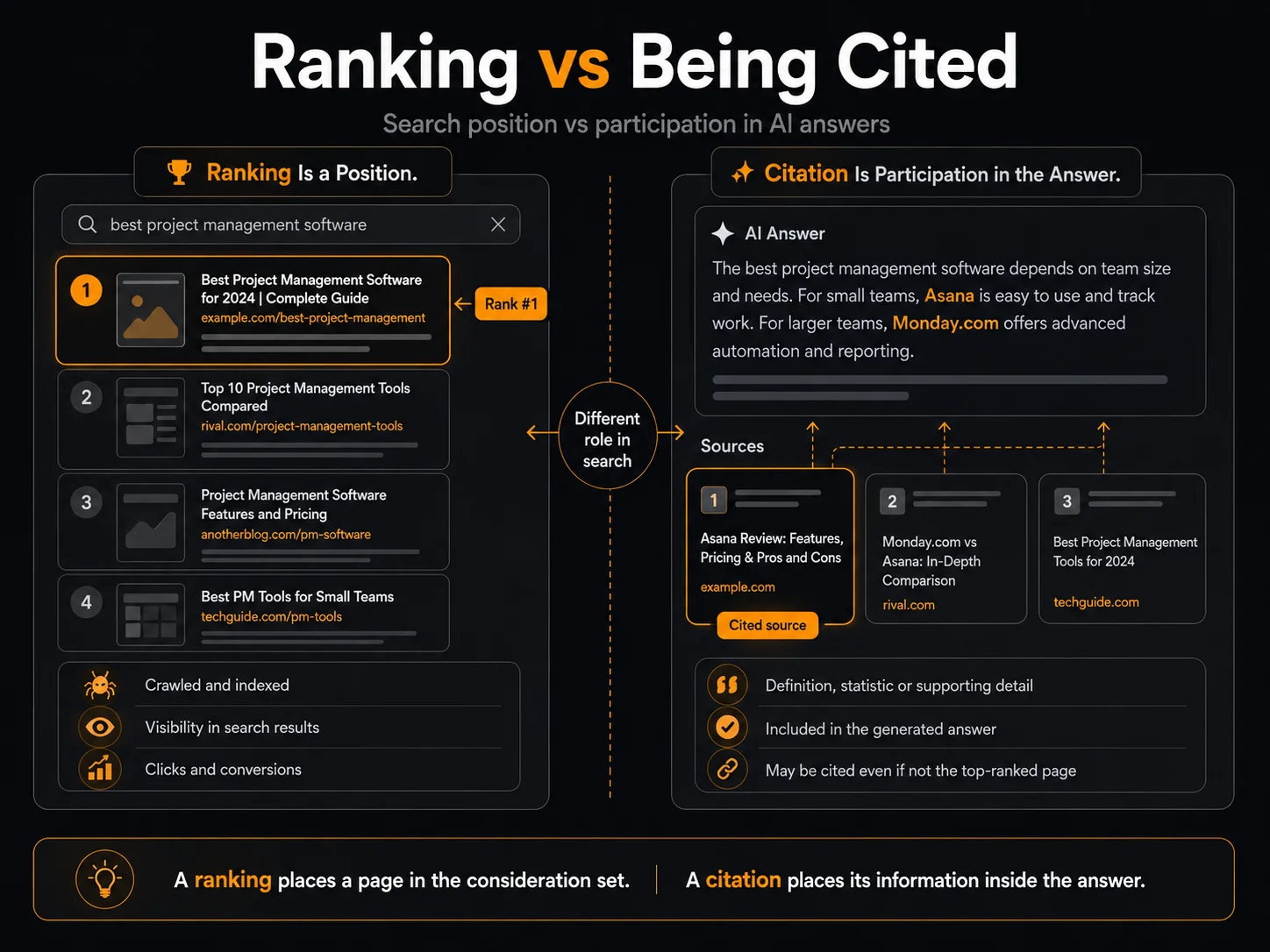
Ranking Is a Position
Traditional SEO focuses on whether a page is crawled and indexed, how closely it satisfies the query and whether it deserves a prominent position compared with competing pages. Marketers measure impressions, rankings, click-through rates, enquiries and conversions to understand commercial performance.
A strong ranking creates valuable visibility, particularly when buyers want to inspect a provider's credentials, compare detailed information or complete a high-intent action. It also improves the likelihood that a page is available to systems that rely on search indexes and established quality signals.
Citation Is Participation in the Answer
Citation introduces a different question: does the page contain information that an answer system uses confidently to explain the topic?
A source is cited because it provides a definition, statistic, comparison or supporting detail, even when the company behind it is not presented as the preferred supplier. A brand ranks well for one query while remaining absent from the generated answers associated with broader comparisons or follow-up questions.
Does GEO Replace Traditional SEO?
GEO does not replace SEO, generative search still relies on accessible, indexed and useful web content. Google's developer guidance is explicit: "There are no additional requirements to appear in AI Overviews or AI Mode, nor other special optimizations necessary. You don't need to create new machine readable files, AI text files, or markup to appear in these features."
This distinction matters because some GEO commentary presents AI search as a completely separate channel requiring an entirely new technical playbook. In practice, poor crawlability, weak internal linking, thin content and unclear page purpose limit visibility, regardless of whether the desired outcome is an organic ranking or inclusion in a generated answer.
The case for GEO is not that SEO has stopped working. Marketers now manage an additional layer of discovery in which evidence is extracted, compared and cited before a buyer visits the company's website.
What Does a GEO Partner Actually Build?
A credible GEO partner builds the conditions that help search and answer systems discover, interpret and verify a brand. The work connects technical search readiness, evidence-led content, consistent entity information, credible third-party corroboration and meaningful performance measurement.
A GEO agency builds the operating system that helps a B2B brand become eligible, understandable and worth citing across answer-led search.
Technical Discoverability
The technical foundation includes crawlability, indexation, internal linking, rendering and the accessibility of important information in page text. Structured data clarifies page content when it accurately reflects what readers see, though it should support the page rather than present a separate version of the information.
This work is not fundamentally different from good technical SEO. The consequences of ambiguity become more visible when a system is extracting a concise answer from several competing sources.
Citation-Ready Content
Citation-ready content gives search systems something specific and defensible to use. Clear definitions, direct answers, transparent comparisons and identifiable evidence outperform broad claims that appear on every competitor's website.
Original research, expert observations, detailed case evidence and clearly explained frameworks create information that a generic summary cannot reproduce. Google's guidance encourages unique, expert-led and people-first content that adds value beyond common knowledge.
Consistent Brand Information
A company's services, expertise and positioning should remain consistent across its website, author profiles, business listings and credible third-party coverage. Conflicting descriptions make it harder for buyers and automated systems to determine what the organisation does.
External corroboration must be earned rather than manufactured. Relevant editorial mentions, attributable expertise, detailed reviews and evidence-backed case studies create a stronger information environment than repeated promotional claims.
Meaningful Measurement
GEO performance is assessed through citations, brand mentions, appearing pages, AI referrals, branded demand and conversions connected to commercially relevant questions. Raw mention counts provide little insight when the brand appears only in low-value conversations.
Measurement tools are also moving beyond conventional rank tracking. LLMrefs for AI search visibility tracking highlights capabilities such as share-of-voice monitoring, citation-source analysis and competitor benchmarking across ChatGPT, Google AI Overviews, Perplexity and other AI engines. These metrics help marketers see whether visibility is improving across the prompt sets that matter to buyers.
Measurement is becoming more practical as platforms expose additional visibility data. Google introduced dedicated Search Console reporting for generative AI features in June 2026, covering impressions and the pages, countries, devices and dates associated with that visibility.
What Should B2B Marketers Do Now?
B2B marketers should begin with the questions buyers ask when defining a problem, comparing approaches and shortlisting providers. They then examine which sources appear in generated answers and improve the information required to compete within those responses.
- Map commercially important questions across problem awareness, category education, comparison and provider selection.
- Record the sources and content formats that answer engines currently use. Focus on the evidence those pages contribute, not just their structure.
- Strengthen existing pages through clearer answers, better technical access, more precise claims and stronger supporting evidence.
- Create new content where the company adds information the current search landscape does not already provide: first-party data, specialist analysis or a useful decision framework.
For teams deciding whether to build this capability internally or use external support, reviewing Australian AEO agencies compared by technical capability, content approach and measurement model provides a practical way to assess which type of partner fits the programme.
A citation becomes commercially valuable when it increases recognition, relevant visits, branded searches, enquiries or progression through a buying process.
GEO Matters Because the Buying Interface Has Changed
GEO is not a reason to abandon SEO, nor does it justify chasing every new platform feature. It is a reason to expand the definition of search visibility beyond the position of an individual page.
B2B brands need useful websites that rank, attract qualified visitors and convert demand. They also need their evidence available when an AI system explains the market, compares competing approaches or identifies credible providers. The priority is to build a brand that is found, understood and verified wherever buyers ask commercially important questions.
FAQs

Editorial Staff
The Editorial Staff at AIChief is a team of Professional Content writers with extensive experience in the field of AI and Marketing. AIChief was Founded in 2025, AIChief has quickly grown to become the largest free AI resource hub in the industry. Stay connected with them on Facebook, Instagram and X for the latest updates.