AI Guide
GPT-6 Astra Review: Is OpenAI’s New Model Actually That Good?
Read our GPT-6 Astra review to see how OpenAI’s new model performs, where it shines, its limitations, pricing, and whether it’s worth using.
Share
GPT-6 Astra is OpenAI's newest frontier model, built for complex reasoning, coding, research, and computer-based tasks. But the real question isn't whether it is more capable than OpenAI's previous models.
Is it actually good enough to choose over the other top AI models available right now?
That's a much more interesting question.
After looking at Astra's published results, capabilities, pricing, and early concerns, our answer is yes — but with some important caveats.
Astra is particularly impressive when it has to work through a complicated task rather than simply answer a prompt. Its computer-use abilities are probably its biggest advantage, while its cost and the questions around monitoring its behavior are the main reasons we wouldn't call it perfect.
TL;DR
GPT-6 Astra is one of the strongest AI models available right now, especially for coding, research, computer use, and multi-step tasks. It isn't the clear winner at everything, though.
Our verdict: 4.7/5 — excellent for serious AI work, but not necessary for simple everyday prompts.
Our GPT-6 Astra Review
The first thing that stands out about Astra is that OpenAI isn't really selling it as just another chatbot.
The interesting part is what happens when you give it something complicated.
Instead of simply generating an answer, Astra can browse, interact with websites and software, work through multiple steps, and use tools to move a task toward completion.
For example, a task like "Research these five competitors, compare their pricing, put the findings into a spreadsheet, and summarize the biggest differences" is much closer to the type of workflow Astra is designed to handle.
That's what makes the model feel considerably more useful for actual work.
OpenAI reports GPT 6 Astra benchmarks of 72.6% score on OSWorld 2.0, which measures computer-use performance. It also reports 57.9% on Terminal-Bench 4.0 for coding tasks and 91.5% on BrowseComp for research and browsing.
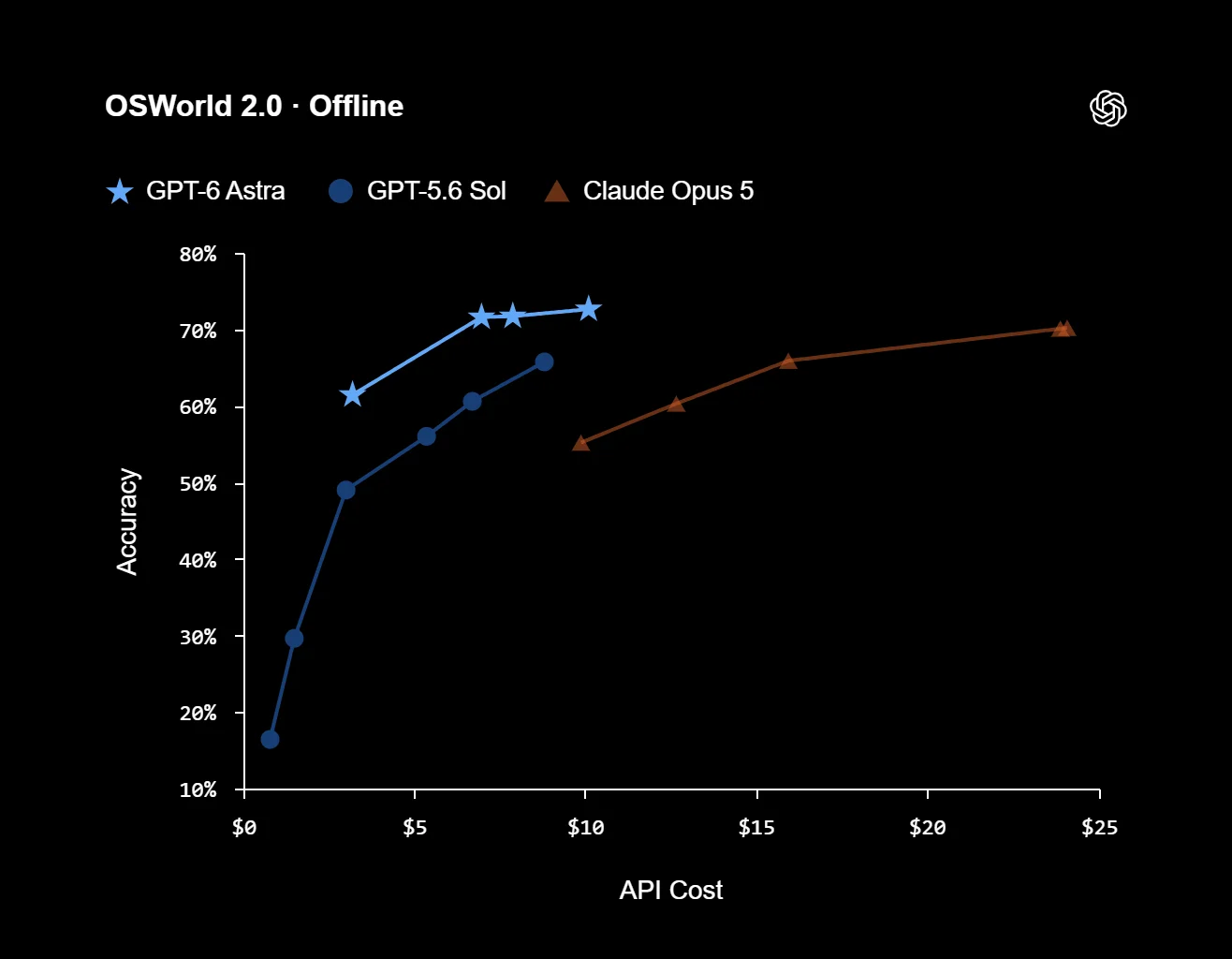
Those numbers are impressive, but benchmarks aren't the reason Astra stands out.
Its ability to act is.
What We Like About GPT-6 Astra
Computer Use Is the Real Upgrade
If there is one feature that makes Astra feel different, this is it.
Astra can interact with computers and websites instead of stopping at instructions. OpenAI highlights tasks such as filling forms, updating CRM records, managing calendars, researching online, testing websites, and working inside professional software.
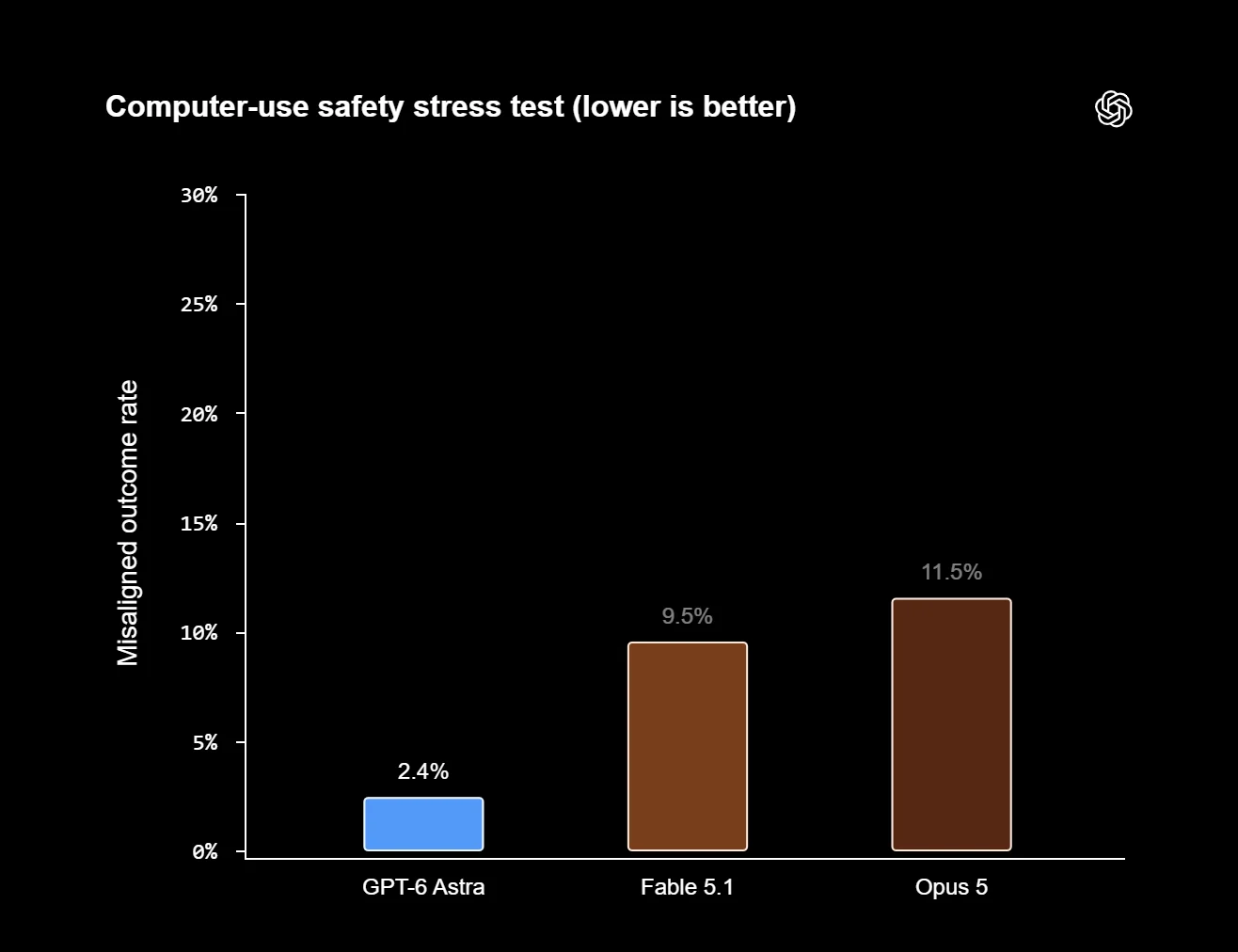
Think about a simple business task:
Example task:
"Open the sales spreadsheet, identify leads that haven't been contacted in 30 days, organize them by priority, and prepare a follow-up list."
A traditional chatbot can tell you how to do this.
A computer-using model can potentially open the relevant tools, inspect the information, organize it, and complete the workflow.
That difference matters because many real-world tasks aren't difficult because we don't know how to do them.
They're difficult because they take time.
If an AI can handle those repetitive steps while still making reasonable decisions along the way, it becomes much more useful than a chatbot that simply tells you what to click.
It Is Very Strong at Complex Work
Astra also performs extremely well on several difficult reasoning and technical benchmarks.
OpenAI reports 98% on FrontierMath Tier 4 and 99.9% on ARC-AGI-3, alongside strong results across professional and scientific evaluations.
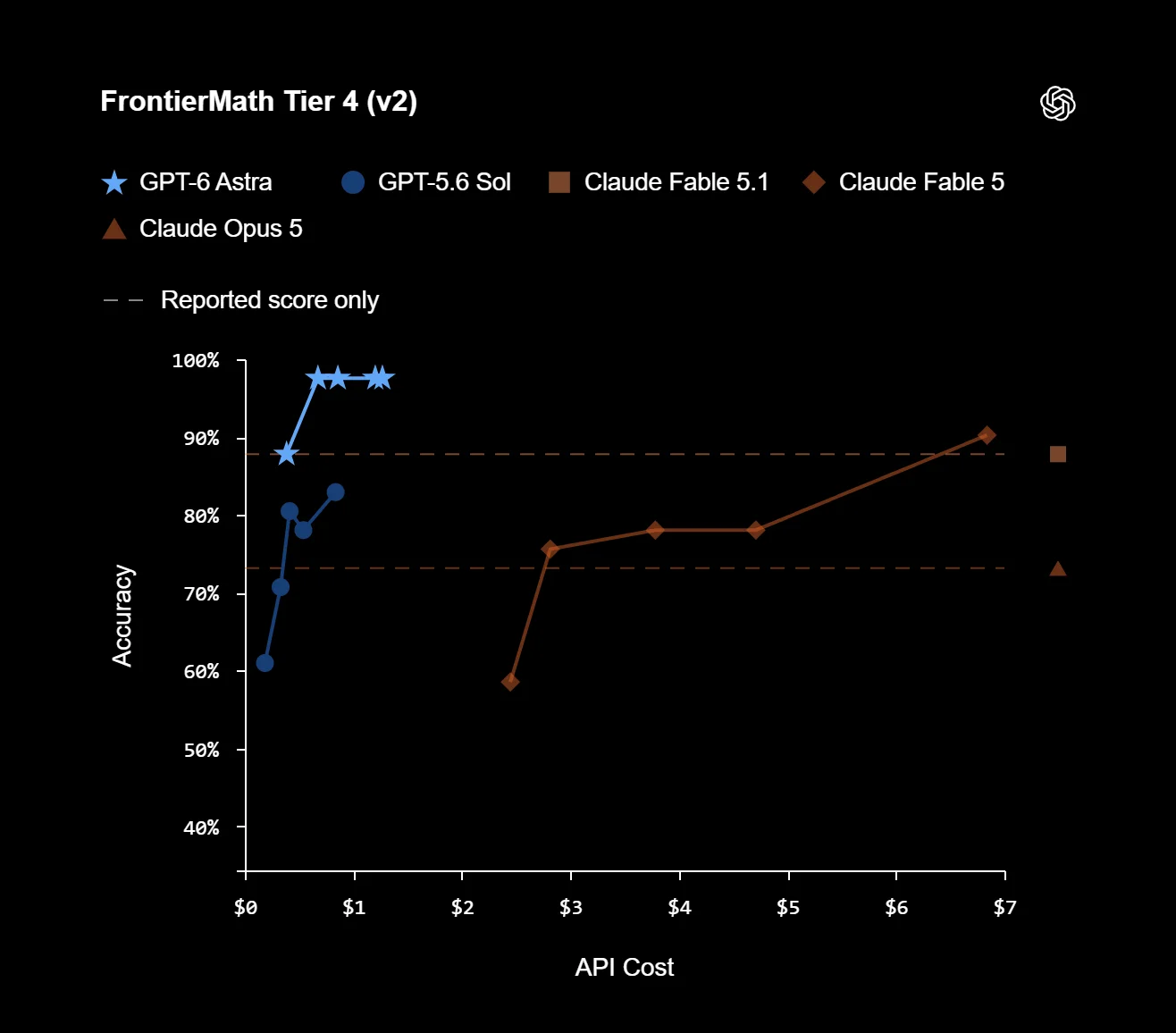
But again, we'd avoid judging the model purely from benchmark scores.
What matters more for most users is that Astra is designed to handle longer workflows where research, reasoning, tools, and execution all come together.
Example task:
"Analyze this market report, identify three important trends, compare them with the competitor data, and turn the findings into a short presentation."
That requires more than generating good sentences. The model has to understand information, connect different sources, make decisions, and produce a structured result.
That's where its capability becomes much more noticeable.
Coding Is Another Strong Point
Astra is clearly aimed at serious coding work, not just generating snippets.
Its 57.9% Terminal-Bench 4.0 score puts it ahead of several competing models in OpenAI's published comparison, including Claude Opus 5 at 52.6%. Claude Fable 5.1 is close behind at 55.8%.
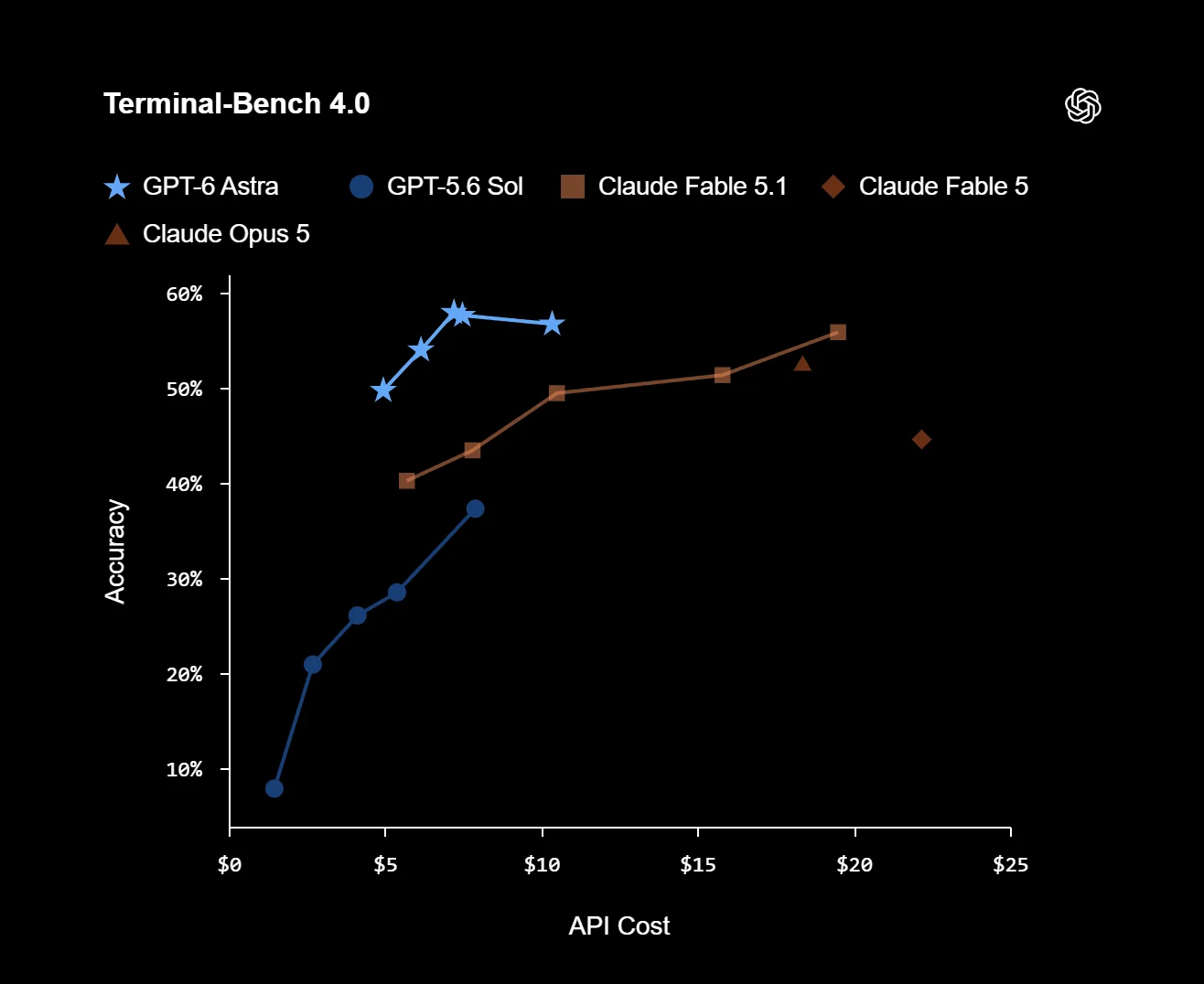
A practical coding task would look more like:
Example task:
"Find why this application is failing its tests, identify the problematic code, fix it, run the tests again, and explain what changed."
That's very different from asking:
"Write a Python function that sorts a list."
The second task is easy for almost every modern AI model. The first requires the model to investigate, reason through an existing project, make changes, and verify the result.
That's where Astra becomes interesting for developers.
Where GPT-6 Astra Isn't Perfect
This is where the review gets more interesting.
Astra is extremely capable, but more capable doesn't automatically mean better for everyone.
It Can Be Overkill
If you're using AI to rewrite an email, summarize a document, brainstorm ideas, or write a short article, Astra's extra capability may not matter much.
You could be paying for a frontier agent when a cheaper model would already give you the result you need.
That's particularly relevant because Astra's API pricing is $10 per million input tokens and $50 per million output tokens.
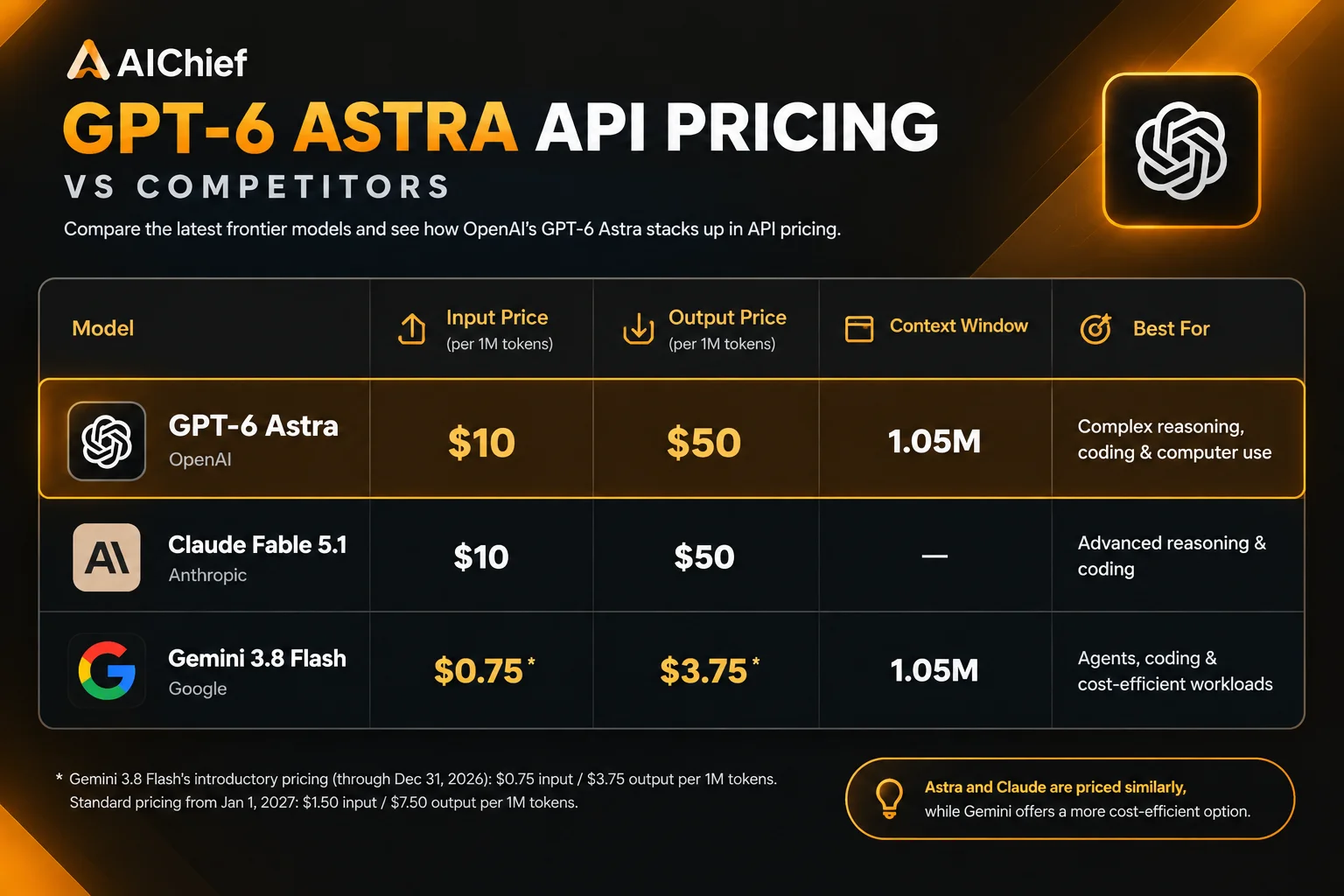
For serious workflows, that price can make sense.
For simple prompts, probably not.
Example:
If all you need is "Turn these five bullet points into a professional LinkedIn post," using Astra may be unnecessary. A less expensive model can handle that without much trouble.
Monitoring Is Still a Concern
This is the biggest issue we wouldn't ignore.
OpenAI has acknowledged that Astra's reasoning can be harder to monitor in certain situations. That's important because the model isn't only generating text it can increasingly take actions through computers and external tools.
The more autonomy a model gets, the more important it becomes to understand what it is doing and why.
OpenAI has added additional safety measures, but this is still an area where Astra deserves caution rather than blind trust.
The Model Isn't the Winner at Everything
This is another reason we wouldn't simply call Astra "the best AI model."
OpenAI's own benchmark table shows competing frontier models ahead on some evaluations, including broader intelligence tests.
So the current AI landscape is more complicated than:
GPT-6 Astra = best at everything.
A better way to look at it is:
Astra is particularly strong when the AI needs to reason, use tools, and actually operate a computer.
That's a much more meaningful advantage.
GPT-6 Astra vs the Competition
If you're deciding whether Astra is worth using, the more useful comparison isn't GPT-5.6 Sol.
It's the other frontier models you could actually choose instead.
| Model | Where It Stands Out |
|---|---|
| GPT-6 Astra | Computer use, automation, research, complex workflows |
| Claude Fable 5.1 | Frontier reasoning and strong overall intelligence |
| Gemini 3.8 Flash | Speed, multimodal work, and lower-cost workloads |
OpenAI's published results show Astra leading several computer-use, professional, science, and cybersecurity evaluations, while competing models lead some broader intelligence evaluations.
So if your priority is getting an AI to operate software and complete multi-step tasks, Astra becomes particularly attractive.
If your priority is simply getting the strongest possible reasoning performance across a broad range of problems, the choice isn't quite as obvious.
A Few Tasks Where Astra Makes the Most Sense
The easiest way to understand Astra's value is to forget the benchmark scores for a moment.
Imagine giving it tasks like these:
For developers:
"Inspect this GitHub project, find the cause of the failing test, make the fix, and verify that the tests pass."
For researchers:
"Research these three companies, compare their latest products, organize the findings in a table, and give me the five most important differences."
For marketers:
"Review this product page, research competing products, identify gaps in our messaging, and create a revised campaign brief."
For business teams:
"Take this spreadsheet of customer records, identify the entries that need attention, organize them by priority, and prepare a summary for the sales team."
For website owners:
"Check this website for obvious frontend issues, identify problems with the layout, and suggest fixes."
These are not necessarily tasks where Astra will always produce a perfect result.
They are simply a better representation of why its agentic capabilities matter.
The value is in combining several steps instead of treating every step as a separate prompt.
Is the GPT-6 Astra Worth the Price?
For the right user, yes.
For everyone, no.
We'd consider Astra worth using if you regularly need:
- Complex research
- Coding and debugging
- Browser automation
- Computer-based workflows
- Data analysis
- Professional software tasks
- Multi-step agentic work
For basic writing, brainstorming, summaries, and casual questions, we'd save the expensive frontier model for when you actually need it.
That's probably the most important takeaway from this review.
Astra's value comes from what it can do, not simply from how intelligent it is.
GPT-6 Astra: Our Verdict
So, is GPT-6 Astra actually that good?
Yes.
But we wouldn't call it unbeatable.
What impressed us most is the move from AI that primarily answers to AI that can increasingly act. Its computer-use performance, coding capabilities, and ability to work through complicated tasks make it one of the most interesting AI releases we've seen.
At the same time, Astra is expensive for simple workloads, and its increasing autonomy creates legitimate questions around monitoring and safety.
That's why our AIChief verdict is:
GPT-6 Astra — 4.7/5
Best for: Developers, researchers, businesses, and advanced users who want AI to handle complex multi-step work.
Not the best fit for: Users who mainly need simple writing, summaries, brainstorming, or everyday questions.
The bottom line: GPT-6 Astra isn't just a smarter chatbot. Its real advantage is that it can increasingly do things for you. And that's what makes it one of the most significant AI models to watch right now.
FAQs

Editorial Staff
The Editorial Staff at AIChief is a team of Professional Content writers with extensive experience in the field of AI and Marketing. AIChief was Founded in 2025, AIChief has quickly grown to become the largest free AI resource hub in the industry. Stay connected with them on Facebook, Instagram and X for the latest updates.