AI Use Cases
AI-Powered Competitive Analysis Tactics That Cut Research Time by 80%
Discover how AI can enhance competitive analysis to drive business growth. Learn practical strategies to gain valuable insights. Read the article now!
Share
In today's hyper-competitive global marketplace, the ability to swiftly and accurately understand the intricate dynamics of the market and the strategic maneuvers of rivals is no longer an advantage—it's a necessity. The sheer volume and velocity of data generated daily make traditional, manual approaches to competitive analysis increasingly insufficient.
With global data creation projected to reach 181 zettabytes by 2025 and continue accelerating toward nearly 300 zettabytes by 2027, businesses are increasingly shifting from manual competitive analysis to AI-driven systems for faster, more scalable decision-making.
This is precisely where AI in Competitive Analysis emerges as a game-changer, transforming raw data into actionable intelligence and empowering businesses to not only keep pace but to surge ahead. This article explores how artificial intelligence is revolutionizing the way organizations approach competitive intelligence, offering unprecedented depth, speed, and foresight to secure a decisive strategic edge.
What is Competitive Analysis and Why is it Crucial for Business Growth?
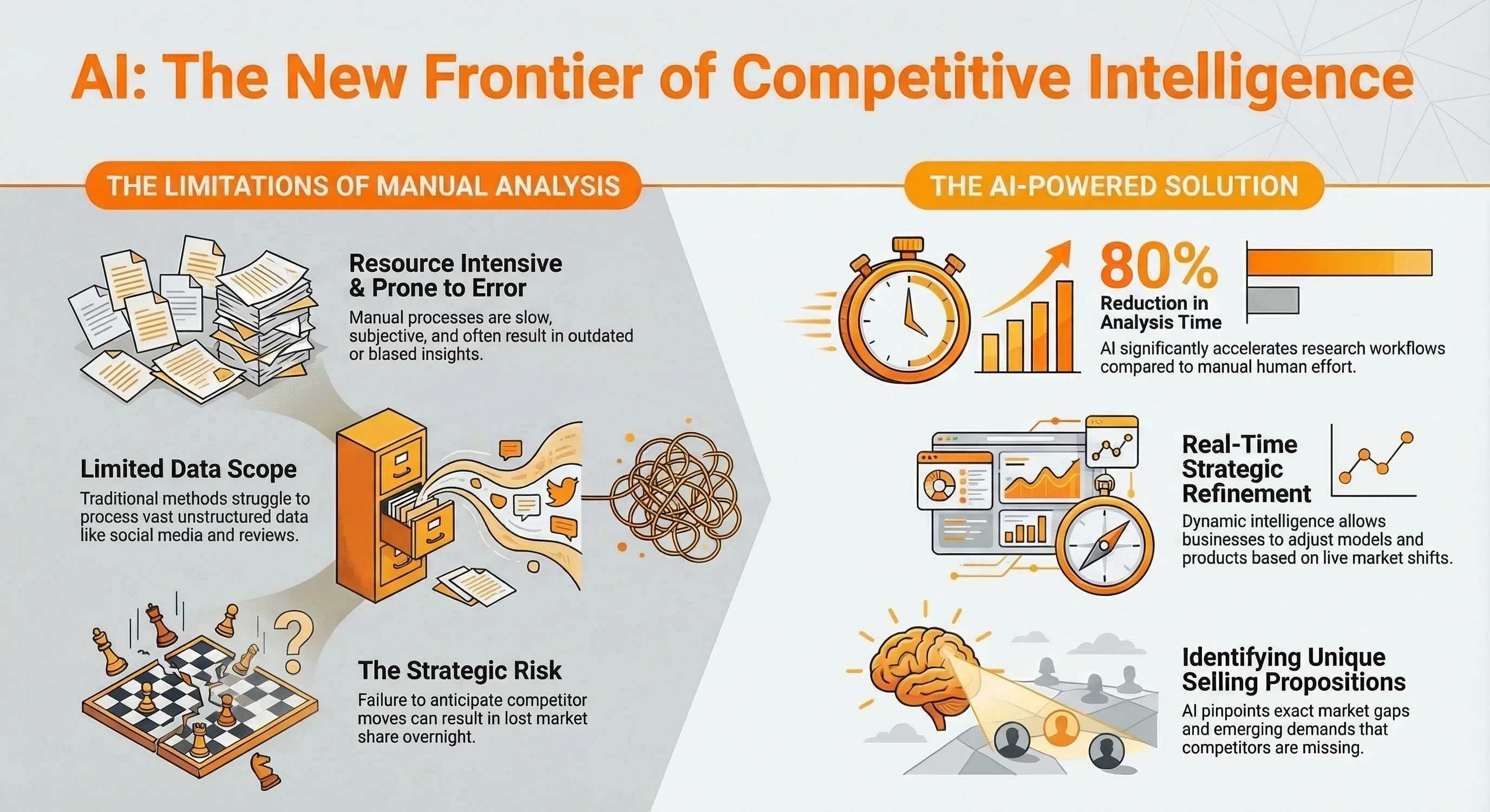
Competitive analysis is the process of systematically evaluating competitors to understand their strategies, positioning, and vulnerabilities in real time. It involves gathering comprehensive information about their products, services, marketing strategies, sales tactics, operational efficiencies, and overall market positioning. The primary objective is to understand the competitive landscape thoroughly, enabling a business to:
- Identify Unique Selling Propositions (USPs): Clearly define what differentiates your offering in crowded and competitive markets.
- Uncover Market Opportunities: Discover underserved niches or emerging demands that your competitors are not addressing.
- Mitigate Potential Threats: Anticipate competitor moves and market shifts to develop counter-strategies proactively.
- Refine Strategic Direction: Adjust your business model, product development, and marketing efforts based on real-time market intelligence.
In today’s data-saturated environment, where thousands of signals—from pricing changes to customer sentiment-shift daily, relying on periodic or manual analysis is no longer sufficient.
It enables faster, evidence-based decisions across product development, pricing, market entry, and customer engagement, ensuring businesses remain responsive, competitive, and strategically aligned.
The Limitations of Traditional Competitive Analysis Methods: Why AI is Essential
For decades, traditional methods of competitive analysis have relied heavily on manual data collection and human interpretation. These methods typically involve extensive market research, surveys, SWOT analyses, and the painstaking review of publicly available information such as financial reports, news articles, and online research.
- While these approaches have yielded valuable insights in the past, they are increasingly proving inadequate in the face of today's complex and data-rich environment. The limitations are manifold:
- Time-Consuming and Resource-Intensive: Manual processes demand significant human effort and time, often delaying insights.
- Prone to Human Error and Bias: Human interpretation can introduce inaccuracies and subjective biases into the analysis.
- Outdated Insights: The rapid pace of market changes means manually collected data quickly becomes irrelevant.
- Limited Scope: Sifting through immense volumes of unstructured data (e.g., social media, customer reviews) is virtually impossible, leading to incomplete analysis.
- Difficulty in Identifying Subtle Patterns: Traditional methods struggle to uncover nuanced trends and correlations hidden within vast datasets.
This inherent inefficiency and lack of real-time capability underscore why AI is essential for modern competitive analysis, offering a scalable, accurate, and dynamic solution to these long-standing challenges.
According to McKinsey (2024), AI-driven automation can reduce competitive research workflows by up to 60–80%, particularly in data collection and pattern detection.
The Power of AI in Competitive Analysis: Revolutionizing Data-Driven Insights
AI-powered competitive analysis represents a paradigm shift in how businesses approach market intelligence. It moves beyond the limitations of traditional methods by leveraging advanced artificial intelligence capabilities to automate, accelerate, and deepen the analysis of the competitive landscape.
At its core, it involves the application of sophisticated AI algorithms and machine learning algorithms to process and interpret massive quantities of structured and unstructured data points from diverse data sources. This includes everything from public financial reports and news articles to social media conversations, customer feedback, and pricing data.
The goal is to transform raw data into valuable insights and actionable insights that empower businesses to make more informed strategic decisions.
This new era of strategic intelligence is characterized by its ability to provide real-time or near real-time understanding of competitor strategies, market trends, and consumer behavior, thereby enabling a proactive rather than reactive stance in the marketplace.
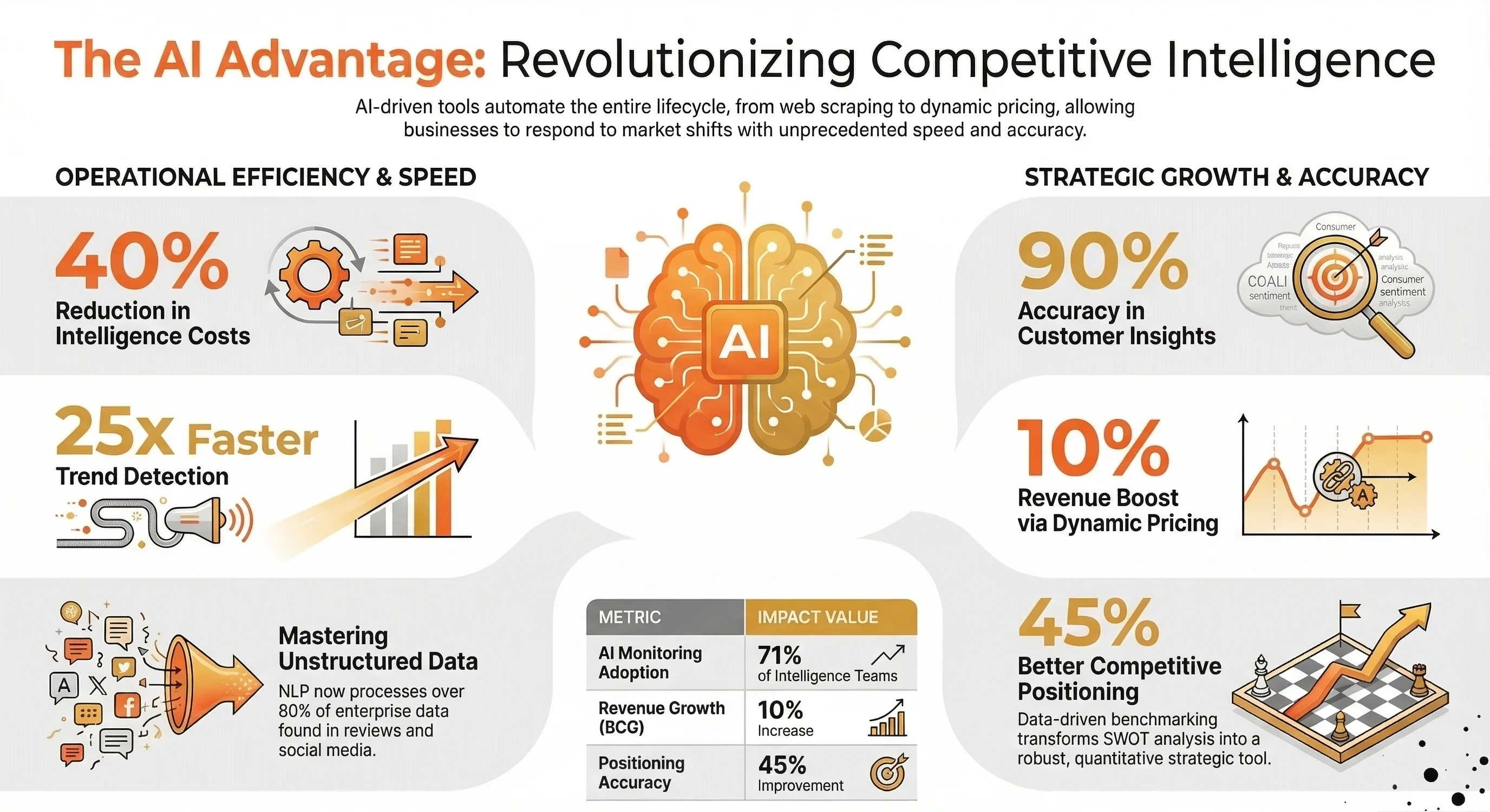
Over 60% of high-performing organizations now use AI to monitor competitors continuously.
By embracing AI in competitive analysis, companies can unlock a level of analytical depth and predictive capability previously unattainable, leading to a significant strategic advantage.
A quick illustration of the comparison between the traditional competitive analysis and the AI-powered competitive analysis.
| Feature | Traditional Competitive Analysis | AI-Powered Competitive Analysis |
|---|---|---|
| Data Volume | Limited, often manual | Vast, automated, real-time |
| Speed | Slow, periodic updates | Rapid, continuous insights |
| Accuracy | Prone to human error/bias | High, algorithm-driven |
| Insight Depth | Surface-level, descriptive | Deep, predictive, actionable |
| Resource Use | Labor-intensive | Automated, efficient |
| Adaptability | Less flexible | Highly adaptable, scalable |
This table clearly highlights how AI-powered competitive analysis offers a superior approach, enabling businesses to navigate the complexities of modern markets with greater agility and precision.
Key AI Technologies Driving Competitive Analysis: Machine Learning, NLP, and Predictive Analytics
AI-driven competitive analysis is powered by a combination of technologies that enable businesses to process, interpret, and predict market dynamics at scale.
| Technology | Description | Applications |
|---|---|---|
| Machine Learning (ML) | Machine Learning (ML) algorithms enable systems to learn from data, identify complex patterns, and make predictions without explicit programming. | Identifying emerging trends, segmenting target audience behavior, forecasting market movements. |
| Natural Language Processing (NLP) | NLP enables AI systems to comprehend, interpret, and produce human language. It is essential for analyzing unstructured text data like customer reviews, social media posts, and news articles. | Sentiment analysis, theme extraction, analyzing customer feedback, and extracting insights from social media or text data. |
| Predictive Analytics | Powered by ML and NLP, predictive analytics helps businesses anticipate future outcomes by identifying patterns and trends in historical data. | Proactive decision-making, anticipating market shifts, competitor actions, and future outcomes based on data-driven insights. |
Research shows that AI can significantly improve decision-making performance by enhancing data accuracy, reducing human bias, and accelerating analysis speed.
By combining these powerful AI technologies, AI-powered competitive analysis tools can provide a holistic and forward-looking view of the market, offering insights that go far beyond what human analysts can achieve alone.
These technologies collectively empower businesses to gain insights and process vast amounts of data efficiently, leading to more accurate and timely strategic decision-making.
Automating Data Collection and Processing: Streamlining Analysis Processes with AI Tools
One of the most significant benefits of AI in competitive analysis is its ability to automate repetitive tasks and streamline analysis processes. Traditionally, data collection has been a labor-intensive and time-consuming task, often involving manual online research, sifting through news articles, and compiling financial reports.
However, with AI-powered tools, much of this can be automated.
Consider these key areas of automation:
- Web Scraping and Data Ingestion: AI-driven tools can automatically gather vast amounts of data, including pricing information, product details, and marketing content, from competitor websites, social media platforms, and news outlets. This eliminates the need for manual data entry and ensures real-time data streams.
- Data Processing and Categorization: Once collected, raw data is automatically processed and categorized by AI systems. This reduces the likelihood of human error and significantly accelerates the analytical workflow, transforming unstructured data into usable formats.
- Data Visualization: AI extends to data visualization, where AI algorithms can quickly transform complex datasets into easily digestible formats, such as interactive charts and graphs. These visualizations highlight key performance indicators and key differences, making insights immediately accessible.
By automating data collection and processing, AI-powered competitive analysis solutions free up human analysts to focus on higher-level strategic thinking, interpretation, and the development of actionable insights, rather than being bogged down by mundane, repetitive tasks.
This efficiency allows businesses to maintain a continuous pulse on the competitive landscape and respond swiftly to market shifts.
Industry research consistently shows that automation reduces operational costs and improves efficiency, particularly in data-intensive processes like competitive intelligence.
Applications of AI in Competitive Analysis: Gaining a Competitive Edge
AI in competitive analysis profoundly transforms market research by enabling businesses to identify and respond to emerging trends with unprecedented speed and accuracy. Traditional market research often relies on historical data, which can quickly become outdated in rapidly evolving markets.
However, AI-powered tools can continuously monitor vast amounts of real-time data from diverse data sources, including social media, news feeds, industry publications, and consumer forums.
Through sophisticated machine learning algorithms and natural language processing, these tools can detect subtle patterns and anomalies that signify new market demands, shifts in consumer behavior, or the rise of disruptive technologies.
For instance, AI algorithms can analyze millions of online conversations to pinpoint nascent interests or unmet needs, providing valuable insights into potential product development opportunities.
This proactive identification of future trends allows businesses to adapt their strategies, innovate their offerings, and position themselves to capture new market segments, thereby securing a significant competitive advantage and maintaining a competitive edge.
Key ways AI uncovers emerging trends include:
- Real-time Data Monitoring: Continuously scans and analyzes vast amounts of data from various sources, including social media, news feeds, and industry publications.
- Pattern and Anomaly Detection: Utilizes ML and NLP to identify subtle patterns, shifts, and anomalies that indicate new market demands or disruptive technologies.
- Predictive Modeling: Forecasts future trends and consumer behavior based on historical data and identified patterns, allowing for proactive strategic planning.
- Sentiment Analysis: Gauges public opinion and sentiment around products, services, and brands, revealing unmet needs and potential opportunities.
This proactive identification of future trends allows businesses to adapt their strategies, innovate their offerings, and position themselves to capture new market segments, thereby securing a significant competitive advantage and maintaining a competitive edge.
Because 80–90% of enterprise data is unstructured, technologies like NLP are essential for extracting insights from sources such as customer reviews, social media, documents, and competitor messaging.
Competitor Monitoring and Strategy Analysis: Understanding Competitor Strategies and Market Shifts
Effective competitor monitoring is paramount for understanding the competitive landscape and anticipating market shifts. AI in competitive analysis elevates this process by providing comprehensive and continuous surveillance of competitor strategies. AI-powered competitive analysis tools can automatically track competitor websites, social media activity, press releases, and even job postings to infer strategic moves.
Around 71% of competitive intelligence teams now rely on AI monitoring tools.
For example, by analyzing changes in product descriptions or pricing data, AI can alert businesses to new product launches or pricing adjustments. Furthermore, natural language processing can be used to analyze competitor marketing campaigns and public statements, revealing their messaging, target audience, and strategic positioning.
Key aspects of AI-driven competitor monitoring include:
- Real-time Tracking: Continuously monitors competitor websites, social media, news, and job postings for immediate updates on strategic moves.
- Pricing and Product Change Alerts: Automatically detects and alerts businesses to changes in competitor pricing, product features, and new product launches.
- Marketing Campaign Analysis: Uses NLP to analyze competitor marketing messages, identifying their target audience, messaging, and strategic positioning.
- Patent and IP Monitoring: Tracks competitor patent filings and intellectual property developments to anticipate future innovations and market directions.
Customer Sentiment and Behavior Analysis: Leveraging AI for Deeper Customer Insights
Understanding customer sentiment and consumer behavior is critical for developing products and services that truly resonate with the target audience. AI in competitive analysis provides powerful capabilities for extracting deeper customer insights from a multitude of unstructured data sources.
Through advanced sentiment analysis techniques, AI-powered tools can process millions of customer reviews, social media comments, and forum discussions to gauge public opinion about products, services, and brands, both their own and their competitors. This allows businesses to identify pain points, understand customer preferences, and even predict future needs.
For example, by analyzing customer feedback across various platforms, AI can highlight specific features that users love or dislike, providing direct input for product development. Furthermore, AI can analyze browsing patterns, purchase histories, and interaction data to build comprehensive profiles of consumer behavior, enabling highly personalized marketing efforts and product recommendations.
As we move toward 2027, a 90% accuracy benchmark in sentiment analysis is no longer a luxury; it is the baseline for hyper-personalized customer experiences.
Key applications of AI in customer sentiment and behavior analysis include:
| Technology | Description |
|---|---|
| Sentiment Analysis | Automatically processes large volumes of text data (such as reviews, social media, forums) to determine the emotional tone and public opinion towards products, services, and brands. |
| Behavioral Pattern Recognition | Analyzes browsing history, purchase data, and interaction patterns to build comprehensive profiles of individual and group consumer behavior. |
| Predictive Personalization | Uses AI to forecast future customer needs and preferences, enabling highly targeted marketing campaigns and personalized product recommendations. |
| Customer Journey Mapping | Identifies key touchpoints and pain points in the customer journey, helping businesses optimize experiences and improve customer satisfaction. |
Product and Pricing Data Analysis: Optimizing Strategies with AI-Driven Insights
Product and pricing data are crucial elements of any competitive analysis, and AI in competitive analysis offers sophisticated capabilities for optimizing strategies in these areas. AI-powered tools can continuously monitor competitor product catalogs, features, and pricing data across various channels, providing real-time updates on market dynamics.
This allows businesses to quickly identify pricing discrepancies, understand competitor pricing strategies, and adjust their own pricing models to remain competitive. Beyond simple monitoring, AI algorithms can perform complex analyses to identify optimal pricing points based on market demand, competitor pricing, and perceived value.
Dynamic pricing driven by AI boosts revenue by up to 10%, according to BCG research.
For products, AI can analyze market trends and customer feedback to identify gaps in the market or opportunities for product innovation. For instance, by analyzing competitor product reviews and sales data, AI can suggest new features or improvements that could give a product a significant edge.
Key ways AI optimizes product and pricing strategies:
- Real-time Price Monitoring: Continuously tracks competitor pricing across various channels, enabling dynamic pricing adjustments to maintain competitiveness.
- Optimal Pricing Point Identification: AI algorithms analyze market demand, competitor pricing, and perceived value to suggest optimal pricing strategies for maximum profitability.
- Product Feature Gap Analysis: By analyzing competitor product reviews and sales data, AI identifies unmet customer needs and opportunities for product innovation or feature enhancements.
- Market Trend Forecasting: Predicts future market trends and consumer preferences, allowing businesses to proactively develop products that align with upcoming demands.
SWOT Analysis and Performance Benchmarking: Identifying Strengths, Weaknesses, and Opportunities
SWOT analysis (Strengths, Weaknesses, Opportunities, and Threats) is a foundational framework in competitive analysis, and AI in competitive analysis enhances its effectiveness by providing more comprehensive and data-driven insights. While traditional SWOT analysis often relies on qualitative assessments, AI-powered tools can infuse it with quantitative data, making the analysis more robust and objective.
Data-driven benchmarking improves competitive positioning accuracy by as much as 45%
For example, AI can analyze internal performance data and external market data to identify a company's true key performance indicators and compare them against industry benchmarks, thereby pinpointing specific strengths and weaknesses.
For opportunities and threats, AI can leverage its ability to identify emerging trends and analyze market shifts to uncover new market opportunities or potential competitive threats that might otherwise be overlooked.
Key contributions of AI to SWOT analysis and performance benchmarking:
- Data-Driven Strengths & Weaknesses: AI analyzes internal performance data and external market data to identify true key performance indicators and compare them against industry benchmarks, providing objective insights into strengths and weaknesses.
- Proactive Opportunity & Threat Identification: AI leverages its ability to identify emerging trends and analyze market shifts to uncover new market opportunities or potential competitive threats that human analysts might otherwise overlook.
- Automated Performance Benchmarking: AI algorithms automatically compare a company's performance across various metrics against its competitors, offering a clear picture of its market position and highlighting areas for improvement.
- Enhanced Strategic Decision-Making: By providing a holistic understanding of internal capabilities and external market dynamics, AI empowers businesses to make informed strategic decisions that maintain a strong competitive advantage.
This integration of AI transforms SWOT analysis from a qualitative exercise into a powerful, data-driven strategic tool.
Implementing AI for Competitive Advantage: Best Practices and Strategic Decisions
Successfully implementing AI for competitive analysis hinges significantly on selecting the right AI tools. The market is rapidly expanding, with a diverse array of AI-powered solutions that offer unique functionalities and cater to different needs. When making this crucial decision, businesses should consider several factors:
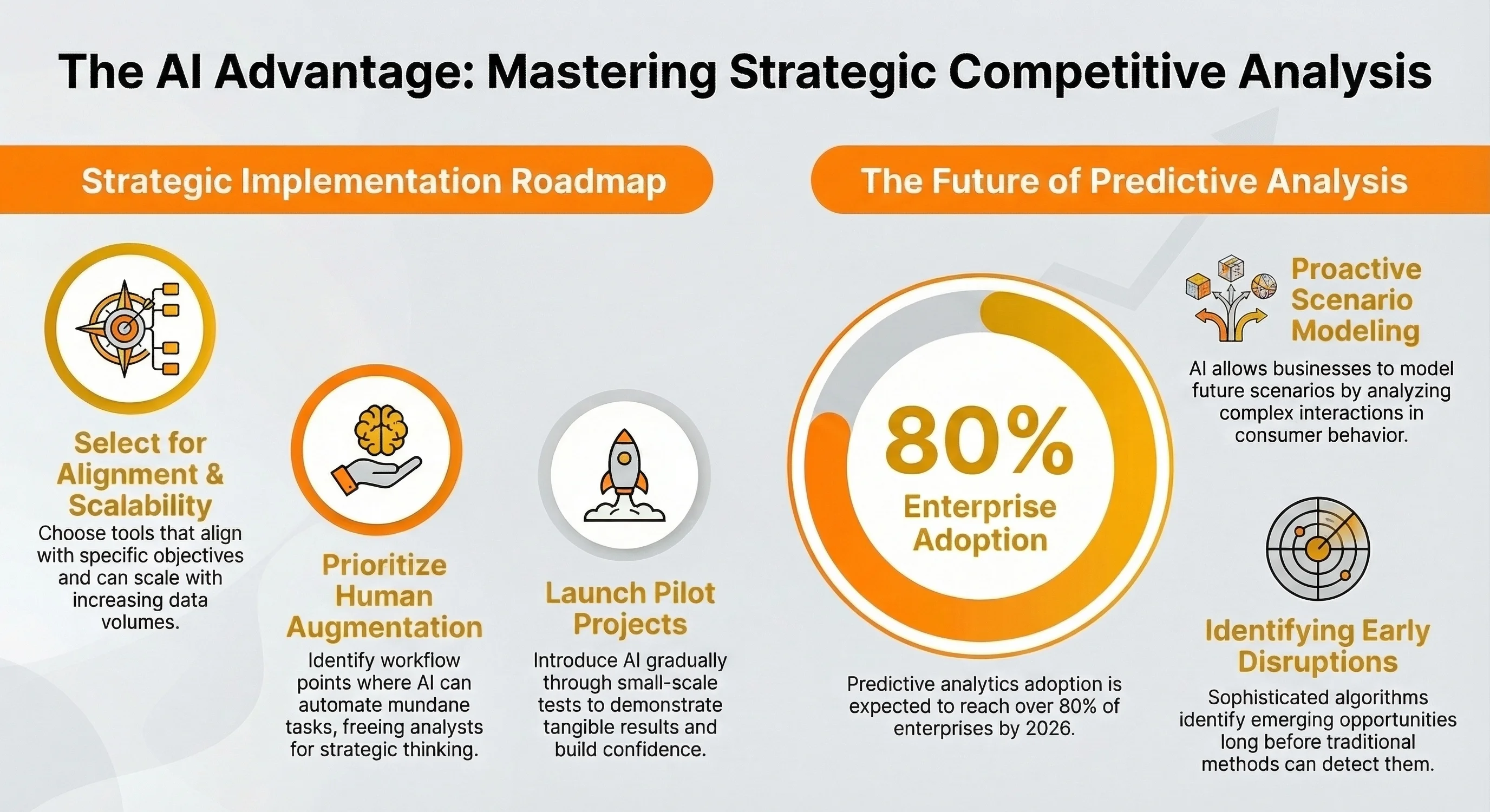
- Alignment with Objectives: The tool should align with the specific objectives of your competitive analysis efforts, whether it's primarily for market research, competitor monitoring, sentiment analysis, or predictive analytics.
- Integration Capabilities: The tool's ability to seamlessly integrate AI with existing analysis processes and data sources is crucial for avoiding data silos and ensuring a cohesive workflow.
- Scalability and Flexibility: The chosen solution should be able to handle increasing volumes of data points and adapt to evolving market demands.
- User-Friendliness and Support: User-friendliness and the availability of comprehensive support and training are crucial, as effective adoption depends on the team's ability to leverage the tool's potential fully.
Integrating AI into Your Existing Analysis Processes: A Seamless Transition
Integrating AI into existing analysis processes is not merely about adopting new AI tools; it's about fostering a seamless transition that enhances, rather than disrupts, current workflows. A successful integration strategy begins with a clear understanding of how AI technologies can augment human expertise, rather than replace it.
Key steps for seamless AI integration:
- Identify AI Augmentation Points: Pinpoint specific areas in your current workflow where AI can automate mundane tasks or provide deeper insights, allowing human analysts to focus on strategic thinking.
- Upskill Your Team: Provide training and resources to ensure your team is comfortable and proficient in using new AI-powered solutions, fostering adoption and maximizing tool potential.
- Manage Change Effectively: Emphasize the benefits of AI, such as increased efficiency, deeper insights, and enhanced strategic decision-making, to encourage buy-in and smooth the transition.
- Start with Pilot Projects: Introduce AI gradually through small-scale pilot projects to demonstrate tangible results and build confidence within the organization.
The Future of Competitive Analysis: Leveraging AI for Sustained Growth
The future of competitive analysis is inextricably linked with the continued advancement and integration of AI technologies, particularly in the realm of predictive analytics. As AI algorithms become more sophisticated, their ability to forecast future trends and anticipate market demands will become even more precise and indispensable.
Predictive analytics adoption is expected to reach over 80% of enterprises by 2026.
Businesses will increasingly rely on AI-powered solutions to not only understand the current competitive landscape but also to model various future scenarios, allowing for proactive strategic planning. This involves analyzing complex interactions between consumer behavior, market trends, competitor strategies, and broader economic indicators to identify potential disruptions or emerging opportunities long before they become apparent through traditional methods.
Key aspects of AI in predictive analytics:
- Sophisticated Forecasting: AI algorithms become more precise in forecasting future trends and anticipating market demands.
- Scenario Modeling: Businesses can model various future scenarios to allow for proactive strategic planning.
- Complex Interaction Analysis: AI analyzes complex interactions between consumer behavior, market trends, competitor strategies, and broader economic indicators.
- Proactive Opportunity and Disruption Identification: Identifies potential disruptions or emerging opportunities long before they become apparent through traditional methods.
Conclusion
According to AIChief analysis, the integration of AI in competitive analysis marks a pivotal evolution in how businesses navigate the complexities of the modern marketplace. From automating laborious data collection to delivering predictive insights and enhancing strategic decision-making, AI-powered solutions offer an unparalleled advantage.
However, it is imperative to remember that while AI provides the tools and the data, the ultimate success hinges on the indispensable human element.
The synergy between advanced AI technologies and human expertise—in defining objectives, interpreting nuances, validating outputs, and formulating actionable strategies—is what truly unlocks sustained growth and a decisive competitive edge.
As we look to the future, embracing this collaborative approach will be key to transforming raw data into profound strategic intelligence, ensuring businesses not only adapt but thrive in an ever-evolving competitive landscape.
FAQs

Arfa Farheen
Arfa Farheen is part of AIchief's global editorial team, reviewing and testing AI tools. With a background in digital marketing, she helps businesses grow their online presence using simple, no-code strategies.