AI Use Cases
9 AI in Real Estate Use Cases Reshaping the $989B Property Market
Discover how AI is enhancing virtual reality with real-time personalization, intelligent avatars, and immersive experiences across industries.
Share
For a long time, virtual reality felt like a part of the future, but something was missing. The visuals were stunning, the environments impressive, yet the interactions often felt shallow or scripted. No matter how real the world looked, it rarely responded like one.
That’s where AI changes everything.
By introducing artificial intelligence into VR, we move beyond static simulations. Now, virtual environments can respond to your actions, learn from your behavior, and even adjust in real time. Instead of following a pre-set path, your experience becomes dynamic, changing based on how you move, speak, or react.
This shift is solving some of VR’s biggest limitations. Whether it’s a medical simulation that adapts to a trainee’s skill level or a virtual classroom that personalizes lessons on the fly, AI brings responsiveness and depth. The result? Virtual experiences that feel less like tech demos and more like living, breathing worlds built around you.
In the healthcare sector, VR training programs that use AI have improved procedural accuracy by 30% in surgical practice.
AI-driven personalization has led to a 50% increase in user engagement in educational VR platforms.
What Is AI-Powered Virtual Reality?
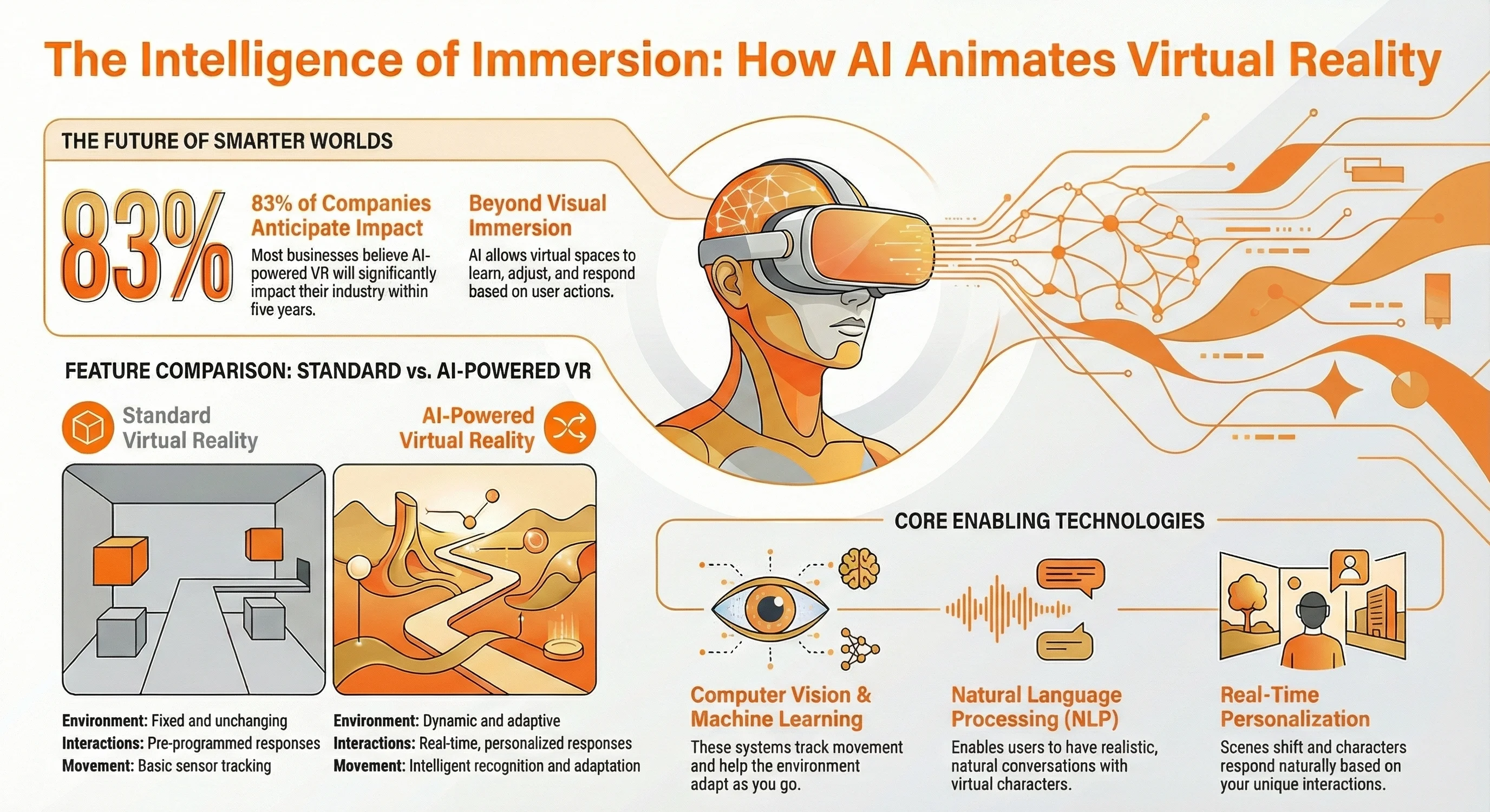
At its core, AI-powered virtual reality is about making virtual worlds smarter and more responsive. It’s the combination of two powerful technologies, artificial intelligence (AI) and virtual reality (VR), working together to create digital environments that don’t just look real, but also react and adapt as the real world would.
According to a PwC report, 83% of companies believe that AI in VR will have a significant impact on their industry over the next 5 years.
Think of VR as the tool that transports you into a computer-generated world, through headsets, motion sensors, and controllers. You can look around, move through spaces, and maybe interact with objects. But without AI, those experiences are usually fixed. They don’t change based on who you are or what you do.
That’s where AI steps in.
AI gives these virtual spaces the ability to learn, adjust, and respond. It can pick up on how you move, what you say, even how you react, then tailor the experience in real time. Characters can respond more naturally. Scenes can shift based on your actions. Every interaction starts to feel more personal.
This is made possible by a few key technologies:
- Machine Learning helps the system adapt as you go.
- Computer Vision tracks your movement and recognizes what’s around you.
- Natural Language Processing (NLP) lets you talk to virtual characters and get realistic responses.
Put it all together, and you get virtual environments that don’t just surround you; they interact with you. It’s a step beyond visual immersion. It’s about presence, connection, and intelligence all working in sync.
Why Integrate AI with Virtual Reality?
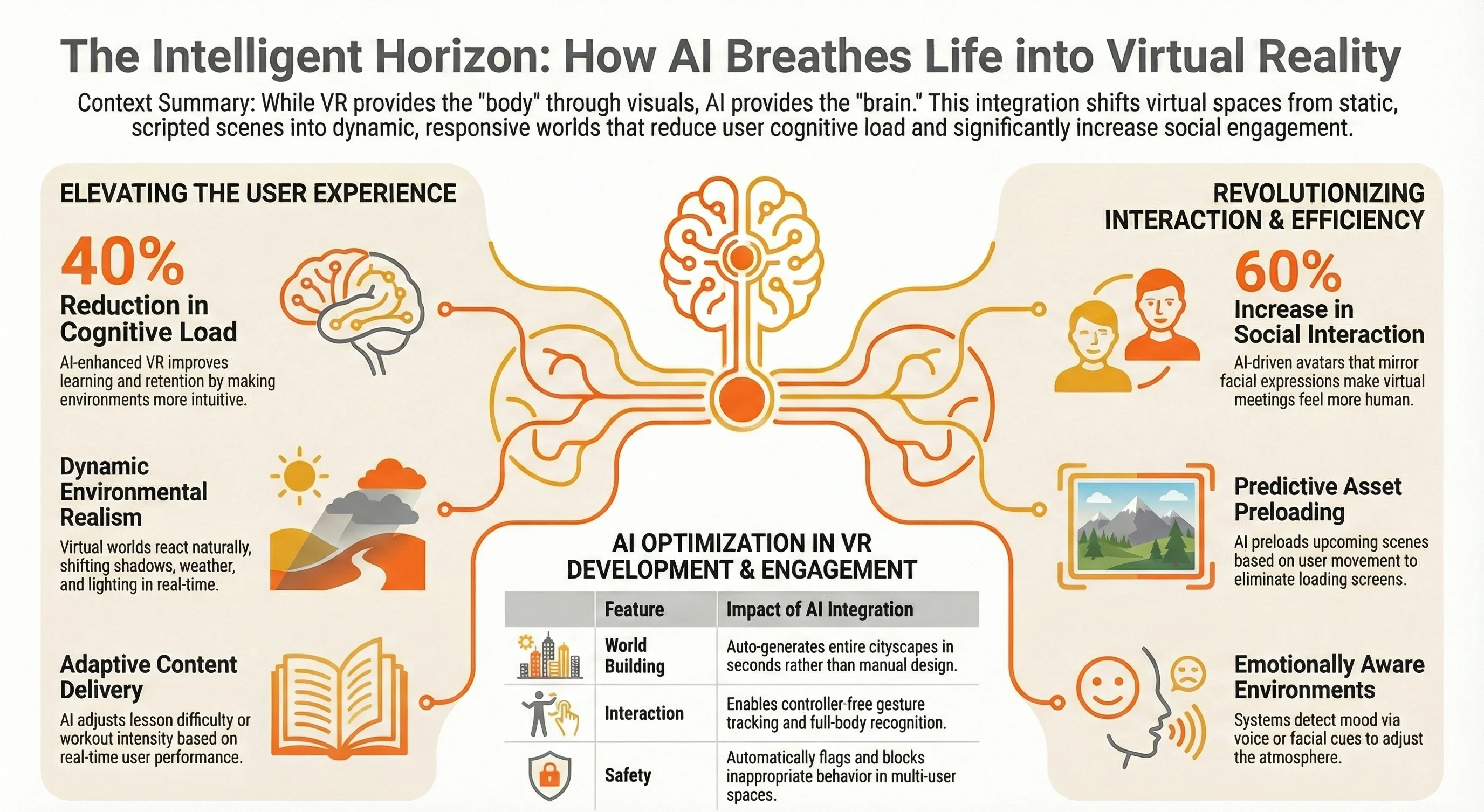
Virtual reality has come a long way in terms of visuals, but for many users, the experience still feels a bit scripted. Scenes look real, but they don’t always feel real. That’s where artificial intelligence steps in, adding the brain to VR’s body. VR experiences enhanced with AI have shown a 40% reduction in cognitive load for users, improving learning and retention.
By integrating AI into VR, we unlock environments that respond, adapt, and evolve based on how you move, speak, or engage. Every action you take can influence what happens next, making each session feel more personal and lifelike.
Let’s look at how AI is pushing VR to the next level:
Enhancing Realism: Making Virtual Worlds Feel Alive
AI makes virtual spaces look and behave more like the real world. Instead of walking through a frozen scene, you move through environments that shift and react naturally, adding depth to the immersion. Here is what AI can do to make it real.
- AI can generate lifelike textures, lighting, and sound based on context and movement.
- Virtual environments respond in real time—whether it’s shadows shifting with the sun or a breeze moving the trees.
For Example:
- On a virtual nature walk, AI makes the trees sway with the simulated wind.
- Birds or animals behave realistically as you approach.
- Or, if a storm rolls in, the weather changes dynamically based on your location in the scene.
Personalization: Adapting the Experience to Each User
AI can also learn about how you interact, what you prefer, and how you respond, then customize the environment accordingly. Isn’t it cool? No two users will have exactly the same journey. Here is how it helps in personalization:
- Storylines can change based on your interests, actions, or skill level.
- Difficulty levels adjust on the fly to keep you challenged but not overwhelmed.
Example:
- In a VR fitness app, AI could edit workouts based on your performance and progress.
- In educational apps, lessons adjust automatically, speeding up when you’re excelling, slowing down when you need more support.
Efficiency: Faster Development and Smoother Experiences
Behind the scenes, AI helps developers save time, and users avoid lag. It streamlines world-building and keeps everything running smoothly in real time.
- AI can auto-generate environments and characters, cutting down production time.
- Predictive systems preload assets based on what you’re likely to do next.
Example:
- Instead of designing every room manually, a developer can use AI to build entire cityscapes in seconds.
- While you're exploring a game, AI quietly preloads upcoming scenes to avoid loading screens.
Even More Benefits of AI in VR
The AI-VR combination isn’t just about visuals and speed; it’s also making virtual experiences more inclusive, emotionally aware, and content-rich. Let’s explore a few more benefits of AI in VR.
- Accessibility: Real-time captions, voice navigation, gesture-based controls, and content tailored to users with disabilities.
- Emotion Recognition: AI detects your mood through voice or facial cues and adjusts the tone or pacing accordingly. For instance, if a therapy patient appears anxious, the scene may shift to a calming environment.
- Content Generation: AI can generate new levels, missions, or challenges automatically.
In adventure games, this means every playthrough offers something different. - Real-Time Guidance: Virtual assistants can offer tips, feedback, or tutorials without interrupting the experience.
- Moderation & Safety: AI helps keep multi-user VR spaces respectful by flagging or blocking inappropriate behavior.
- Smart Analytics: AI tracks user behavior to improve future experiences, whether it’s adjusting content, improving UX, or offering better personalization.
- Device Integration: VR connects seamlessly with other smart tools.
Example: Your smart home lights dim automatically when you enter a VR meditation session.
Adding AI to VR isn’t just about upgrading the tech; it’s about completely rethinking how virtual experiences work. With AI, these environments become more than just interactive, they become intelligent. They learn, respond, and grow with each user, making every virtual world feel uniquely your own.
How AI Transforms Virtual Reality Experiences
Virtual reality is evolving fast, but it’s AI that’s making it feel truly alive. We're no longer just wearing a headset and watching things happen. Now, the world inside responds, just like in the movies. Think Ready Player One, where digital avatars talk, react, and evolve with you. Or Her, where AI understands emotion and builds a connection. That kind of interaction is starting to happen in real-world VR, thanks to AI.
AI-driven avatars have increased user interaction by 60% in virtual meetings and social VR apps.
Here's how it's improving key parts of the VR experience:
- Emotional Avatars: AI enables avatars to read facial expressions and voice tone, responding in real time, making virtual meetings and games feel more human.
For example, Spatial avatars now mirror your real facial expressions, like in Ready Player One. - Gesture Tracking: AI improves hand and body recognition, allowing you to interact with objects without a controller. For example, Meta Quest 3 uses AI to support full-body gesture input for natural interactions.
- Real-Time Feedback: AI analyzes user behavior during tasks, like training or surgery practice, and provides instant corrections. Like, VR simulations in healthcare highlight mistakes and adjust complexity on the fly.
- Emotion Recognition: AI detects your mood through microexpressions or voice and adjusts the environment, calming it down or offering support when needed. It’s now used in VR therapy apps for anxiety and PTSD.
- Smarter NPCs: AI powers non-playable characters with dynamic dialogue and reactions. Just In Asgard’s Wrath 2, characters respond differently every time, no pre-scripted lines.)
- Personalized Learning: AI tailors content based on user progress, offering hints, challenges, or easier paths depending on performance. Corporate training apps like ENGAGE XR use this to improve retention.
How AI Enhances VR Experiences — At a Glance
| Area | How AI Helps | Example / Outcome |
|---|---|---|
| Avatars | Detects facial expressions, voice tone & emotional cues | Realistic, expressive avatars in platforms like Spatial |
| Gesture Tracking | Improves the accuracy of hand/body movement recognition | Controller-free interaction in Meta Quest 3 |
| Real-Time Feedback | Analyzes user performance & adjusts difficulty or gives instant corrections | Adaptive medical VR training that improves skill retention |
| Emotion Recognition | Reads user's mood to adapt the environment or response | Calming environments in VR therapy apps when stress is detected |
| NPC Intelligence | Powers characters with dynamic, unscripted dialogue and behavior | Lifelike conversations in Asgard’s Wrath 2, similar to Her |
| Personalized Learning | Customizes learning pace, content, and difficulty based on performance | ENGAGE XR adjusts corporate training modules in real time |
What Are the Applications of AI in Virtual Reality?
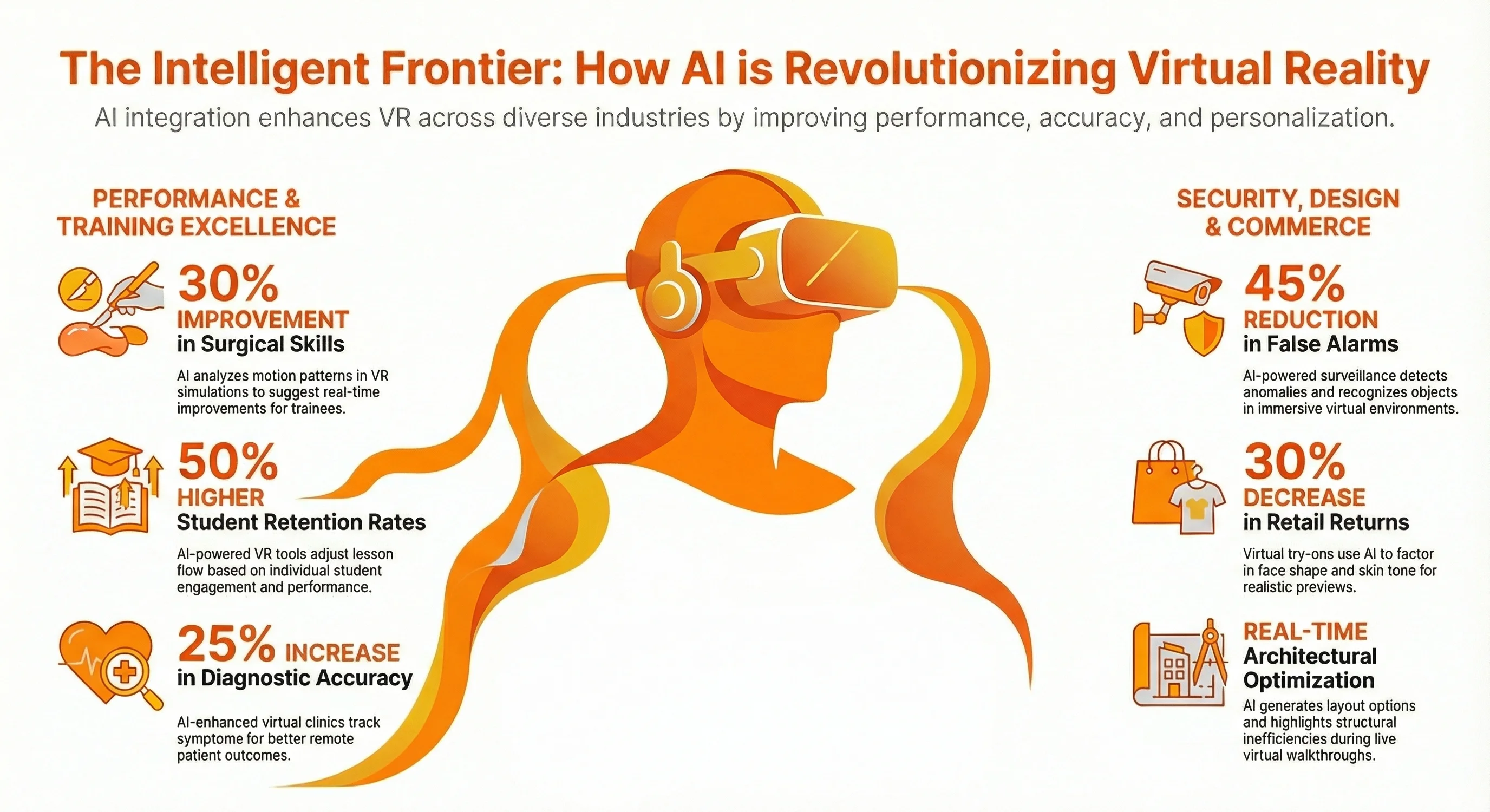
Artificial Intelligence is transforming how we interact with virtual environments, making them smarter, faster, and more human-like. Across industries like healthcare, education, security, entertainment, and design, AI-driven VR isn’t just enhancing visuals it’s solving problems, accelerating workflows, and delivering more personalized experiences. Let’s explore how this powerful combination is reshaping the real world.
Healthcare: From Training Simulations to Patient Care
AI-integrated VR is transforming the way medical professionals learn and care for patients. With AI analyzing performance, VR simulations offer hands-on practice in realistic, zero-risk environments, ideal for training in surgery, emergency care, and rehabilitation.
It's also being used for real-time therapy, such as pain management and exposure therapy.
- Surgical Simulation: Trainees can practice complex procedures in VR while AI analyzes their technique and suggests real-time improvements. For instance, Stanford surgeons use VR platforms that detect motion patterns and highlight errors mid-simulation. A study by the American Journal of Surgery found that AI-enhanced VR simulations can improve surgical skills by 30%.
- Therapeutic Treatment: Patients suffering from anxiety, PTSD, or chronic pain benefit from AI-tailored VR environments. These virtual spaces adjust in real time based on physiological signals, reducing stress without medication.
AI-enhanced virtual clinics have improved remote patient diagnostics, showing a 25% improvement in diagnostic accuracy compared to traditional methods. - Virtual Clinics: Doctors now meet patients in VR for remote therapy, physical rehab, or diagnostics, with AI tracking symptoms and progress for better treatment outcomes.
Education: Smarter Classrooms, Interactive Learning
AI adds intelligence to VR-based learning, making education more responsive and immersive than ever. Here is how it helps in education:
- Adaptive Learning: Lessons adjust instantly based on student behavior, performance, or attention span. For example, platforms like ClassVR tailor lesson flow using engagement data.
- Immersive Exploration: Students can interact with historical events, molecules, or planets in 3D. AI ensures each experience is paced and structured for the individual learner.
- Performance Tracking: Teachers get detailed insights into how students perform in real time, enabling timely support and personalized learning paths.
A report from EdTech Magazine revealed that 70% of students engaged with AI-powered VR learning tools show a 50% improvement in retention rates.
Security & Surveillance: Smarter Monitoring in Real Time
As security threats grow more complex, traditional monitoring systems like NVRs and DVRs are struggling to keep up. They often rely on manual observation, delayed response times, and limited contextual awareness. This is where AI and VR step in, creating smarter, faster, and more proactive security environments.
By combining intelligent video analytics with immersive virtual simulations, organizations can now detect potential threats before they escalate, streamline incident response, and gain deeper insights into patterns of behavior.
The result is a more secure, real-time monitoring system that evolves as threats do.
- Anomaly Detection: AI spots unusual behavior, like loitering, unauthorized access, or suspicious movements, within seconds, removing the need for manual footage review.
- Facial & Object Recognition: Systems can identify faces, license plates, or even unattended bags in crowded spaces, improving situational awareness.
- Remote VR Monitoring: Security personnel can patrol virtual replicas of real environments, with AI alerting them to threats in real time, ideal for airports, warehouses, or campuses.
AI-powered surveillance systems have reduced false alarm rates by 45% in large public venues.
Entertainment: Personalized Games and Dynamic Worlds
In VR gaming, AI introduces evolving narratives, smarter characters, and tailored experiences that keep players coming back.
- NPC Intelligence: Characters adapt to your choices, tactics, and emotional state, making gameplay feel alive. In games like Half-Life: Alyx, enemy behavior shifts based on player strategy.
- Story Customization: Games offer different plotlines or outcomes based on past sessions, powered by AI’s ability to learn and predict preferences.
- On-the-Fly Environment Changes: As players explore, the world reshapes itself, weather, lighting, and obstacles adapt in real time.
Architecture & Design: Building in Real Time
Architects and designers use AI and VR to visualize and modify concepts before anything is physically built.
- Live Walkthroughs: Clients can walk through detailed virtual models and give instant feedback. AI suggests structural changes or highlights inefficiencies in real time.
- Automated Design Suggestions: AI generates layout options based on client needs or budget constraints—speeding up the creative process.
- Remote Collaboration: Teams across different locations can co-design in a shared virtual space, adjusting elements on the fly.
Retail: Try Before You Buy—Virtually
Shopping is becoming more intelligent with AI-driven VR, turning your device into a personalized fitting room.
- Virtual Try-Ons: Shoppers can preview clothing, makeup, or glasses in 3D. AI factors in face shape, skin tone, and style preferences for realistic previews.
- Product Recommendations: Based on behavior, AI suggests styles or accessories tailored to the shopper’s taste.
- Reduced Returns: With better-fitting previews and AI-assisted sizing, retailers report lower return rates and higher satisfaction.
Retailers using AI-driven sizing and fit technology have reported a 30% decrease in return rates, with customer satisfaction improving by 20%
Overcoming Challenges in AI-Driven Virtual Reality
While AI-driven VR opens exciting new possibilities, it also brings along some tough challenges. From system performance to privacy and accessibility, here’s a breakdown of the main obstacles—and how innovators are working to solve them:
| Challenge | What It Affects | How It's Being Solved |
|---|---|---|
| Processing Power | High-end AI and VR require a lot of computing, which can slow things down. | Offloading tasks to the cloud and edge devices, and using more efficient hardware (like GPUs). |
| Latency & Lag | Even small delays can ruin immersion or impact learning/training effectiveness. | Predictive AI preloads environments; edge computing helps reduce delays in real time. |
| Data Privacy Concerns | VR often collects sensitive data like voice, gestures, and emotions. | Systems now use encryption, anonymized tracking, and transparent user consent settings. |
| Time-Intensive Content Creation | Designing VR worlds manually takes time and creative effort. | Generative AI tools help build environments, avatars, and scripts automatically. |
| Limited Accessibility | Many VR setups aren't friendly to users with mobility or sensory impairments. | Adaptive controls like voice input, gesture tracking, and eye-tracking make VR more inclusive. |
| Ethical & Safety Risks | Social VR and adaptive systems can sometimes cross boundaries or feel invasive. | AI moderators, behavior filters, and customizable settings help maintain a safe experience. |
The integration of AI into VR systems promises to revolutionize various industries, from gaming and entertainment to education and healthcare. However, addressing the challenges of computational power, privacy concerns, accessibility, content generation, and user experience is crucial for the widespread adoption of AI-powered VR.
With ongoing advancements in AI optimization, security protocols, and accessibility features, the future of VR is becoming more inclusive, immersive, and intelligent.
The Road Ahead for AI-Powered Virtual Reality
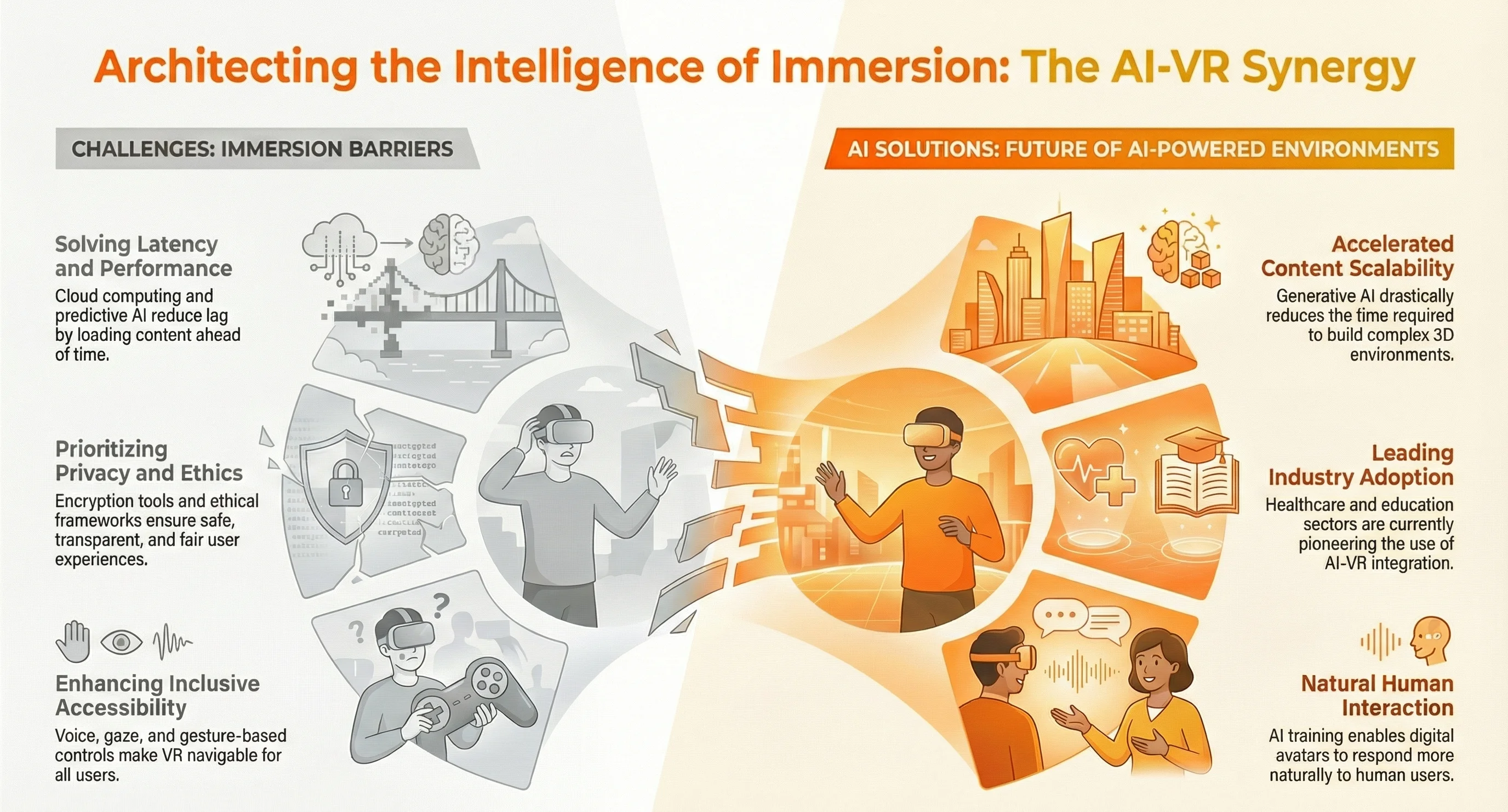
As AI and VR continue to evolve together, the potential is massive, but so are the challenges. For AI-powered virtual reality to reach its full impact across industries, developers need to solve issues around performance, privacy, inclusivity, and content scalability.
The good news? Many of these problems are already being addressed with smarter systems and more ethical design choices. Here's what lies ahead:
- Processing-heavy VR apps are becoming faster with cloud and edge computing.
- Predictive AI is helping reduce lag by loading content ahead of time.
- Data privacy concerns are being met with encryption and transparency tools.
- Voice, gaze, and gesture-based controls are making VR more accessible.
- Generative AI is reducing the time needed to build 3D environments.
- Real-time moderation is making social VR spaces safer and more inclusive.
- Better AI training is helping avatars respond more naturally to users.
- Cross-platform integration is connecting VR with IoT and smart devices.
- Education and healthcare apps are leading the way in AI-VR adoption.
- Ethical frameworks are being built to ensure safe and fair experiences for all.
Conclusion
The fusion of artificial intelligence and virtual reality is no longer a futuristic idea; it’s happening now, and it’s reshaping how we live, learn, heal, design, and connect. AI gives VR the intelligence it once lacked, making digital environments smarter, more adaptive, and deeply personalized.
Whether it’s helping doctors rehearse surgeries, students grasp complex concepts, or gamers experience living, breathing storylines, this powerful integration is solving real-world problems in virtual spaces.
Still, the journey is just beginning. Challenges around performance, privacy, and accessibility must continue to be addressed with thoughtful, human-centered innovation.
But as AI becomes more refined and ethical, and as VR becomes more immersive and inclusive, we’re headed toward a future where virtual experiences feel just as meaningful, and sometimes more impactful, than those in the real world.
In the end, AI-powered VR isn’t just changing technology; it’s changing how we experience possibility itself.
FAQs

Emily Newton
Emily Newton is an experienced Editor-in-Chief who has spent the last decade sharing her insights on science and technology advances through platforms like IoT for All and DZone. She is deeply interested in showcasing how connected technologies and smart ecosystems transform modern businesses. When she isn’t writing, Emily enjoys walking local trails, playing video games, or curling up with a good book.