AI Use Cases
How AI in Healthcare Jumped 28% in One Year: What You Need to Know
Discover how AI in healthcare works, its latest trends, real-world examples, and implementation for improving efficiency for better patient outcomes.
Share
Accurate and timely diagnoses are at the heart of effective healthcare, yet millions of patients each year face delays or errors that impact their well-being. As the complexity of medical data continues to grow, healthcare providers are overwhelmed with vast amounts of information, and traditional diagnostic methods can no longer keep up with the demand.
In one study, providers selected an AI diagnosis in 84.2% of cases, with top‑rank AI suggestions chosen 60.9% of the time.
Today, machine learning and data-driven technologies are helping to tackle these challenges. By processing massive amounts of medical data in real-time, these systems enable healthcare professionals to identify patterns, detect diseases earlier, and make more informed decisions. From early disease detection to personalized treatment plans, these innovations are revolutionizing the way healthcare is delivered.
A meta‑analysis found generative AI models had an overall diagnostic accuracy of 52.1%, comparable to non‑expert physicians (but lower than experts).
As technology evolves, it's transforming not only the accuracy of diagnoses but also the speed at which treatments are administered, ultimately improving patient outcomes and healthcare efficiency.
The number of physicians using healthcare AI jumped from 38% in 2023 to 66% in 2024, showing rapid practitioner adoption.
This article explores how AI in healthcare is reshaping the future of diagnostics and helping healthcare providers deliver better care to their patients. So, let’s get started!
The Intersection of AI and Healthcare
The fusion of artificial intelligence with healthcare is ushering in a new era of medical advancements, where technology and human expertise work together to enhance patient care. By analyzing vast amounts of data, AI is enabling healthcare providers to make more informed, accurate decisions, ultimately improving patient outcomes.
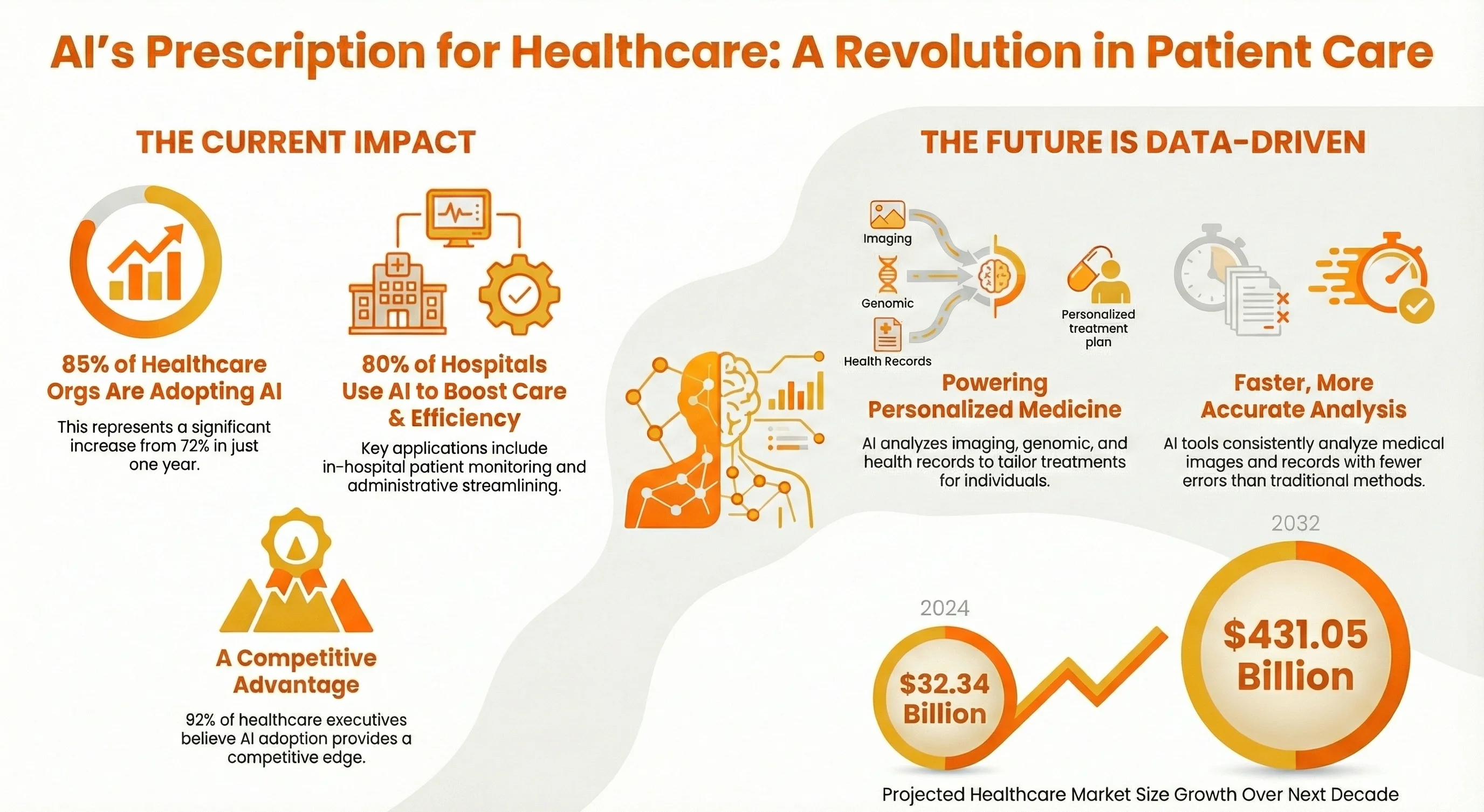
The share of healthcare organizations using or exploring generative AI rose from 72% to 85% in one year. 92% of healthcare executives believe AI adoption will give organizations a competitive edge.
About 43% of healthcare leaders are already using AI for in‑hospital patient monitoring, and 40% report improved operational efficiency from AI solutions.
In the following sections, we will explore how these technologies are driving change in diagnostics, treatment, and healthcare administration, while also addressing the challenges and future potential of AI in the industry.
What is AI in Healthcare?
Artificial intelligence (AI in healthcare) refers to the use of AI technologies to improve healthcare delivery, including patient care, diagnostics, disease management, and administrative tasks. With AI applications in healthcare, medical data is processed at an unprecedented scale, offering deep insights into patient health, disease diagnosis, and clinical decision-making.
AI can combine data from imaging, labs, genomics, and EHRs to tailor treatments to individual patient profiles
Machine learning, deep learning, and large language models (LLMs) play a critical role in processing large amounts of data, ensuring that healthcare systems deliver data-driven solutions.
AI tools have repeatedly shown the ability to analyze medical images and patient records faster and with fewer errors than traditional methods.
AI in healthcare has the potential to revolutionize the industry by providing innovative solutions that improve efficiency, diagnostic accuracy, and scalability in healthcare systems. From predicting patient outcomes to personalized treatment plans, AI-powered tools are helping clinicians make better decisions faster and more accurately.
A Brief History of AI in Healthcare
The journey of AI in healthcare began in the mid-20th century with the development of early AI systems aimed at assisting healthcare providers in diagnostic decision-making. Over time, these technologies evolved to include machine learning and deep learning, significantly enhancing the ability to process complex medical data and improve diagnostic accuracy.
Below is a brief timeline and key milestones in the history of AI in healthcare:
- 1950s-1970s: Early expert systems were created to assist in medical decision-making, using rule-based algorithms to guide physicians in diagnosing diseases.
- 1980s: The first AI-driven diagnostic tools began emerging, focusing on areas like radiology and cardiology. AI was applied to medical imaging, helping to detect early signs of heart disease and cancer.
- 1990s-2000s: Machine learning models advanced, enabling AI systems to process more complex datasets, such as genomic data and electronic health records (EHR), to assist with predictive analytics and personalized treatment plans.
- 2010s-Present: The rise of deep learning and neural networks led to significant breakthroughs, particularly in medical imaging (e.g., detecting tumors in radiology scans) and drug discovery. AI systems are now integrated into numerous healthcare applications, such as clinical decision support, personalized medicine, and real-time patient monitoring.
Key Benefits and Potential
- Enhancing Clinical Decision-Making: AI provides healthcare professionals with powerful tools to analyze large amounts of clinical data, aiding in accurate and timely diagnoses.
About 80% of hospitals now use AI to improve patient care and operational efficiency across clinical and administrative functions. - Improving Patient Outcomes: By enabling early detection of diseases, AI contributes to better patient care and long-term health management.
- Transforming Healthcare Delivery: The integration of AI technologies in healthcare systems is streamlining processes like drug discovery, clinical trials, and healthcare administration.
Globally, the AI healthcare market is rapidly expanding. It is projected to grow from $32.34 billion in 2024 to $431.05 billion by 2032 as investment in AI capabilities surges.
As these technologies continue to evolve, AI has the potential to transform healthcare even further, providing greater insights, enhancing the quality of care, and ensuring more efficient healthcare delivery.
Core AI Technologies in Healthcare Driving Change
The integration of advanced AI technologies is significantly transforming the healthcare landscape. From diagnostics to patient care, these innovations are reshaping healthcare systems by enhancing efficiency, improving clinical decision-making, and ultimately delivering better patient outcomes. Technologies like Machine Learning (ML), Deep Learning (DL), Natural Language Processing (NLP), and AI-assisted Robotics are at the forefront of this transformation.
The global AI in healthcare market was valued at around $26.57 billion in 2024. It is projected to reach $505.59 billion by 2033 at a 38.8% CAGR, reflecting the rapid adoption of AI technologies
Each of these technologies plays a unique role in improving healthcare delivery, from enabling more accurate disease detection to facilitating minimally invasive surgeries.
Surveys show 71% of acute care hospitals reported using predictive AI integrated into electronic health records to support clinicians.
Below are the core AI technologies driving this revolution and how they are being applied in real-world healthcare settings.
| AI Field | Applications | Technologies Used | Real-World Examples |
|---|---|---|---|
| Machine Learning (ML) |
|
Supervised Learning, Unsupervised Learning, Decision Trees |
Cancer: ML models help predict breast cancer progression. Cardiology: Algorithms detect heart disease patterns for better prevention. |
| Deep Learning (DL) |
|
Convolutional Neural Networks (CNN), Autoencoders |
Radiology: DL models detect early signs of breast cancer with high accuracy. Pathology: Systems identify cell abnormalities in biopsy images faster than experts. |
| Natural Language Processing (NLP) |
|
Named Entity Recognition (NER), Text Mining, Sentiment Analysis |
EHR Analysis: NLP tools process patient records to identify risks like sepsis. Medical Research: NLP systems extract data from studies to accelerate drug discovery. |
| AI-Assisted Robotics |
|
Motion Planning, Computer Vision, Control Algorithms |
Robotic Surgery: da Vinci System performs prostate surgeries with precision. Orthopedic Surgery: AI robots assist in performing joint replacements accurately. |
The Power of AI in Healthcare: 8 Real-World Examples
Are you ready for some crazy examples and facts about how artificial intelligence is transforming the medical industry? From cutting-edge diagnostics to personalized treatments, AI is not just a buzzword anymore—it's actively shaping healthcare in ways we never thought possible.
The AI healthcare market grew from $1.1 billion in 2016 to $22.4 billion in 2023, a 1,779% increase, illustrating how fast adoption is happening.
In this section, we’ll dive into real-world applications of AI, showing you how it's changing patient care, speeding up drug discovery, and even making surgeries more precise.
Let's explore how AI is making a tangible difference in healthcare today!
AI in Diagnostics: How AI Helps in Disease Detection
AI tools are improving diagnostic processes, helping doctors identify diseases earlier and more accurately than ever before. Let’s explore some real-world examples for a better overview.
AI in Breast Cancer Detection
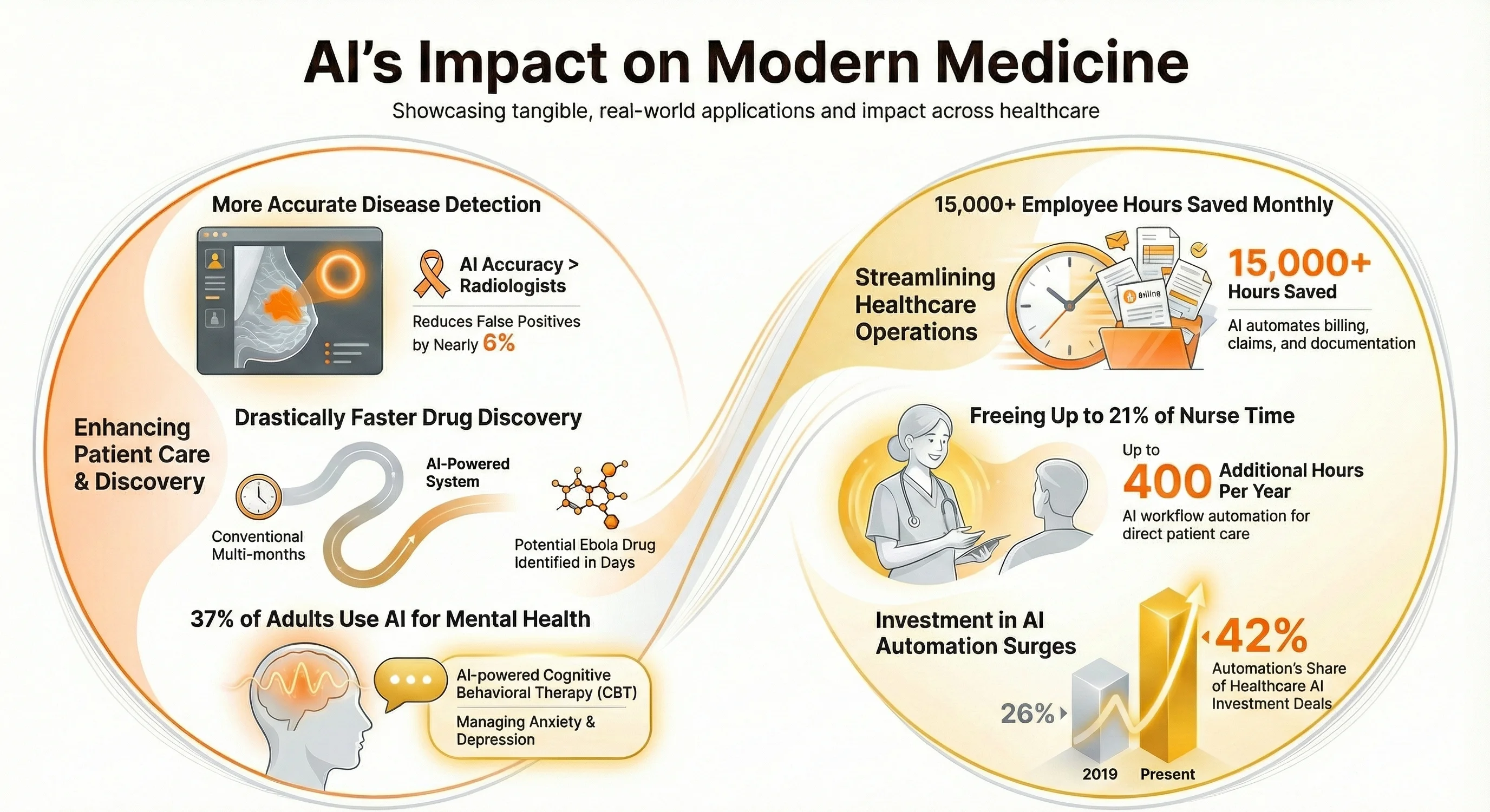
- DeepMind's AI System: Google's DeepMind developed an AI system capable of detecting breast cancer from mammograms with accuracy comparable to or exceeding that of radiologists. A study published in Nature demonstrated that this AI model reduced false positives by nearly 6% in the U.S. and by 1.2% in the U.K., and false negatives by over 9% in the U.S. and nearly 3% in the U.K.
- Google Health's AI System: Google Health has developed an AI system for mammography that assists radiologists in detecting breast cancer more accurately, quickly, and consistently. The system has been trained on thousands of de-identified mammograms and is being tested with real patients and clinicians to improve cancer detection.
- IBM Watson for Oncology: This AI system analyzes vast amounts of medical literature and clinical data to recommend personalized treatment options for breast cancer patients. A study published in Annals of Oncology found that Watson's recommendations were highly concordant with those of expert tumor boards, particularly for early-stage breast cancer cases.
AI in Diabetic Retinopathy Detection
- IDx-DR System: IDx-DR is the first and only autonomous AI system authorized by the FDA and CE Marked for the detection and automated early diagnosis of diabetic retinopathy. It analyzes retinal images to identify signs of the disease, enabling early intervention and preventing vision loss.
- Clinical Performance: In a pivotal trial, the IDx-DR system achieved a sensitivity of 87.2% and specificity of 90.7% in detecting diabetic retinopathy, demonstrating its effectiveness in real-world clinical settings.
How AI is Improving Drug Discovery and Clinical Trials
Artificial Intelligence is transforming drug discovery and clinical trials, speeding up the development of new treatments and improving their safety and effectiveness. Let’s find out some real-time change!
AI in Drug Discovery: Finding Medications Faster
- Atomwise: Traditional drug discovery can take years, but Atomwise is changing that. Their AI system quickly analyzes millions of compounds to identify potential drug candidates. For instance, Atomwise's AI helped identify a potential Ebola drug in just days, a process that usually takes months.
- AtomNet: Their AtomNet deep learning model has achieved a 74% success rate in predicting how compounds interact with proteins, far surpassing traditional methods. This is helping researchers narrow down the most promising drug candidates faster.
Optimizing Clinical Trials: Faster Patient Recruitment
- Ava Biochem: AI also plays a major role in clinical trials by predicting which patients are most likely to respond to specific treatments. Ava Biochem uses AI to match patients with the best therapies, speeding up trial processes and ensuring better patient outcomes.
- AI in Screening: AI tools are improving patient recruitment by automating the screening process, making clinical trials faster and more accurate. For example, AI-assisted screening has significantly sped up patient enrollment in heart failure trials.
AI is not only accelerating drug discovery but also ensuring that clinical trials are more efficient and targeted, ultimately improving patient safety and helping get treatments to market faster.
How AI in Mental Health Works?
AI is making significant strides in the field of mental health, offering new ways to provide support and treatment that’s both accessible and effective.
AI Chatbots for Therapy
- For those who struggle with mental health issues like anxiety or depression, AI chatbots like Woebot are providing a form of cognitive behavioral therapy (CBT).
- These AI-powered platforms offer real-time conversations that help patients manage their emotional health, all from the comfort of their own home.
Over 37% of adults have used an AI chatbot to support their mental health or wellbeing.
Predicting Mental Health Crises
- AI is also being used to predict mental health crises before they happen.
For example, AI algorithms analyze speech patterns and social media activity to detect signs of depression or suicidal thoughts, enabling early intervention by healthcare providers.
A national study found that about 13.1% of U.S. adolescents and young adults use generative AI tools for mental health advice.
How AI Helps in Healthcare Administration?
AI is not only revolutionizing patient care, but it’s also making healthcare operations more efficient and cost-effective.
Automating Administrative Tasks
- AI-powered platforms are automating repetitive tasks like patient scheduling, billing, and claims processing, saving time and reducing human error.
- This means healthcare workers can focus more on patient care, while AI tools handle administrative burdens.
A major healthcare provider automated billing, claims, and documentation with AI, resulting in over 15,000 employee hours saved per month. Also, 40% reduction in documentation time, 50% faster turnaround, and a 30% ROI from automation
Predicting Patient Flow
- AI models help hospitals predict patient volumes based on historical data.
- This allows hospitals to better manage resources, ensure proper staffing, and prepare for surges in patient demand, ultimately improving patient care and reducing wait times.
AI workflow automation tools can free up 13 – 21% of nurse time, translating into 240 – 400 additional hours per nurse per year for direct patient care.
AI is quickly becoming an essential part of healthcare, making a real difference in improving patient outcomes, boosting diagnostic accuracy, and personalizing treatments based on genetic data and clinical histories.
From transforming mental health care to streamlining hospital operations with natural language processing (NLP) for clinical documentation, AI is reshaping every aspect of healthcare.
AI automation now accounts for about 42% of all healthcare AI investment deals, up from 26% in 2019, indicating administrators and executives see real financial value
As AI technology continues to evolve, we can expect even more innovative solutions, such as AI tools for predictive analytics, that will continue to improve the way we provide and receive care.
Top 5 AI Tools for Healthcare
AI is making waves in healthcare, offering smarter solutions that enhance decision-making, streamline operations, and improve patient outcomes. Let’s explore some key AI-powered tools and how they are transforming healthcare today.
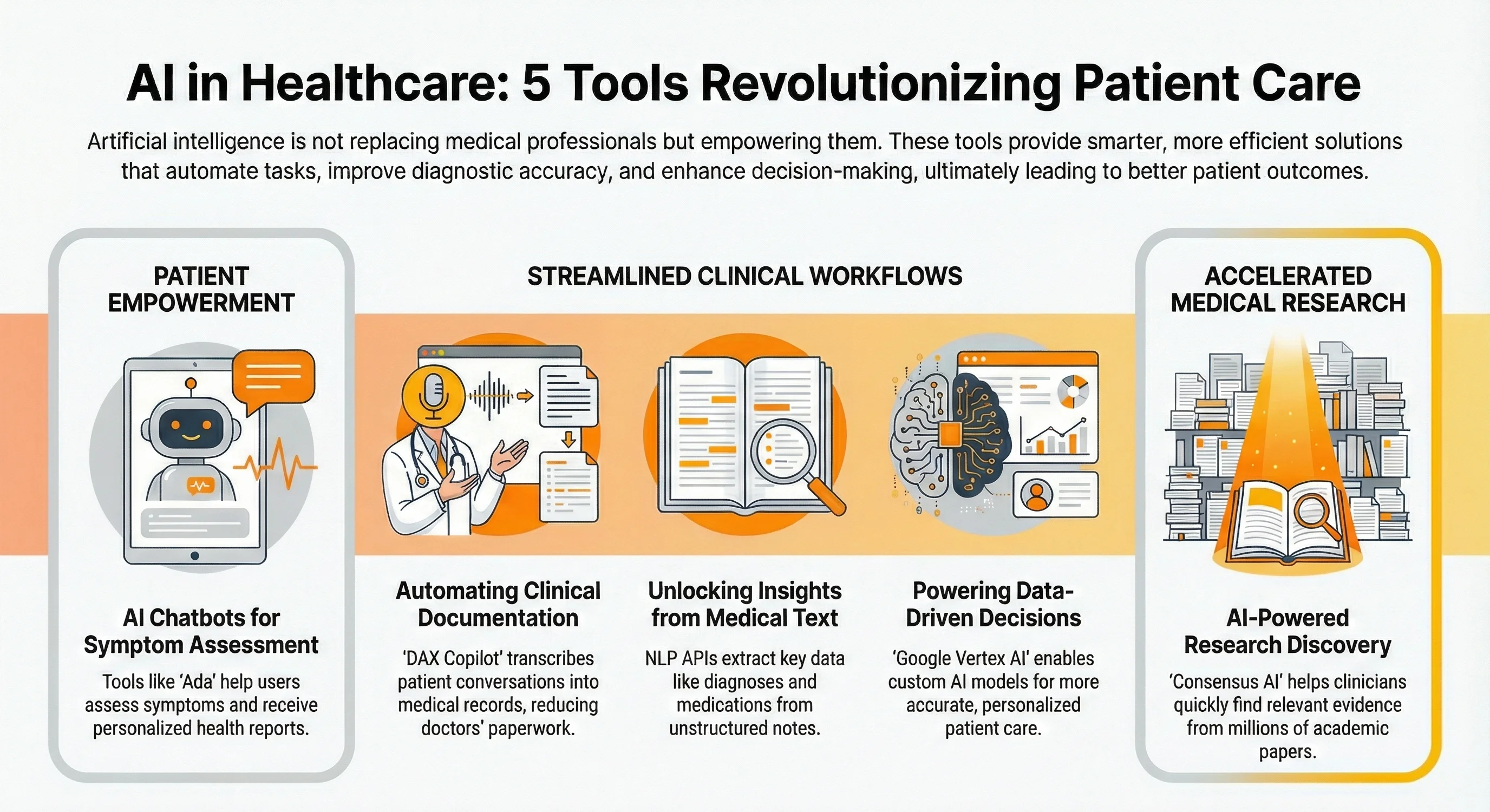
1. Ada - AI Chatbot for Self-Diagnosis
- What it does: Ada is an AI-powered chatbot designed to help individuals assess their symptoms and get a personalized health report.
- How it helps: It asks users relevant questions based on their symptoms and health data, providing potential diagnoses before they see a healthcare provider. This speeds up the process and empowers patients to seek timely medical attention.
The platform has been used in over 150 countries, with 13+ million users and 30+ million symptom assessments completed, making it one of the most widely adopted AI health tools globally.
2. DAX Copilot by Nuance - Automating Clinical Documentation
- What it does: DAX Copilot is an AI tool that integrates with Electronic Health Records (EHRs) to automate clinical documentation.
- How it helps: It captures voice conversations during patient visits, transcribes them, and organizes the information into structured medical records. This reduces the time doctors spend on paperwork, allowing them to focus more on patient care.
Clinicians can focus more on patient care rather than data entry, because DAX Copilot captures details in real time and drafts accurate, readable patient notes for review.
3. Consensus AI - Streamlining Medical Research
- What it does: Consensus is an AI-powered search engine designed to help doctors and researchers find and interpret medical research.
- How it helps: It simplifies the process of sifting through vast amounts of medical literature, helping healthcare professionals quickly find relevant studies and evidence to guide clinical decisions.
With a corpus of 200+ million academic sources, physicians, scientists, and healthcare decision‑makers get faster, evidence‑based insights. It can improve clinical decisions and reduce the time spent on literature review.
4. Google Vertex AI - Smarter Clinical Decision-Making
- What it does: Google Vertex AI is a platform that allows healthcare organizations to build and deploy custom AI models.
- How it helps: It provides tools to analyze patient data, helping doctors make more accurate, data-driven decisions. This tool boosts operational efficiency and enhances personalized patient care.
Google‑linked medical AI models like MedGemma (related to Vertex AI development ecosystem) have achieved 91.1% accuracy on USMLE‑style medical knowledge benchmarks, indicating high clinical relevance for AI decision support.
5. Google Cloud Healthcare Natural Language API
- What it does: This AI tool assists healthcare professionals in extracting meaningful insights from medical documents using natural language processing (NLP).
- How it helps: By analyzing text from clinical notes, patient histories, and research papers, it speeds up data extraction, helping providers access critical information faster and with more accuracy.
The API uses machine learning models to identify and classify medical entities (like diagnoses, medications, procedures, and symptoms) from free‑form text, transforming them into structured data that’s easier to work with.
These AI-powered tools are not replacing medical professionals but are empowering them with more efficient, accurate, and timely solutions.
From automating documentation to improving diagnostic accuracy and helping researchers stay on top of the latest findings, AI is making healthcare smarter and more personalized. As AI continues to evolve, the potential to improve patient outcomes will only grow.
Addressing AI Challenges in Healthcare
The integration of AI into healthcare presents a range of ethical, legal, and technical challenges. Overcoming these obstacles is key to ensuring that AI tools benefit patient care, improve clinical decision-making, and are implemented safely within healthcare systems.
Ethical Concerns in AI Adoption
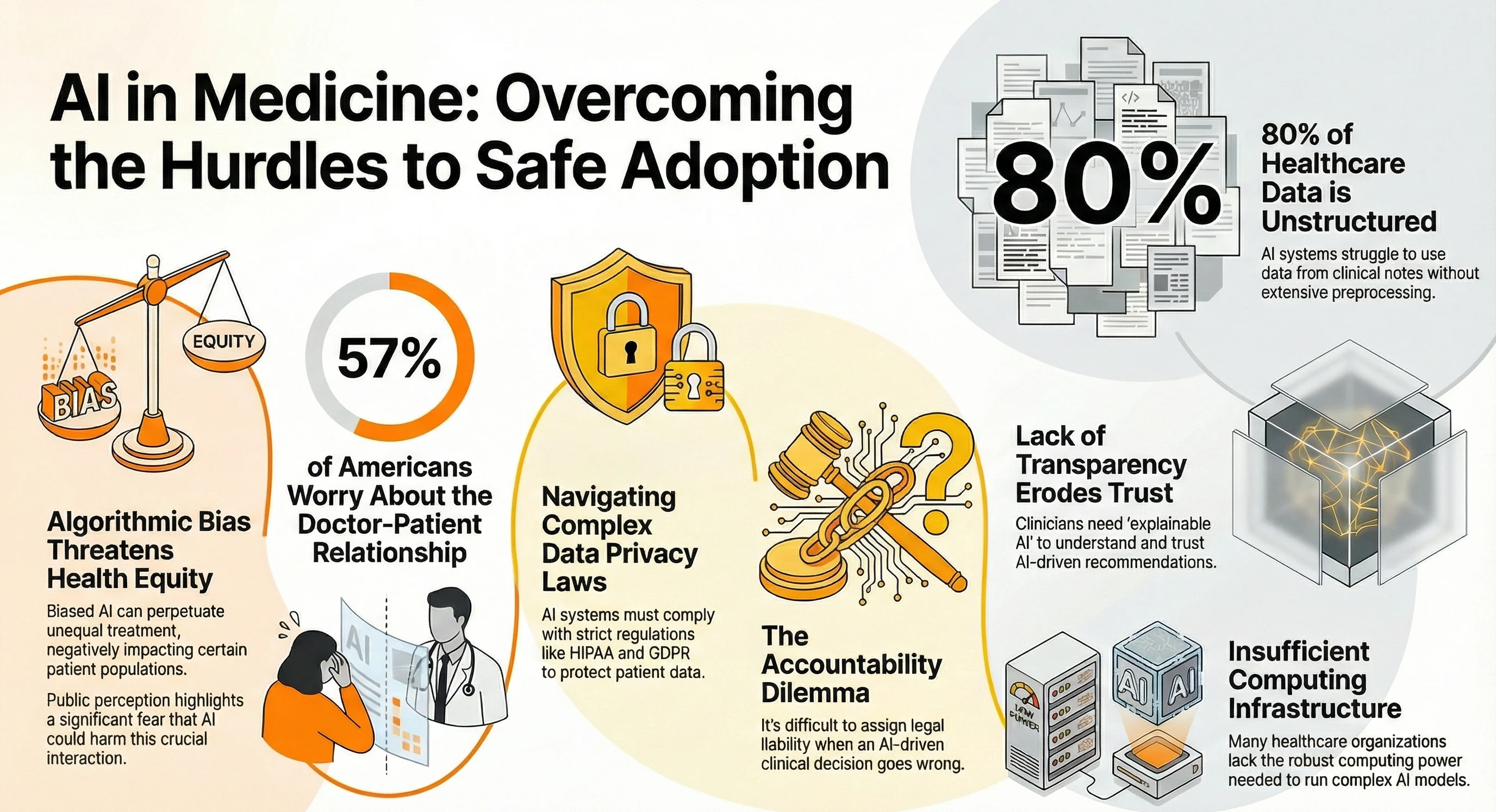
- Bias in AI Models: AI systems need to be developed with fairness and accountability to ensure they don’t perpetuate bias. Bias in AI algorithms can result in unequal treatment of certain populations, which could negatively impact public health and patient outcomes.
Public perceptions reflect these risks; for example, 37% of Americans believe AI will worsen the security of patient health records, and *57% worry it could negatively impact the doctor‑patient relationship. - Mitigating Bias: Efforts to reduce bias are crucial for the success of AI-powered healthcare solutions. Ensuring equitable access and outcomes for all patient populations is a priority, especially in areas like population health, where AI could influence healthcare delivery.
Efforts to reduce bias are crucial for AI success in healthcare. Research emphasizes the importance of fairness‑aware algorithms, diverse datasets, and ongoing monitoring to ensure equitable outcomes across populations
Legal and Regulatory Issues
- Data Privacy and Compliance: The use of AI in healthcare must comply with regulations like HIPAA and GDPR to protect patient privacy and ensure data security. Healthcare organizations must navigate these regulations to use AI effectively without compromising patient care.
The complexity of AI systems also raises questions about accountability. When an AI‑driven clinical decision goes wrong, it can be challenging to determine legal liability among clinicians, software developers, and healthcare organizations, complicating regulatory frameworks. - Establishing Standards: Clear frameworks and certifications are essential to ensure AI models are safe and reliable. As AI for healthcare becomes more widespread, these standards will ensure that tools remain effective and meet the legal and ethical requirements of the healthcare industry.
Technical Barriers to AI Integration
- Data Quality and Interoperability: For AI to be effective, it needs access to high-quality data from diverse sources. Challenges with data quality, interoperability, and integrating AI with existing healthcare systems must be addressed to ensure accurate results.
- AI Transparency: Ensuring that AI systems are interpretable by clinicians is critical. Doctors must be able to understand AI-driven decisions, which means building AI models that are transparent and explainable for clinical decision-making.
About 80% of enterprise data, including clinical notes and medical reports, is unstructured, meaning it’s not organized in a way that AI systems can easily use without preprocessing
To fully realize the potential of AI in healthcare, we must address ethical, legal, and technical challenges. As AI-driven solutions continue to evolve, overcoming these obstacles will be crucial for improving patient safety, ensuring data security, and delivering more effective, personalized care.
Large datasets and complex models require a robust computing infrastructure that many healthcare organizations lack.
The Future of AI in Healthcare: Emerging Trends
AI is rapidly transforming the healthcare industry, improving patient outcomes, and enabling more efficient operations. As artificial intelligence (AI) continues to evolve, its role in healthcare expands, making treatments more personalized and care more accessible. In 2025 and beyond, AI solutions will not only enhance diagnostic accuracy and precision medicine but also streamline healthcare processes, empowering healthcare professionals and improving population health globally.
Key Trends in AI for Healthcare
| Trend | Impact |
|---|---|
| Enhanced Diagnostics | AI-powered tools help healthcare providers detect diseases earlier, leading to better patient outcomes. |
| Personalized Medicine | AI and machine learning help tailor treatments based on electronic health records (EHR) and genetic data. |
| Operational Efficiency | AI solutions automate routine administrative tasks like scheduling, reducing overhead costs. |
| Remote Monitoring | AI tools enable real-time patient health tracking, facilitating proactive care in public health. |
| Data-Driven Decisions | AI uses learning algorithms to process large amounts of data, improving clinical decision-making. |
These AI-driven tools are becoming increasingly integrated into healthcare systems worldwide, helping healthcare professionals make better, evidence-based decisions. With AI for healthcare, medical devices can be more effective in diagnosing and treating a wide range of conditions.
According to recent industry data, about 80% of hospitals now use AI to improve patient care and operational efficiency, including diagnostics and administrative automation
By integrating AI, healthcare organizations can ensure more efficient workflows and better patient care, ultimately improving the quality of life for people around the world.
Conclusion: The Future of AI in Healthcare
In conclusion, artificial intelligence and machine learning are poised to completely reshape the healthcare industry, driving innovations that will improve patient care, optimize clinical workflows, and make healthcare more efficient and personalized. The rise of new AI technologies will continue to accelerate the integration of AI into healthcare systems, helping healthcare providers make more informed, data-driven decisions in real-time.
As AI can help healthcare professionals improve their ability to deliver precision treatments and personalized care, the role of AI solutions in population health and public health will be crucial in ensuring better health outcomes for diverse patient populations. Through intelligence and machine learning, AI systems will continue to enhance diagnostic capabilities, automate administrative tasks, and even provide continuous patient monitoring, ultimately leading to more efficient and effective healthcare delivery.
By integrating AI into every aspect of healthcare, we will see even greater improvements in clinical decision-making, enabling healthcare professionals to offer better evidence-based treatments. As we look to the future, it’s clear that AI for healthcare will play an essential role in shaping the way we approach healthcare, offering solutions that benefit patients around the world and driving the future of medicine.
FAQs

Asia Hussain
Asia helps brands create a strong online presence with smart content strategies. She also reviews and curates the best AI tools, shaping editorial content and providing insights at AIChief.