AI Use Cases
How AI Is Transforming Education - Key Facts & Trends
Discover how AI is transforming education with real-world use cases, intelligent tutoring systems, personalized learning, and future innovations.
Share
Imagine stepping into a classroom where lessons adapt to your learning style, assignments are graded instantly, and teachers spend more time mentoring instead of managing paperwork. This is no longer science fiction; this is how AI in education is transforming the learning experience for students and teachers alike.
Across the world, about 86% of students use AI tools in their studies. More than half use them weekly, showing real classroom adoption.
If you're an educator, policymaker, or someone passionate about innovation in learning, you are likely already aware that artificial intelligence (AI) is not just a buzzword; it’s reshaping the future of teaching and learning.
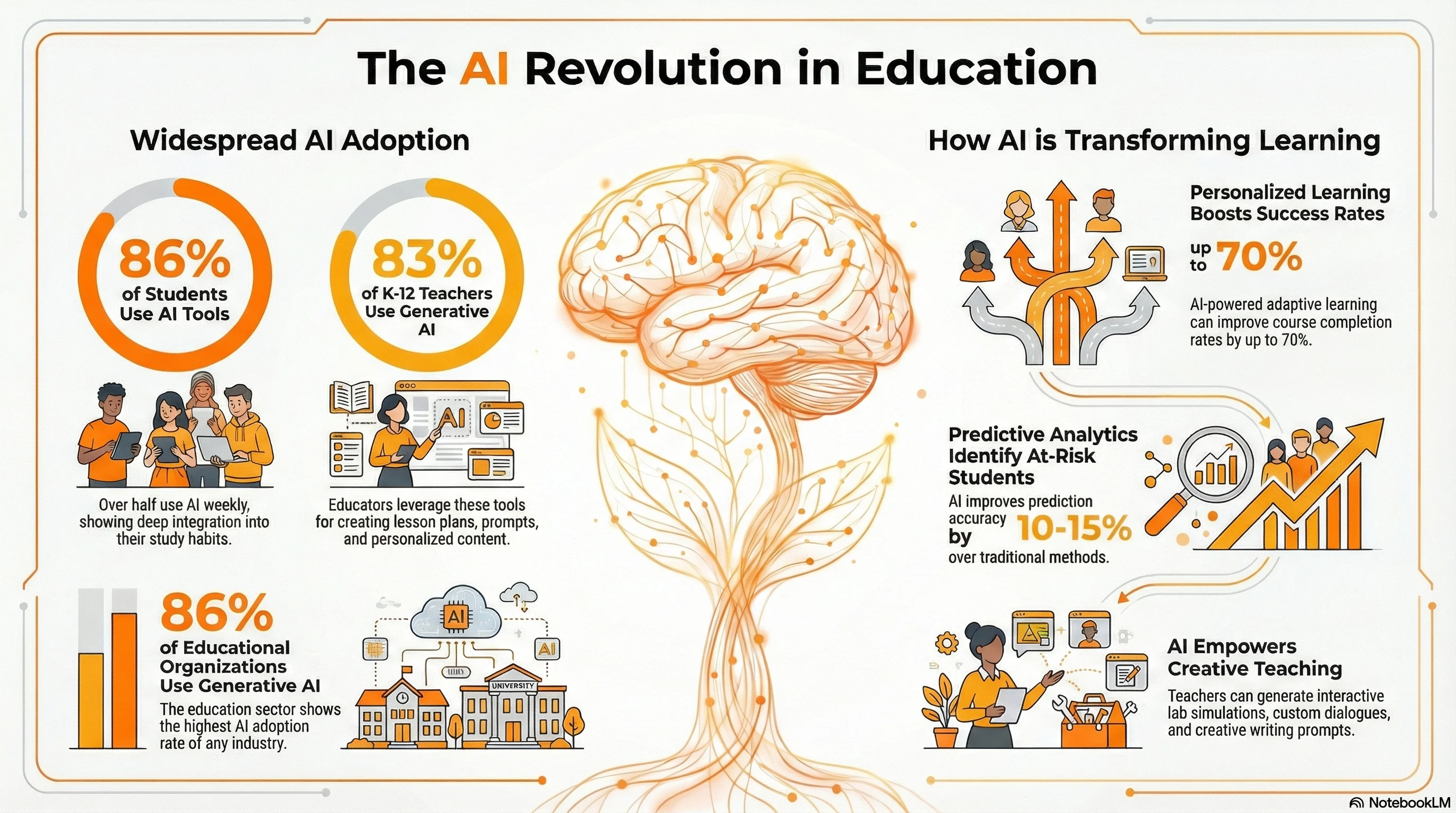
In K‑12 classrooms, teachers report that about 60% now use AI daily, and 83% of K‑12 teachers use generative AI tools. It shows broad educator adoption.
From intelligent tutoring systems to automated grading and personalized learning experiences, AI is providing powerful tools to improve both academic outcomes and educational operations. This guide is designed to help you understand how to effectively use AI in the classroom, in administration, and beyond.
The global AI in education market was valued at USD 18.92 billion in 2025 and is projected to grow to about USD 48.6 billion by 2030, expanding rapidly as schools adopt adaptive learning and analytics tools.
In this discussion, we will explore:
- Real-world examples of AI being used in schools and universities
- Breakthrough AI technologies like machine learning, large language models, and generative AI
- The future role of AI applications in lesson plans, language learning, and even policy decision-making
A meta‑analysis of 87 studies found that students using AI learning tools outperform their peers by around 12.4% on average, indicating measurable academic impact.
By the end of this article, you’ll gain a clearer understanding of the benefits of AI, how to utilize AI for better learning outcomes, and what the future holds for teachers and students in an AI-led world.
Furthermore, research shows that 30% of students' outcomes can be improved with AI-powered learning.
Current Use Cases and Examples of AI in Education
The integration of AI applications into education has moved well beyond theory. Today, institutions around the world are using artificial intelligence in education to improve instruction, personalize learning, and enhance administrative efficiency. If you're considering how to use AI in your educational workflows, it's helpful to explore the key areas where it’s already making a measurable difference.
According to the World Economic Forum, 71% of teachers and 65% of students say AI tools are essential for success in college and the workplace, showing broad belief in AI’s value across education
This is no longer science fiction; this is how AI in education is transforming the learning experience.
1. Intelligent Tutoring Systems and Personalized Learning with AI
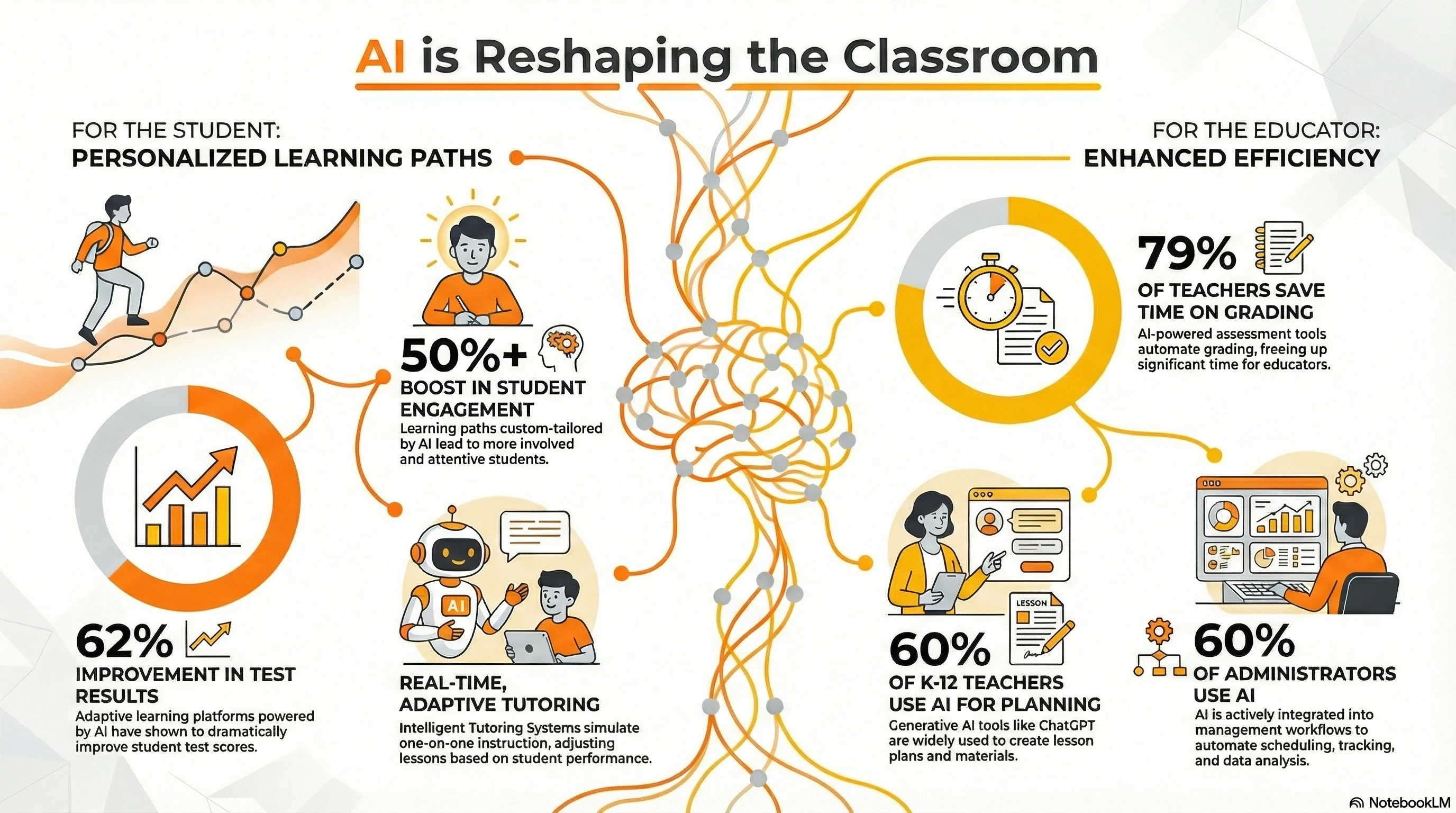
One of the most transformative uses of AI is through intelligent tutoring systems (ITS). It is a set of AI-powered tools that deliver tailored instruction based on each student’s progress, strengths, and weaknesses. These systems simulate one-on-one tutoring, adapting lessons in real time to offer personalized learning paths.
Platforms like Carnegie Learning and Squirrel AI use machine learning algorithms to assess student performance continuously. These systems analyze data such as response time, error patterns, and content mastery, then adjust the lesson accordingly, providing targeted feedback or additional practice where needed.
By offering real-time support, AI helps students overcome learning challenges as they arise, while enabling teachers to focus on mentoring and deeper instruction. For educators in K-12 or higher education, ITS can serve as a scalable solution to address diverse learning styles and abilities in a single classroom.
2. Adaptive Learning Platforms Tailored to Individual Students
AI-powered adaptive learning platforms extend the benefits of intelligent tutoring across a broader curriculum. These systems adjust content, difficulty levels, and assessments dynamically, ensuring that individual students receive instruction that suits their unique learning pace.
Research shows that adaptive learning supported by AI has been shown to improve student test results by up to 62% compared to traditional instruction. It demonstrates substantial gains in performance when educational content adapts in real time to student needs.
For instance, platforms like DreamBox (math) and Knewton (college-level courses) use AI algorithms to design learning paths tailored to student engagement and comprehension. These tools support critical thinking by gradually increasing challenge levels and provide immediate feedback to reinforce knowledge.
Studies also indicate that AI‑powered personalized learning can boost student engagement by over 50%, meaning students are more involved and attentive when learning paths are custom‑tailored to them.
Moreover, educators can also utilize AI dashboards to track learning outcomes and identify students who may need additional support. This empowers timely decision-making to improve classroom instruction and interventions.
Research reviews have shown that AI‑driven personalized learning systems can improve learning outcomes by approximately 20–30% compared to traditional methods, underscoring their effectiveness.
3. AI Applications in Content Creation and Automated Lesson Plans
Another robust use case of AI technologies in education is in the creation of lesson plans and instructional content. With the help of generative AI tools like ChatGPT, teachers can now generate quizzes, reading materials, summaries, and even full curriculum outlines in minutes.
This shift isn’t just anecdotal; about 38% of educators report using AI specifically for lesson planning and creating instructional materials. It shows that AI is already an active part of educators’ workflows.
For example, a history teacher preparing a unit on World War II can use AI to design differentiated materials for students at varying reading levels, aligned to their comprehension abilities.
In broader practice, nearly 60% of K‑12 teachers report using generative AI tools like ChatGPT for planning, feedback, or content support in their classes. It demonstrates how mainstream these tools have become.
Similarly, science educators can quickly draft interactive worksheets or simulations.
These AI tools don’t replace teacher creativity; they help teachers save time on repetitive tasks, allowing them to invest more energy in student engagement and lesson refinement.
One survey found that about 44% of teachers already apply AI for research tasks, while around 38% use it for lesson planning and 37% for generating classroom materials. It reflects real adoption across core instructional tasks.
Automating content preparation also supports professional development by enabling teachers to experiment with new formats and strategies.
4. AI-Powered Assessment: Real-Time Feedback and Automated Grading
Grading assignments and providing detailed feedback is one of the most time-consuming tasks in education. AI offers a solution through automated grading systems that assess objective responses, such as multiple-choice or fill-in-the-blank questions, and, increasingly, even short answers and essays.
Tools like Gradescope utilize machine learning to evaluate student work consistently and efficiently, providing teachers with detailed analytics on student learning trends. More advanced systems also provide real-time feedback to students, enabling iterative learning and revision before submission deadlines.
AI grading is often cited as a time‑saving feature by teachers. In a recent poll, 79% of educators said AI saves them time specifically on grading tasks, alongside other instructional duties.
This not only streamlines instructor workloads but also enhances the learning process by enabling students to reflect on and improve their work independently.
5. AI Tools for Language Learning and Tutoring
Language acquisition has seen a surge in effectiveness through AI-powered tools like Duolingo, ELSA Speak, and Babbel. These platforms use AI algorithms to personalize vocabulary drills, grammar practice, and pronunciation coaching, all tailored to the learner’s pace and language goals.
AI‑enabled pronunciation and fluency tools accounted for nearly 17.35% of revenue share within digital English‑learning platforms in 2024. It reflects strong learner demand for pronunciation‑focused AI features.
Through data collection and analysis, these apps identify patterns in learner errors and customize future lessons accordingly. Some, like ELSA, even use speech recognition and natural language processing (NLP) to correct pronunciation with near-human accuracy.
Duolingo alone has approximately 130 million monthly active users, with about 46.6 million daily active users, showing how widely these tools are used worldwide.
Such innovations make language learning more accessible and efficient for a global audience, from K–12 students to adult learners pursuing bilingual proficiency.
6. Automating Administrative Tasks and Data Management with AI
Artificial intelligence AI doesn’t just revolutionize classroom learning; it’s also transforming how schools and universities operate. By automating administrative tasks, AI tools reduce burdens on staff and improve institutional efficiency.
In fact, about 60% of school and university administrators report using AI in their institutions, showing that AI is no longer experimental but actively integrated into management workflows.
Tasks such as scheduling, attendance tracking, enrollment processing, and even financial aid management can be streamlined using AI systems. Chatbots, for instance, are now widely used by universities to answer common student queries 24/7, freeing up human resources for more complex concerns.
AI tools also contribute to time savings. Educators using AI for administrative tasks, including scheduling, data management, and automated reporting, save about 44% of their time compared to traditional workflows. This efficiency enables teachers and administrators to dedicate more effort to student engagement and instructional quality.
AI also supports data analysis across departments, helping administrators identify enrollment trends, optimize resource allocation, and improve policy-level decision-making. According to reports, 52% of institutions use AI to automate administrative workflows
7. Learning Analytics: AI-Driven Data Analysis and Decision Making
Modern education relies heavily on data, and AI excels at transforming raw information into actionable insights. Using AI-driven learning analytics, schools can now identify at-risk students, forecast performance trajectories, and measure the effectiveness of different instructional strategies.
In fact, learning analytics systems, especially AI‑enabled early warning models, can predict academic performance with accuracy rates as high as ~89%. It allows educators to detect struggling students well before traditional assessments would.
Platforms like PowerSchool or BrightBytes apply machine learning to detect subtle signals in student behavior, attendance, or engagement that may precede a drop in academic performance. This early-warning capability allows educators and counselors to intervene proactively.
AI early warning models identified students who would fail a course with 74% accuracy within the first three weeks. It offers significant intervention time.
Moreover, these insights inform best practices in curriculum design, scheduling, and instructional delivery, ultimately supporting better learning outcomes across the board.
Advancements and Innovations in AI Technologies in Education
While current AI applications in education have already demonstrated significant value, the pace of innovation continues to accelerate. Emerging AI technologies, particularly those powered by machine learning and generative AI, are expanding the possibilities for what artificial intelligence in education can accomplish.
If you’re looking to stay ahead in today’s evolving learning terrain, understanding these advancements is essential for you.
1. Large Language Models and Conversational AI in Education
One of the most groundbreaking developments is the emergence of large language models (LLMs), like OpenAI’s ChatGPT, Google’s Gemini, or Anthropic’s Claude. These AI-powered systems can generate coherent, context-aware responses to complex prompts, making them highly effective for tutoring, writing support, and content generation.
AI adoption among students has surged. A global survey found that 86% of students use AI tools in their studies, with 54% using AI weekly and 25% using it daily. It shows regular interaction with systems like ChatGPT
You can now integrate tools like ChatGPT into learning platforms or LMS systems to support both students and teachers.
For instance:
- Students can interact with AI tutors to brainstorm ideas, get writing feedback, or clarify difficult concepts.
- Teachers can utilize these tools to generate tailored lesson plans, explain concepts in multiple ways, or create discussion prompts that cater to different learning styles.
Because these tools continuously learn from vast data sets, they are able to simulate human-like interaction, which is particularly beneficial in virtual or hybrid learning environments.
2. Machine Learning Algorithms and Predictive Analytics in Educational Tools
Behind many AI systems in education lies machine learning, which is the ability of an algorithm to improve its performance over time through the analysis of data. These algorithms are now embedded into most leading educational technologies, driving everything from curriculum recommendations to risk detection.
For example, machine learning models can:
- Identify patterns in student behavior that signal disengagement or academic struggles
- Predict test performance based on past assessments and learning
- Recommend specific resources or learning paths to individual students
Roughly 86% of education organizations report adoption of generative AI and related analytics tools. It shows how widespread advanced data‑driven systems have become in the sector.
These capabilities enable educational institutions to make data-informed decisions, refine intervention timing, and optimize student outcomes.
Research shows that combining machine‑learning models with contextual data can improve prediction accuracy by about 10–15% over traditional analytic methods. It means institutions get more reliable early warnings of students needing support.
3. AI-Powered Learning Platforms and Virtual Tutoring Assistants
The next wave of AI in education is heavily shaped by AI-powered learning platforms that blend adaptive learning with virtual tutors. These platforms don’t just respond to student performance; they anticipate needs, offer scaffolding, and track long-term progress.
A broad review of adaptive learning studies found that about 59% of implementations increased student academic performance. And 36% reported increased engagement, confirming that adaptive platforms can meaningfully improve outcomes compared with traditional instruction.
Notable platforms include:
- Squirrel AI (China): Delivers AI-driven personalized education, capable of micro-level diagnostics for thousands of concepts.
- Century Tech (UK): Uses AI algorithms to create intelligent pathways through learning materials, supporting both teachers and students.
- Querium (US): Combines virtual tutors with predictive analytics for STEM subjects.
AI‑personalized learning has been associated with students achieving up to 70% better course completion rates compared to traditional approaches.
What makes these platforms stand out is their ability to provide real-time, personalized learning experiences, often indistinguishable from human support, while enabling teachers to scale their efforts and target instruction more effectively.
4. Generative AI for Content Creation and Creative Learning Experiences
Generative AI tools are also redefining what’s possible in the classroom. These models can produce educational content ranging from flashcards and infographics to story-based problems and even realistic simulations.
Reports suggest that 86% of educational organizations and institutions report using generative AI in some capacity. That’s the highest adoption rate of any industry in one IDC/Microsoft study on AI in education.
Consider these examples:
- A science teacher using AI to create interactive lab simulations with virtual reality
- A literature instructor generates alternative endings to classic novels for analysis
- A language teacher designing custom dialogues for conversational practice
These tools, like Canva’s Magic Write, Notion AI, and ChatGPT, empower educators to be more creative, responsive, and student-centered. And for students, AI-generated resources can cater to their interests and curiosities, enhancing motivation and ownership in the learning process.
Future Projections: How AI Will Transform Education?
As we look ahead, AI in education is set to expand its influence far beyond current capabilities. The future will be defined by greater integration, more intelligent systems, and deeper insights into how people learn. But it will also bring challenges, from data security to the role of teachers in an AI-driven environment.
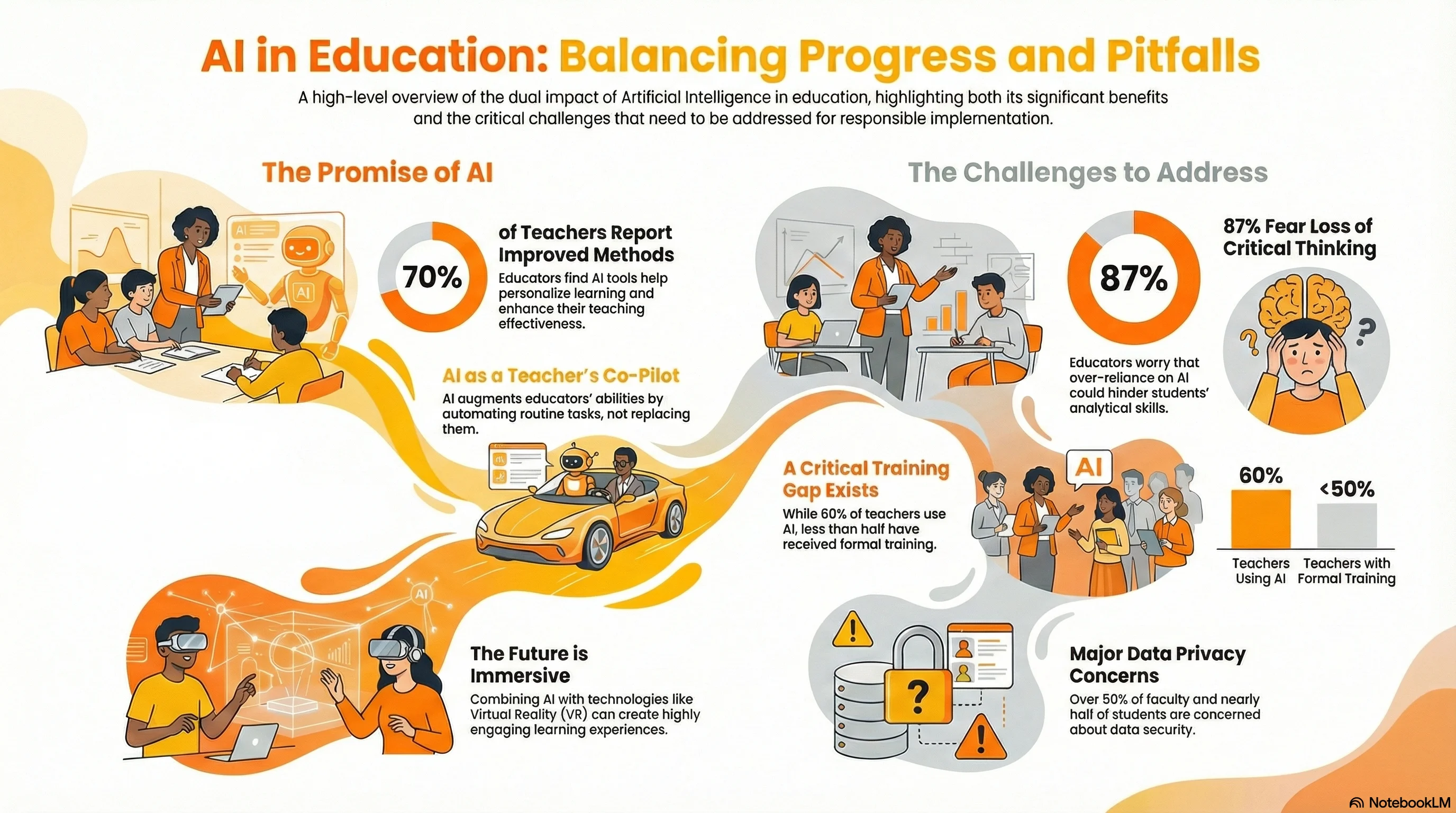
Reports suggest that 70% of teachers say AI tools improve teaching methods and help with personalization, and 59% report that AI enables more personalized learning.
1. AI’s Impact on Students and Teachers: Evolving Learning Experiences
Future classrooms will be shaped by AI-powered tools that support individual students throughout their academic journey, from kindergarten to 12th grade and beyond.
You’ll likely see:
- AI companions that track a student’s development across multiple subjects and years
- Systems that understand cognitive patterns and suggest optimal learning paths
- Teachers supported by AI co-pilots that handle routine tasks and recommend interventions
Rather than replacing educators, artificial intelligence will augment their abilities, allowing them to focus more on mentoring, empathy, and creativity.
Teachers are already using AI to personalize learning (60‑70% reporting benefits), and researchers document adaptive systems improving outcomes. AI isn’t a promise; it’s current practice moving toward future scale.
2. Ethical Concerns and Data Privacy in AI-Driven Education
With the rise of data collection and personalized learning, protecting student information becomes critical. AI systems rely on enormous amounts of data to function effectively, but this raises serious concerns about data privacy, consent, and misuse.
Over half of faculty (51.2%) and nearly half of students (47.5%) in a university study expressed concern about data privacy and security related to AI use in education.
Educational institutions must adopt:
- Transparent data policies and usage terms
- Ethical frameworks for deploying AI tools
- Compliance with local and international regulations (e.g., GDPR, FERPA)
As an educator or policymaker, understanding these issues is vital to ensure that the benefits of AI do not come at the cost of student rights or safety.
Parental resistance, with around 70% opposing AI data sharing in some contexts, shows this isn’t just an academic debate.
3. Professional Development: Preparing Educators to Use AI Tools Effectively
To maximize the benefits of AI technologies, teachers require support and training. As these tools evolve, so must educators’ ability to assess them, integrate them meaningfully, and remain aware of potential risks.
According to surveys, Less than half of teachers have been trained on AI so far. By fall 2024, only about 43–47% of teachers reported receiving at least one formal training session on AI tools.
Professional development programs should include:
- Training on using AI tools for instruction and assessment
- Ethical implications and responsible use of artificial intelligence
- Real-world scenarios and workshops on AI applications in the classroom
Investing in teacher readiness ensures that AI is transforming education equitably, not widening the digital divide.
4. Adopt Critical Thinking in an AI-Driven Learning Environment
As AI systems become more prominent, fostering critical thinking becomes even more essential. Students need to understand how these tools work, what biases they may have, and how to evaluate information independently.
A recent national report found 87% of educators worry that AI use could make it less likely for students to develop critical thinking skills. This is because students may lean on tools instead of grappling with problems themselves. Another 82% are concerned that AI could undermine deep engagement with content rather than support it.
Teaching AI literacy should include:
- How AI algorithms process information
- How to validate sources and detect misinformation
- The human role in guiding and interpreting AI outputs
This approach empowers students and teachers to collaborate with AI, rather than rely on it uncritically.
Surveys show 86%+ of students use AI for academic purposes. Yet only about a third get formal guidance on how to evaluate or use these tools responsibly.
5. Policy and Governance: Guiding AI Adoption in Educational Institutions
For successful, sustainable implementation, policymakers must take an active role in defining the role of AI in education. Strategic decisions around infrastructure, budgeting, curriculum integration, and vendor partnerships will shape the digital future of learning.
Reports show that 19% of higher education institutions worldwide already have a formal AI policy in place, and another 42% are actively developing one. That means about 61% of institutions are moving toward governance frameworks rather than ad‑hoc AI use.
Key priorities include:
- Establishing national AI competency frameworks (like UNESCO’s model)
- Funding responsible innovation in AI for public education
- Encouraging open, ethical standards for AI technologies
Your role in shaping these policies could determine how well AI supports long-term educational equity and excellence.
Broader national AI strategies (not always education‑specific) exist in dozens of countries. Countries like the United States have over 80 AI‑related policies and strategies overall. Many of which include governance, regulation, and ethical frameworks relevant to education policy ecosystem planning.
6. The Future of Learning: AI, Virtual Reality (VR), and Emerging Technologies
The classroom of the future will likely combine AI, virtual reality, and biometrics to create immersive, data-driven learning environments. These systems will understand how students feel, what motivates them, and how best to engage them in real time.
About 93% of teachers in one UK survey believe VR is beneficial for teaching, suggesting strong educator confidence in immersive learning tools.
Envision learning scenarios where:
- A VR headset adjusts a historical simulation based on student curiosity
- An AI-driven lab assistant customizes STEM experiments
- Emotional AI adapts content delivery when a student is frustrated or disengaged
These innovations promise not just better performance, but more humane, engaging, and dynamic learning.
Roughly 61% of users think VR and AR are beneficial learning tools overall, indicating broad support among learners and stakeholders for immersive tech in education
Best Practices for Using AI in Education
As you begin to use AI or scale its presence in your educational context, following proven strategies can help ensure positive outcomes.
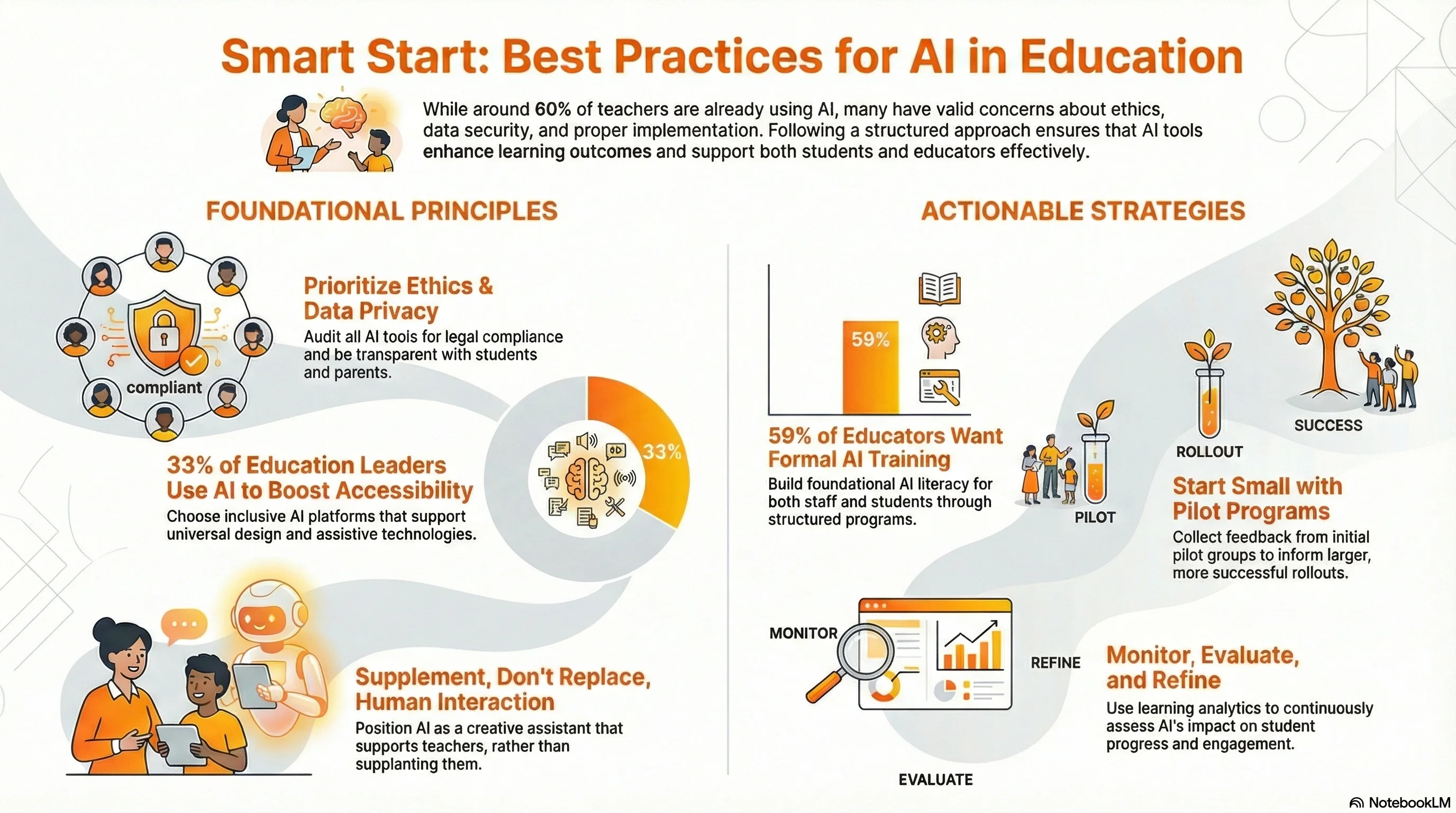
Around 60% of teachers report using AI in classrooms, yet many have concerns about misuse, data security, and ethical impacts. That makes governance and tool auditing essential
1. Ensure Data Privacy and Ethical AI Use
Here is some advice for you to ensure the privacy and implement ethical use of AI:
- Audit third-party tools for compliance with privacy laws
- Be transparent with students and parents about AI usage
- Avoid over-reliance on any single AI system
Audit third‑party tools for compliance with privacy laws and ethical standards. UN bodies like UNESCO are already outlining ethical guidelines for educators on AI use and data handling.
2. Prioritize Accessibility and Inclusion in AI-Powered Learning Tools
To make sure of getting maximum outcomes for AI in education, do this:
- Choose AI applications that support multilingual content and universal design
- Test platforms for compatibility with assistive technologies
A Microsoft report showed that 33% of education leaders use AI to boost accessibility, helping students with diverse needs engage more fully in learning.
Train Educators and Students in AI Literacy
Ensure to:
- Build a foundational understanding of machine learning, AI tools, and ethical use.
- Encourage reflective use of AI-generated content.
Around 59% of educators want structured AI training (“train the trainer” programs) rather than figuring it out alone
Start Small: Pilot Programs and Scale Up
Use data from pilots to inform broader rollouts
Collect feedback from teachers and students to improve tool selection
Balance AI Tools with Human Interaction to Foster Critical Thinking
- Position AI as a supplement, not a substitute
- Focus on projects that blend tech and human creativity
Monitor and Evaluate AI Impact on Learning Outcomes
- Use learning analytics to assess value
- Refine your strategy based on student progress, engagement, and feedback
Conclusion and Key Takeaways by AIChief
The AIChief editorial staff has conducted comprehensive research and crafted this precise piece of information. We can conclude that the use of artificial intelligence in education is no longer a distant vision. It’s a present-day force that improves instruction, streamlines operations, and reshapes how we think about learning.
If you're an educator, administrator, or policymaker, now is the time to:
- Explore AI tools that match your institutional goals
- Focus on personalized learning, not just automation
- Prepare yourself and your team for the ethical and pedagogical shifts that AI technologies demand
By taking a thoughtful, evidence-based approach, you’ll be better equipped to realize the full potential of AI in education, helping your students thrive in a world where learning is intelligent, adaptive, and deeply human.
FAQs

Arfa Farheen
Arfa Farheen is part of AIchief's global editorial team, reviewing and testing AI tools. With a background in digital marketing, she helps businesses grow their online presence using simple, no-code strategies.